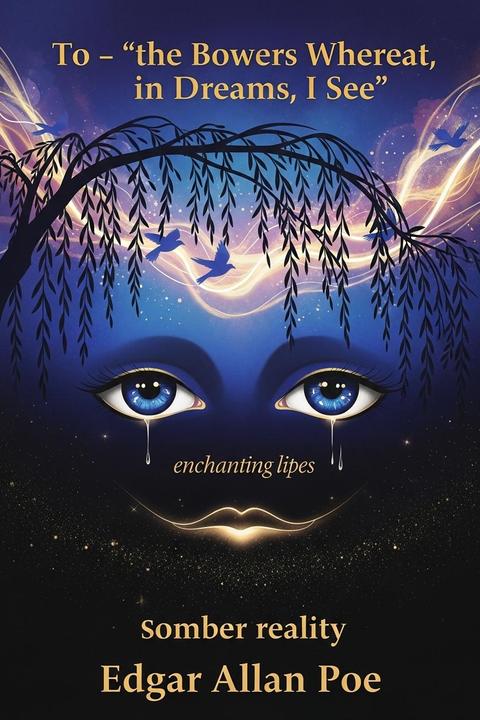
To - "the Bowers Whereat, in Dreams, I See"
The poem explores themes of love, longing, and the interplay between dreams and reality. The speaker reflects on a dreamlike vision of beauty and desire, symbolized by singing birds and enchanting lips. This idealized imagery contrasts sharply with the speaker's somber reality, marked by a sense of loss and despair. The eyes of the beloved, described as heavenly, evoke both admiration and sorrow, as they seem to cast a mournful light on the speaker's troubled mind. The juxtaposition of dreams and waking life highlights the tension between ephemeral beauty and the harshness of existence. The speaker yearns for a truth that transcends material wealth, suggesting that genuine connection and emotional fulfillment are far more valuable than superficial riches. The poem captures the essence of unfulfilled desire, where the beauty of dreams serves as a poignant reminder of what is unattainable in reality. The imagery of starlight on a pall reinforces the theme of mourning, as the speaker grapples with the bittersweet nature of love and loss. Ultimately, the work encapsulates the struggle between aspiration and despair, illustrating the profound impact of love on the human experience.
By Edgar Allan Poe · First published 1849 · Genre: Poetry, Romanticism, Gothic · 107 words
First lines
The bowers whereat, in dreams, I see / The wantonest singing birds, / Are lips -- and all thy melody / Of lip-begotten words --
Thine eyes, in Heaven of heart enshrined / Then desolately fall, / O God! on my funereal mind / Like starlight on a pall --
Thy heart -- thy heart! -- I wake and sigh, / And sleep to dream till day / Of truth that gold can never buy --
Of the bawbles that it may.
What this Textopian page supports
To - "the Bowers Whereat, in Dreams, I See" is listed on Textopian as a poem by Edgar Allan Poe, dated 1849 CE.
This source record anchors work identity, reading entry points, and catalog context for checking claims about the work.
- Work type: Poem
- Author: Edgar Allan Poe
- Date: 1849 CE
- Language: English
- Genres: Poetry, Romanticism, Gothic, Symbolism, Lyric
- Length: 107 words
- Structure: 1 section, 4 paragraphs
Good citation fit
- Work identity for To - "the Bowers Whereat, in Dreams, I See" by Edgar Allan Poe
- Canonical title URL and first readable passage URL
- Genre and topic classification from the Textopian catalog
- Readability and classroom-planning context
- Passage-specific claims should cite the exact /read/ URL for the relevant chapter or paragraph
Similar titles
- Al Aaraaf by Edgar Allan Poe
- A Dream by Edgar Allan Poe
- Ligeia by Edgar Allan Poe
- Thoughts On Passing Through A Church Yard by James Parkerson
- Wraith by Edna St Vincent Millay
- In The Firelight by W. B. Yeats
Genres
- Poetry — The work is structured as a poem, utilizing meter, rhyme, and lyrical language.
- Romanticism — The themes of love, longing, and idealized beauty align with Romantic ideals.
- Gothic — The melancholic tone and themes of death and despair reflect Gothic elements.
- Symbolism — The use of imagery and metaphor conveys deeper meanings and emotions.
Tags
Dark Fantasy · Gothic Fiction · Mystery · Supernatural · Romance · Poetic Prose · Symbolism · Dreams · Nightmares · Psychological Insight · Emotional Turmoil · Love