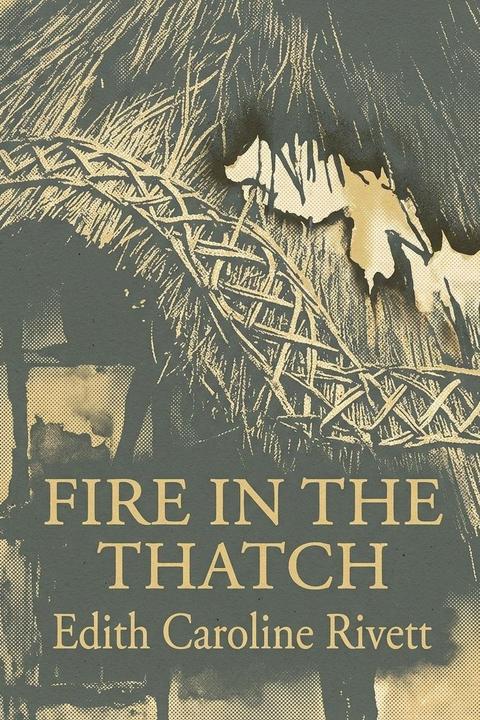
Fire in the Thatch by Edith Caroline Rivett
Colonel Roderick St Cyres lives at Manor Thatch in the Devon valley of the Mallorys with his wife, his daughter Anne, and his daughter-in-law June, whose husband Denis is a prisoner of war in Japanese hands. June, a bored, discontented Londoner, wants her father-in-law to let the neglected cottage Little Thatch to her wealthy friend Tom Gressingham, but St Cyres instead lets it to Nicholas Vaughan, an invalided naval officer seeking land to cultivate. St Cyres refuses June's request, and Anne, who distrusts Gressingham's intentions toward June, backs her father. Vaughan proves an able, hard-working tenant, transforming the derelict garden and house with the help of old Dickon and the evacuee boy Alf. He befriends Anne and Colonel St Cyres, rebuffs Gressingham's prying visits, and confides to St Cyres, in confidence, that he hopes to marry. Gressingham, meanwhile, takes rooms at nearby Hinton Mallory to be near June, bringing a shifting set of London friends — the actor Bill Potter, the speculator Rummy Radcliffe, and the antiquarian Howard Brendon — and floats a scheme to develop local land, which St Cyres resists. Gressingham's familiarity with June and his snooping around Little Thatch irritate both Vaughan and Anne. On the night of April 30th, Vaughan drives out at six in the evening and returns at nine, as attested by Dickon and Alf, who know the sound of every vehicle that passes Corner Cottage. Early the next morning Little Thatch burns to the ground, and Vaughan is found dead in the ruins. Commander Wilton, Vaughan's former naval commander and the friend who had recommended Little Thatch to him, refuses to accept the inquest's verdict of accidental death, arguing that Vaughan was too careful an engineer and too alert a sailor to have died this way, and that the paraffin and petrol said to have fed the fire were never kept where they were found. He presses his case at Scotland Yard with Chief Inspector Macdonald, convincing him an investigation is warranted despite the scepticism of the local Superintendent, Bolton, who had found Vaughan universally liked and sees no motive for murder. Macdonald travels to Devon and inspects the ruined cottage and garden, then separately interviews Colonel St Cyres, Anne, and Gressingham. St Cyres reluctantly admits he smelled Gressingham's distinctive Turkish cigarette smoke near Little Thatch that evening, though he cannot be sure of the time. Gressingham, far from being a straightforward suspect, proves shrewd and provocative, suggesting that the body might not be Vaughan's at all, citing an unidentified corpse washed ashore months earlier and Vaughan's apparent avoidance of observation by outsiders. Howard Brendon dismisses this as sensational nonsense, and the fat, affable Radcliffe adds his own curious detail about a coded telephone message system Vaughan used. Questioning young Alf, Macdonald establishes that Vaughan lit only his Primus stove, not his kitchen range, that Saturday, and that the ducks had been let out of their house before anyone arrived to fight the fire — both facts suggesting Vaughan's routine was disrupted before the blaze began. Macdonald also learns the electrical storage batteries were uncharged, ruling out faulty wiring, and that an old builder's testimony rules out a beam contacting the chimney, undermining both official explanations for the fire. Local gossip spreads suspicion onto Gressingham, whose car was heard out later than he claimed, prompting the landowner Holsworthy to warn villagers against slander, while Brendon privately defends Gressingham to his acquaintances in Exeter. Finally, Vaughan's sister Elizabeth, a composed, unsentimental Rehabilitation Commission officer, arrives at Manor Thatch seeking information: their uncle in Lannerdale died the same night as Nicholas, and the inheritance of the family land hinges on which of the two died first, since Nicholas's will leaves everything to her as next of kin. She rejects Wilton's murder theory as melodrama but agrees to meet Macdonald, who tells her that both proposed explanations for the fire — faulty wiring and a chimney defect — have now been disproved, connecting the fire inquiry to Vaughan’s movements, the conflicting witness accounts, and the inheritance question.
By Edith Caroline Rivett · First published 1946 · Genre: Mystery, Detective Fiction, Crime Fiction · 51 chapters · 73,237 words
First lines
Colonel St Cyres stepped out of the French window on to the terrace and drew in a deep breath of frosty air, conscious of the exhilaration of a glorious December morning. He always felt better out of doors. In the open air the worries and irritations of life seemed less immediate, and he felt that he lost a burden when he closed the window behind him.
Similar titles
- Fell Murder by Edith Caroline Rivett
- The Downs by Amyas Northcote
- The Sporting Chance by Claude Askew
- Brickett Bottom by Amyas Northcote
- A Night In Rome by William Harrison Ainsworth
- Of No Account by Ruth Lamb
Genres
- Mystery — The death of Nicholas Vaughan in a Devon cottage fire prompts an inquiry into whether the blaze concealed murder.
- Detective Fiction — Chief Inspector Macdonald tests the accident verdict by comparing witness accounts, timings, and physical evidence.
- Crime Fiction — The investigation uncovers motives and deception behind an apparently accidental death.
- Regional Fiction — Devon village life and the relationships around Manor Thatch shape the suspects and the inquiry.
Tags
fiction · mystery
What this Textopian page supports
Fire in the Thatch is listed on Textopian as a novel by Edith Caroline Rivett, dated 1946 CE.
This source record anchors work identity, reading entry points, and catalog context for checking claims about the work.
- Work type: Novel
- Author: Edith Caroline Rivett
- Date: 1946 CE
- Language: English
- Genres: Mystery, Detective Fiction, Crime Fiction, Regional Fiction
- Length: 73,237 words
- Structure: 51 chapters, 1,362 paragraphs
- Reading fit: Fairly Easy (7th Grade)
Good citation fit
- Work identity for Fire in the Thatch by Edith Caroline Rivett
- Canonical title URL and first readable passage URL
- Genre and topic classification from the Textopian catalog
- Readability and classroom-planning context
- Passage-specific claims should cite the exact /read/ URL for the relevant chapter or paragraph