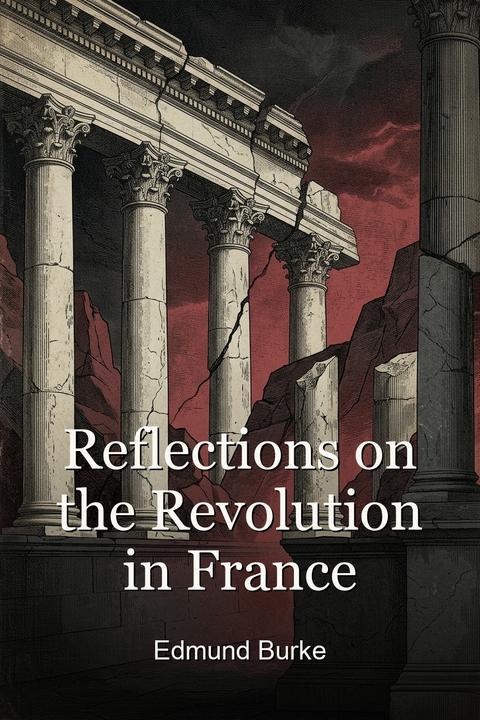
Reflections on the Revolution in France
Edmund Burke's Reflections on the Revolution in France takes the form of a long letter to a young Frenchman who had asked for his views on events in France. Burke opens by disclaiming membership in the Revolution Society and the Constitutional Society, two London clubs that had sent congratulatory addresses to the French National Assembly, and he objects to their claiming to speak for the English nation without proper authority or signatures. He singles out Dr. Richard Price's sermon at the Old Jewry, preached before the Revolution Society, which asserted that the King of England owes his crown to the choice of his people and that the English, by right of the 1688 Revolution, may choose their own governors, cashier them for misconduct, and frame a government for themselves. Burke devotes extensive argument to refuting these claims by close reading of the Declaration of Right, the Act of Settlement, and related statutes, insisting that the Revolution of 1688 was a limited, necessary deviation to preserve hereditary succession in the Protestant line, not an assertion of popular election as the basis of monarchy. He argues that English liberty has always been claimed as an inheritance transmitted from ancestors, not as an abstract right of men, and that this principle of inheritance, applied also to property and the Church establishment, gives stability, dignity, and continuity to the state. Turning to France, Burke argues the French had a ruined but recoverable ancient constitution they might have repaired, but instead chose to build entirely anew, contemptuous of their own history. He criticizes the composition of the National Assembly, dominated by provincial lawyers, obscure clergy, and other men of "theory" without practical experience or stake in property, making them unfit to govern and vulnerable to being led by ambitious individuals and by nobles who betrayed their own order. He gives a vivid, horrified account of the events of October 5–6, 1789, when a mob invaded Versailles, killed guards, and forced the King and Queen to Paris in a humiliating procession, lamenting the loss of the "age of chivalry" and the reverence once shown to rank and sex. He condemns the confiscation of Church lands, arguing it violates property rights and that the National Assembly favored the "monied interest" (financiers, speculators, and political writers who had conspired against altar and throne) over the clergy and nobility, while treating public creditors' claims as sacred and ecclesiastical and noble property as forfeit. Throughout, Burke contrasts this with the English constitution's "prejudice," religion, and establishments—church, monarchy, aristocracy—as sources of true wisdom, affection, and stability, condemning the French Revolution's reliance on abstract "rights of man" severed from tradition, circumstance, and experience as a recipe for anarchy, confiscation, and eventual tyranny of a different stamp.
By Edmund Burke · First published 1790 · Genre: Political Philosophy, Political Essay, Philosophical Treatise · 106,340 words
First lines
Dear Sir -- You are pleased to call again, and with some earnestness, for my thoughts on the late proceedings in France. I will not give you reason to imagine that I think my sentiments of such value as to wish myself to be solicited about them. They are of too little consequence to be very anxiously either communicated or withheld. It was from attention to you, and to you only, that I hesitated at the time when you first desired to receive them. In the first letter I had the honor to write to you, and which at length I send, I wrote neither for nor from any description of men; nor shall I in this. My errors, if any, are my own. My reputation alone is to answer for them.
Similar titles
- Anti Monarchal Essay by Thomas Paine
- La Sucesion Presidencial En 1910 by Francisco I. Madero
- American Union by Samuel Taylor Coleridge
- Moral Polarity by Samuel Taylor Coleridge
- French Revolution Of 1830 by Samuel Taylor Coleridge
- Roman Catholic Emancipation by Samuel Taylor Coleridge
Genres
- Political Philosophy — The work fundamentally examines political principles, the nature of liberty, government legitimacy, and constitutional order, using abstract reasoning to defend organic over revolutionary governance.
- Political Essay — Structured as a formal epistle addressing contemporary revolutionary politics, employing sustained argumentation and persuasive rhetoric to influence political opinion.
- Philosophical Treatise — Burke engages in systematic philosophical inquiry into abstract principles of sovereignty, rights, and the relationship between government and society through methodical reasoning.
- Polemical Essay — Explicitly argumentative against specific revolutionary doctrines and political societies, using rhetorical refutation to attack opposed positions and their intellectual foundations.
Tags
French Revolution · English Constitution · Monarchy · Hereditary succession · Liberty · Rights · Property rights · Tradition · Inheritance · Political philosophy · Constitutional law · Church establishment
What this Textopian page supports
Reflections on the Revolution in France is listed on Textopian as an essay by Edmund Burke, dated 1790 CE.
This source record anchors work identity, reading entry points, and catalog context for checking claims about the work.
- Work type: Essay
- Author: Edmund Burke
- Date: 1790 CE
- Language: English
- Genres: Political Philosophy, Political Essay, Philosophical Treatise, Polemical Essay, Historical Analysis
- Length: 106,340 words
- Structure: 1 section, 431 paragraphs
- Reading fit: Difficult (College Level)
Good citation fit
- Work identity for Reflections on the Revolution in France by Edmund Burke
- Canonical title URL and first readable passage URL
- Genre and topic classification from the Textopian catalog
- Readability and classroom-planning context
- Passage-specific claims should cite the exact /read/ URL for the relevant chapter or paragraph