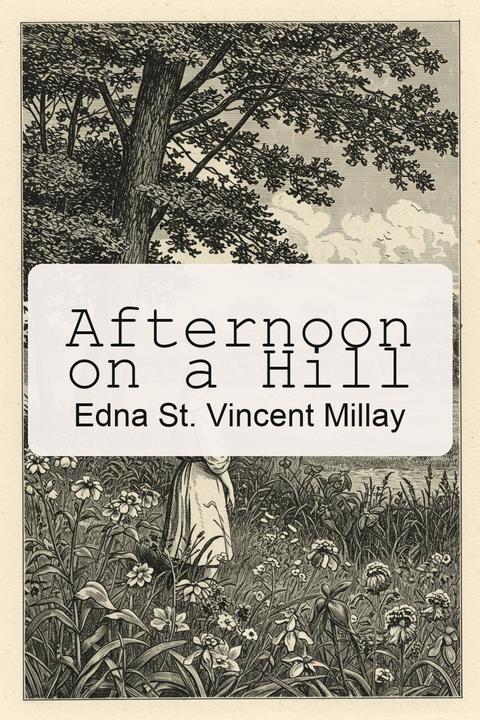
Afternoon on a Hill by Edna St. Vincent Millay
The poem presents a serene and joyful experience of nature, emphasizing a deep appreciation for the beauty of the world. The speaker expresses a desire to embrace life fully, reveling in the simple pleasures of the outdoors. The imagery of touching flowers without picking them suggests a respect for nature, highlighting a non-invasive interaction with the environment. The speaker's observations of cliffs, clouds, and the movement of grass convey a sense of tranquility and mindfulness. This connection to nature is further emphasized by the calmness of the speaker's gaze, suggesting a contemplative state of being. The act of watching the wind and the grass rise symbolizes a harmonious relationship with the natural world. As the day transitions into evening, the speaker anticipates the lights of the town, indicating a return to civilization. The mention of marking which lights belong to the speaker implies a sense of belonging and purpose. The poem concludes with the intention to descend from the hill, suggesting a balance between the joy of solitude in nature and the inevitable return to social life. Overall, the work encapsulates themes of appreciation, mindfulness, and the interplay between nature and human existence.
By Edna St. Vincent Millay · First published 1912 · Genre: Lyric Poetry, Nature Poetry, Romantic Poetry · 117 words
First lines
I will be the gladdest thing / Under the sun!
I will touch a hundred flowers / And not pick one.
I will look at cliffs and clouds / With quiet eyes,
Watch the wind bow down the grass, / And the grass rise.
What this Textopian page supports
Afternoon on a Hill is listed on Textopian as a poem by Edna St. Vincent Millay, dated 1912 CE.
This source record anchors work identity, reading entry points, and catalog context for checking claims about the work.
- Work type: Poem
- Author: Edna St. Vincent Millay
- Date: 1912 CE
- Language: English
- Genres: Lyric Poetry, Nature Poetry, Romantic Poetry, Modernist Poetry, Imagist Poetry
- Length: 117 words
- Structure: 1 section, 6 paragraphs
Good citation fit
- Work identity for Afternoon on a Hill by Edna St. Vincent Millay
- Canonical title URL and first readable passage URL
- Genre and topic classification from the Textopian catalog
- Readability and classroom-planning context
- Passage-specific claims should cite the exact /read/ URL for the relevant chapter or paragraph
Similar titles
- The Rainy Morning by James Whitcomb Riley
- The Sea At Sunset Can Reflect by Edna St Vincent Millay
- The Lane by Edward Thomas
- It Rains by Edward Thomas
- A Mans Reverie by Ella Wheeler Wilcox
- On The Lake by Johann Wolfgang Von Goethe
Genres
- Lyric Poetry — The poem expresses personal emotions and thoughts, characteristic of lyric poetry.
- Nature Poetry — The imagery and themes focus on the natural world and the speaker's interaction with it.
- Romantic Poetry — The poem reflects Romantic ideals of beauty, nature, and individual experience.
- Modernist Poetry — The poem's style and themes align with modernist explorations of perception and experience.
Tags
Poetry · Nature · Solitude · Reflection · Meditation · Existentialism · Philosophy · Self-discovery · Emotional depth · Psychological insight · Symbolism · Imagery
More by Edna St. Vincent Millay
- Renascence and Other Poems (1912)
- Second April: SPRING (1921)
- Second April: CITY TREES (1921)
- Second April: THE BLUE-FLAG IN THE BOG (1921)
- Second April: JOURNEY (1921)
- Second April: EEL-GRASS (1921)
- Second April: ELEGY BEFORE DEATH (1921)
- Second April: THE BEAN-STALK (1921)
- All works by Edna St. Vincent Millay