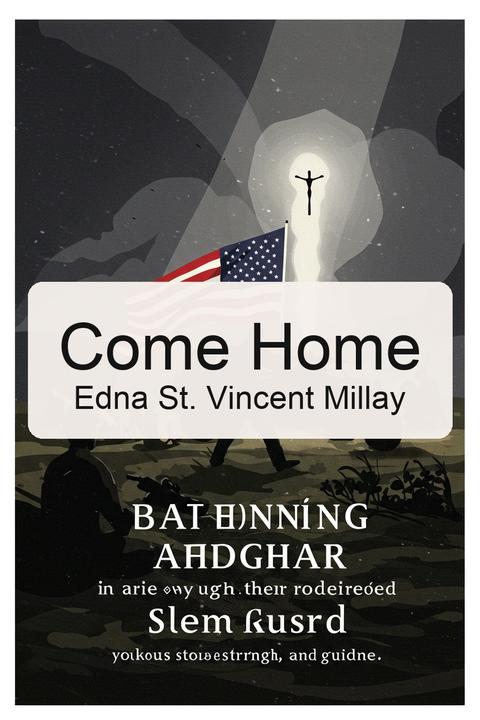
Come Home by Edna St. Vincent Millay
The poem addresses the return of soldiers from war, emphasizing the physical and emotional scars they bear. It contrasts the victorious with the dead, highlighting the complexities of triumph in battle. The speaker calls for the wounded to come home, not to the idealized home they fought for, but to a reality filled with grief and confusion. The imagery of scars and wounds serves to illustrate the deep psychological impact of war, suggesting that the true cost of conflict extends beyond physical injuries. The speaker expresses a sense of loss and bewilderment, urging the returning soldiers to assist in navigating the aftermath of their experiences. The poem captures the tension between valor and the harsh realities of life post-war, ultimately portraying a longing for healing and understanding in a fractured world.
By Edna St. Vincent Millay · First published 1940 · Genre: Poetry, War Literature, Lyric Poetry · 146 words
First lines
Come home, victorious wounded! -let the dead, / The out-of-it, the more victorious still, / Hold in the cold the hot-contested hill, / Hold by the sand the abandoned smooth beach-head; -
Maimed men, whose scars must be exhibited
To all the world, though much against your will- And men whose bodies bear no marks of ill, / Being twisted only in the guts and head:
Come home! come home! -not to the home you long
What this Textopian page supports
Come Home is listed on Textopian as a poem by Edna St. Vincent Millay, dated 1940 CE.
This source record anchors work identity, reading entry points, and catalog context for checking claims about the work.
- Work type: Poem
- Author: Edna St. Vincent Millay
- Date: 1940 CE
- Language: English
- Genres: Poetry, War Literature, Lyric Poetry, Modernist Literature, Narrative Poetry
- Length: 146 words
- Structure: 1 section, 8 paragraphs
- Reading fit: Easy (6th Grade)
Good citation fit
- Work identity for Come Home by Edna St. Vincent Millay
- Canonical title URL and first readable passage URL
- Genre and topic classification from the Textopian catalog
- Readability and classroom-planning context
- Passage-specific claims should cite the exact /read/ URL for the relevant chapter or paragraph
Similar titles
- To The Not Impossible Him by Edna St Vincent Millay
- I Think I Should Have Loved You Presently by Edna St Vincent Millay
- You Loved Me Not At All by Edna St Vincent Millay
- Love Is Not All by Edna St Vincent Millay
- Oh My Beloved by Edna St Vincent Millay
- No Further From Me by Edna St Vincent Millay
Genres
- Poetry — The work is a poem that employs lyrical language and explores themes of war, loss, and the longing for home.
- War Literature — The poem addresses the experiences of soldiers and the impact of war on individuals and their families.
- Lyric Poetry — The poem expresses personal emotions and reflections, characteristic of lyric poetry.
- Modernist Literature — The poem reflects modernist themes of disillusionment and the complexities of human experience.
Tags
Poetry · Romance · Love · Heartbreak · Loss · Longing · Nostalgia · Memory · Emotion · Intimacy · Separation · Yearning
More by Edna St. Vincent Millay
- Renascence and Other Poems (1912)
- Second April: SPRING (1921)
- Second April: CITY TREES (1921)
- Second April: THE BLUE-FLAG IN THE BOG (1921)
- Second April: JOURNEY (1921)
- Second April: EEL-GRASS (1921)
- Second April: ELEGY BEFORE DEATH (1921)
- Second April: THE BEAN-STALK (1921)
- All works by Edna St. Vincent Millay