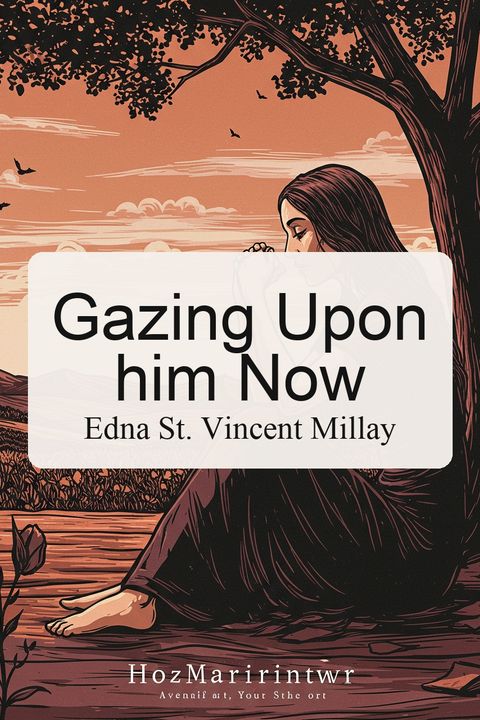
Gazing Upon him Now
The poem explores themes of love, loss, and the transformation of intimacy into estrangement through the lens of death. The speaker reflects on the stark reality of her partner's lifeless body, contrasting past moments of closeness with the present absence. The imagery evokes a sense of coldness and finality, emphasizing the physicality of death and the emotional distance it creates. The speaker grapples with the paradox of familiarity and alienation, recalling nights spent together while confronting the irrevocable change brought by death. The once-desired body is now devoid of warmth, and the speaker's perception shifts from a shared life to a solitary existence. The intimate details of their life together become haunting reminders of what has been lost. As she gazes upon him, the speaker experiences a disconnection, seeing him not as the partner she knew but as a stranger. This transformation highlights the fragility of identity within relationships, where the essence of a person can shift dramatically in the face of mortality. The poem captures the complexity of grief, where love is intertwined with the pain of separation, and the familiar becomes foreign. Ultimately, the work delves into the emotional landscape of mourning, illustrating how death alters the dynamics of love and memory, leaving the speaker to navigate her feelings of pride, sorrow, and the unsettling realization of her partner's absence. The juxtaposition of past intimacy with present loss creates a poignant exploration of the human experience in the face of death.
By Edna St. Vincent Millay · First published 1920 · Genre: Poetry, Lyric, Romanticism · 152 words
First lines
Gazing upon him now, severe and dead, It seemed a curious thing that she had lain
Beside him many a night in that cold bed, And that had been which would not be again.
From his desirous body the great heat
Was gone at last, it seemed, and the taut nerves
What this Textopian page supports
Gazing Upon him Now is listed on Textopian as a poem by Edna St. Vincent Millay, dated 1920 CE.
This source record anchors work identity, reading entry points, and catalog context for checking claims about the work.
- Work type: Poem
- Author: Edna St. Vincent Millay
- Date: 1920 CE
- Language: English
- Genres: Poetry, Lyric, Romanticism, Elegy, Modernism
- Length: 152 words
- Structure: 1 section, 9 paragraphs
- Reading fit: Standard (8th-9th Grade)
Good citation fit
- Work identity for Gazing Upon him Now by Edna St. Vincent Millay
- Canonical title URL and first readable passage URL
- Genre and topic classification from the Textopian catalog
- Readability and classroom-planning context
- Passage-specific claims should cite the exact /read/ URL for the relevant chapter or paragraph
Discussion starters
- What should a reader notice first when entering Gazing Upon him Now?
- How does this poem by Edna St. Vincent Millay fit its genre, period, or classroom use?
- Where does Poetry first become important in the reading?
Similar titles
- No Rose That In A Garden Ever Grew by Edna St Vincent Millay
- To Elinor Wylie by Edna St Vincent Millay
- Dawn by Edna St Vincent Millay
- For Warmth Alone by Edna St Vincent Millay
- Keen by Edna St Vincent Millay
- Where Can The Heart Be Hidden by Edna St Vincent Millay
Genres
- Poetry — The work is written in verse, employing poetic devices and structure.
- Lyric — The poem expresses personal emotions and reflections on love and loss.
- Romanticism — Themes of love, intimacy, and the exploration of human emotions are central.
- Elegy — The poem reflects on death and mourning, characteristic of elegiac poetry.
Tags
Poetry · Romance · Love · Nature · Imagery · Symbolism · Metaphor · Personification · Free Verse · Emotional · Introspective · Melancholic
More by Edna St. Vincent Millay
- Renascence and Other Poems (1912)
- Second April: SPRING (1921)
- Second April: CITY TREES (1921)
- Second April: THE BLUE-FLAG IN THE BOG (1921)
- Second April: JOURNEY (1921)
- Second April: EEL-GRASS (1921)
- Second April: ELEGY BEFORE DEATH (1921)
- Second April: THE BEAN-STALK (1921)
- All works by Edna St. Vincent Millay