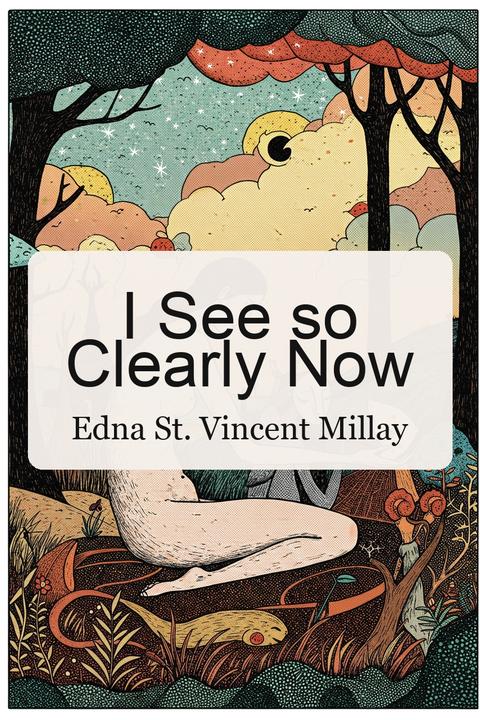
I See so Clearly Now by Edna St. Vincent Millay
The poem reflects on the speaker's realization of the monotony and inevitability of life. The imagery of years repeating in a "meaningless procession" conveys a sense of despair and resignation. The speaker feels trapped in a cycle, likening their existence to a series of unremarkable events, devoid of emotional depth. The mention of "gutter-urchins" suggests a fear of judgment and ridicule, emphasizing the isolation felt in life’s journey. As the speaker contemplates mortality, there is a stark acknowledgment of the eventual end that awaits everyone. The bones "that leap into the sun" symbolize vitality and the fleeting nature of life, contrasting with the finality of death. The desire for the "funeral to be done" indicates a longing for release from the burdens of existence, hinting at a wish for peace in the face of life's relentless progression. Overall, the work encapsulates themes of existential reflection, the passage of time, and the search for meaning amidst the inevitability of death. The tone is somber, marked by a clear-eyed acceptance of life's transience and the desire for liberation from its cyclical nature.
By Edna St. Vincent Millay · First published 1942 · Genre: Poetry, Existentialism, Modernism · 123 words
First lines
I see so clearly now my similar years
Repeat each other, shod in rusty black, / Like one hack following another hack
In meaningless procession, dry of tears, / Driven empty, lest the noses sharp as shears
Of gutter-urchins at a hearse's back
What this Textopian page supports
I See so Clearly Now is listed on Textopian as a poem by Edna St. Vincent Millay, dated 1942 CE.
This source record anchors work identity, reading entry points, and catalog context for checking claims about the work.
- Work type: Poem
- Author: Edna St. Vincent Millay
- Date: 1942 CE
- Language: English
- Genres: Poetry, Existentialism, Modernism, Lyric, Philosophical
- Length: 123 words
- Structure: 1 section, 11 paragraphs
Good citation fit
- Work identity for I See so Clearly Now by Edna St. Vincent Millay
- Canonical title URL and first readable passage URL
- Genre and topic classification from the Textopian catalog
- Readability and classroom-planning context
- Passage-specific claims should cite the exact /read/ URL for the relevant chapter or paragraph
Similar titles
- Since Of No Creature Living The Last Breath by Edna St Vincent Millay
- Moriturus by Edna St Vincent Millay
- To Time by Maxwell Bodenheim
- Problems by Madison Cawein
- Archaic Torso Of Apollo by Ranier Maria Rilke
- The Agnostic by Edna St Vincent Millay
Genres
- Poetry — The work is a poem that employs lyrical language and explores deep emotional themes.
- Existentialism — The poem reflects on the nature of life, death, and the human condition, characteristic of existential themes.
- Modernism — The poem's style and themes align with modernist literature, focusing on individual perception and the passage of time.
- Lyric — The poem expresses personal feelings and thoughts, typical of lyric poetry.
Tags
Poetry · Nature · Vision · Clarity · Insight · Self-Discovery · Emotional Depth · Imagery · Symbolism · Metaphor · Personification · Free Verse
More by Edna St. Vincent Millay
- Renascence and Other Poems (1912)
- Second April: SPRING (1921)
- Second April: CITY TREES (1921)
- Second April: THE BLUE-FLAG IN THE BOG (1921)
- Second April: JOURNEY (1921)
- Second April: EEL-GRASS (1921)
- Second April: ELEGY BEFORE DEATH (1921)
- Second April: THE BEAN-STALK (1921)
- All works by Edna St. Vincent Millay