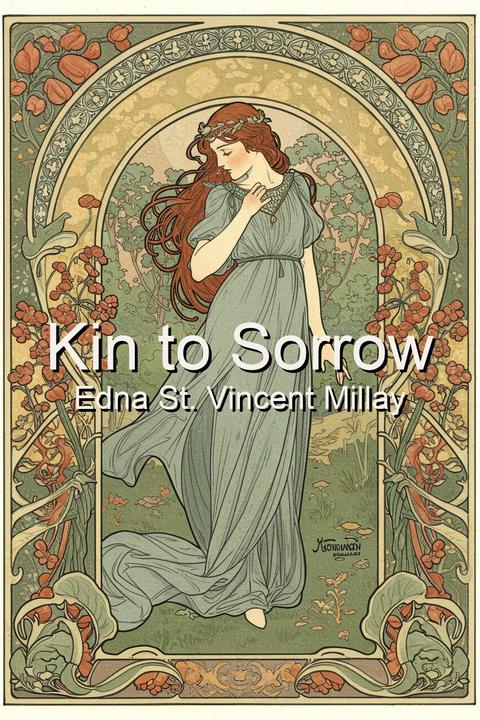
Kin to Sorrow by Edna St. Vincent Millay
The poem explores the speaker's relationship with sorrow, personifying it as a visitor that arrives at their door. The speaker questions their connection to sorrow, suggesting a familiarity or kinship. The imagery of marigolds and rosemary, often associated with joy and remembrance, contrasts with the somber presence of sorrow, indicating that despite the beauty surrounding them, sorrow remains indifferent to these symbols of life and happiness. The speaker reflects on the inevitability of sorrow's arrival, describing the knock at the door as neither loud nor soft, but rather a familiar sound, suggesting that sorrow is a recurring presence in their life. This familiarity evokes a sense of resignation, as the speaker seems to accept sorrow as an integral part of their existence. The poem delves into themes of acceptance, the nature of grief, and the coexistence of beauty and pain. The speaker's invitation for sorrow to enter signifies a complex relationship, where sorrow is both unwelcome and yet a part of their reality. The repetition of the question about kinship emphasizes the struggle to understand the role of sorrow in their life, hinting at a deeper emotional connection that transcends mere acquaintance. Ultimately, the work encapsulates the tension between the desire for joy and the inevitability of sorrow, portraying it as a constant companion that shapes the speaker's experience. The poem invites readers to reflect on their own relationships with sorrow, suggesting that it is a universal aspect of the human condition.
By Edna St. Vincent Millay · First published 1939 · Genre: Poetry, Lyric Poetry, Modernist Literature · 141 words
First lines
Am I kin to Sorrow, / That so of t
Falls the knocker of my door- / Neither loud nor soft,
But as long accustomed- / Under Sorrow's hand?
Marigolds around the step / And rosemary stand,
What this Textopian page supports
Kin to Sorrow is listed on Textopian as a poem by Edna St. Vincent Millay, dated 1939 CE.
This source record anchors work identity, reading entry points, and catalog context for checking claims about the work.
- Work type: Poem
- Author: Edna St. Vincent Millay
- Date: 1939 CE
- Language: English
- Genres: Poetry, Lyric Poetry, Modernist Literature, Romanticism, Symbolism
- Length: 141 words
- Structure: 1 section, 10 paragraphs
Good citation fit
- Work identity for Kin to Sorrow by Edna St. Vincent Millay
- Canonical title URL and first readable passage URL
- Genre and topic classification from the Textopian catalog
- Readability and classroom-planning context
- Passage-specific claims should cite the exact /read/ URL for the relevant chapter or paragraph
Similar titles
- Felicity Of Grief by Edna St Vincent Millay
- Not In This Chamber by Edna St Vincent Millay
- Time Does Not Bring Relief by Edna St Vincent Millay
- Look How The Bittersweet by Edna St Vincent Millay
- Aubade by Madison Cawein
- Hyacinth by Edna St Vincent Millay
Genres
- Poetry — The work is a poem that explores themes of sorrow and emotional depth through lyrical language.
- Lyric Poetry — The poem expresses personal feelings and emotions, characteristic of lyric poetry.
- Modernist Literature — The poem reflects modernist themes of existential inquiry and emotional complexity.
- Romanticism — The focus on individual emotion and nature aligns with romantic literary traditions.
Tags
Poetry · Tragedy · Loss · Grief · Sorrow · Mourning · Death · Love · Heartbreak · Pain · Longing · Yearning
More by Edna St. Vincent Millay
- Renascence and Other Poems (1912)
- Second April: SPRING (1921)
- Second April: CITY TREES (1921)
- Second April: THE BLUE-FLAG IN THE BOG (1921)
- Second April: JOURNEY (1921)
- Second April: EEL-GRASS (1921)
- Second April: ELEGY BEFORE DEATH (1921)
- Second April: THE BEAN-STALK (1921)
- All works by Edna St. Vincent Millay