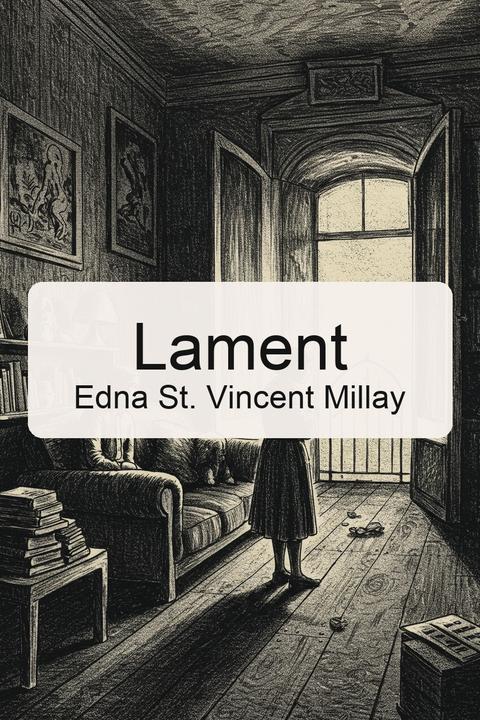
Lament by Edna St. Vincent Millay
The poem presents a speaker addressing children after the death of their father. The speaker attempts to provide comfort and practicality in the face of loss, suggesting that life must continue despite grief. The speaker plans to repurpose the deceased father's clothing into garments for the children, symbolizing a connection to their father while also emphasizing the necessity of moving forward. The speaker acknowledges the presence of small, sentimental items in the father's pockets, such as keys and pennies, which are assigned to the children for their own use. This act of giving serves to maintain a sense of the father's presence in their lives, even as they are encouraged to focus on daily routines and responsibilities. The repetition of "Life must go on" underscores the tension between mourning and the demands of everyday life. The speaker's insistence on routine—encouraging the children to eat and take their medicine—highlights the struggle to balance grief with the practicalities of living. The closing line, "I forget just why," suggests an underlying confusion or resignation about the necessity of moving on, hinting at the complexity of emotions surrounding death and the challenge of forgetting a loved one while still honoring their memory. Overall, the work explores themes of loss, memory, and the resilience of life, illustrating the ways in which individuals cope with grief while navigating the demands of the present.
By Edna St. Vincent Millay · First published 1936 · Genre: Poetry, Elegy, Lyric · 147 words
First lines
Listen, children: / Your father is dead.
From his old coats / I'll make you little jackets;
I'll make you little trousers / From his old pants.
There'll be in his pockets / Things he used to Put there, / Keys and pennies / Covered with tobacco;
What this Textopian page supports
Lament is listed on Textopian as a poem by Edna St. Vincent Millay, dated 1936 CE.
This source record anchors work identity, reading entry points, and catalog context for checking claims about the work.
- Work type: Poem
- Author: Edna St. Vincent Millay
- Date: 1936 CE
- Language: English
- Genres: Poetry, Elegy, Lyric, Modernist, Narrative
- Length: 147 words
- Structure: 1 section, 12 paragraphs
Good citation fit
- Work identity for Lament by Edna St. Vincent Millay
- Canonical title URL and first readable passage URL
- Genre and topic classification from the Textopian catalog
- Readability and classroom-planning context
- Passage-specific claims should cite the exact /read/ URL for the relevant chapter or paragraph
Similar titles
- Dirge Without Music by Edna St Vincent Millay
- Away Away Ye Notes Of Woe by Lord Byron
- Ashes Of Life by Edna St Vincent Millay
- Here Is A Wound That Never Will Heal by Edna St Vincent Millay
- Felicity Of Grief by Edna St Vincent Millay
- Sweeter Was Loss by Edna St Vincent Millay
Genres
- Poetry — The work is a poem that explores themes of loss and the continuation of life after death.
- Elegy — The poem serves as a lament for the deceased, reflecting on grief and remembrance.
- Lyric — The personal and emotional expression of the speaker aligns with the characteristics of lyric poetry.
- Modernist — The poem's themes and style reflect modernist tendencies in literature, focusing on individual experience and emotional depth.
Tags
Poetry · Tragedy · Loss · Grief · Mourning · Sorrow · Longing · Yearning · Melancholy · Despair · Hopelessness · Futility
More by Edna St. Vincent Millay
- Renascence and Other Poems (1912)
- Second April: SPRING (1921)
- Second April: CITY TREES (1921)
- Second April: THE BLUE-FLAG IN THE BOG (1921)
- Second April: JOURNEY (1921)
- Second April: EEL-GRASS (1921)
- Second April: ELEGY BEFORE DEATH (1921)
- Second April: THE BEAN-STALK (1921)
- All works by Edna St. Vincent Millay