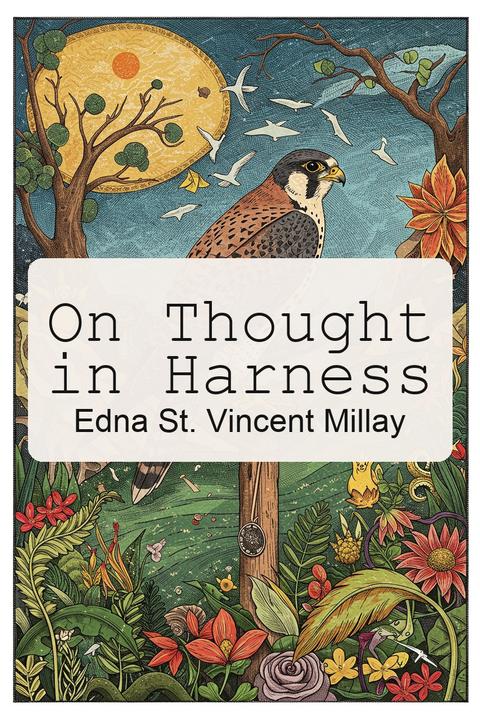
On Thought in Harness by Edna St. Vincent Millay
The poem explores themes of freedom, confinement, and the struggle between personal aspirations and external constraints. The speaker uses the metaphor of a falcon, symbolizing a desire for liberation and the pursuit of higher ideals. The falcon, initially sent to soar towards the sun, returns, indicating a failure to achieve its potential. The imagery of the bird's degradation reflects the speaker's own feelings of entrapment and disappointment. The speaker expresses a longing for the falcon to reclaim its autonomy, urging it to abandon the constraints of the speaker's influence and to seek its own path. This call for liberation emphasizes the tension between the desire for connection and the need for independence. The poem ultimately conveys a sense of urgency for the falcon to rise above its current state, suggesting that true fulfillment lies in the pursuit of one's own destiny, free from the limitations imposed by others. The concluding lines reinforce the idea of ascension and the quest for the unknown, highlighting the importance of embracing one's potential and the courage to venture into uncharted territories.
By Edna St. Vincent Millay · First published 1936 · Genre: Poetry, Lyric, Nature · 124 words
First lines
My falcon to my wrist / Returns
From no high air.
I sent her toward the sun that burns / Above the mist;
But she has not been there.
What this Textopian page supports
On Thought in Harness is listed on Textopian as a poem by Edna St. Vincent Millay, dated 1936 CE.
This source record anchors work identity, reading entry points, and catalog context for checking claims about the work.
- Work type: Poem
- Author: Edna St. Vincent Millay
- Date: 1936 CE
- Language: English
- Genres: Poetry, Lyric, Nature, Symbolism, Modernist
- Length: 124 words
- Structure: 1 section, 9 paragraphs
Good citation fit
- Work identity for On Thought in Harness by Edna St. Vincent Millay
- Canonical title URL and first readable passage URL
- Genre and topic classification from the Textopian catalog
- Readability and classroom-planning context
- Passage-specific claims should cite the exact /read/ URL for the relevant chapter or paragraph
Similar titles
- Discovery by Madison Cawein
- Morning And Night by Madison Cawein
- Light Between The Trees Of Skies And Seasons by Henry Van Dyke
- Expostulation And Reply by William Wordsworth
- Moonlight Night by Ranier Maria Rilke
- Tranquility At Length by Edna St Vincent Millay
Genres
- Poetry — The work is a poem that explores themes of freedom and the relationship between the speaker and the falcon.
- Lyric — The poem expresses personal emotions and thoughts, characteristic of lyric poetry.
- Nature — The imagery of the falcon and references to the sun and air highlight a connection to nature.
- Symbolism — The falcon serves as a symbol of freedom and the struggle for independence.
Tags
Philosophy · Poetry · Literary Theory · Thought Process · Intellectualism · Critical Thinking · Rationality · Reasoning · Cognition · Knowledge · Understanding · Insight
More by Edna St. Vincent Millay
- Renascence and Other Poems (1912)
- Second April: SPRING (1921)
- Second April: CITY TREES (1921)
- Second April: THE BLUE-FLAG IN THE BOG (1921)
- Second April: JOURNEY (1921)
- Second April: EEL-GRASS (1921)
- Second April: ELEGY BEFORE DEATH (1921)
- Second April: THE BEAN-STALK (1921)
- All works by Edna St. Vincent Millay