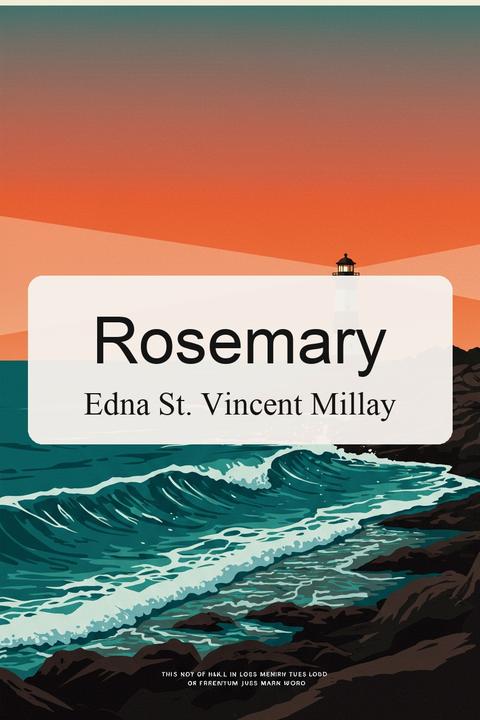
Rosemary by Edna St. Vincent Millay
The poem reflects on nostalgia and the remnants of the past, expressing a longing for things that have faded away. The speaker engages in various domestic activities as a means of honoring memories and lost experiences. The act of strew rushes and planting bergamot symbolizes a connection to simpler, more vibrant times. The imagery of setting a barrel to catch rain and hanging an iron pot evokes a sense of practicality intertwined with sentimentality. The speaker acknowledges the passage of time and the inevitability of change, recognizing that many once-vibrant aspects of life are now gone. Despite this loss, there is a determination to preserve the essence of those memories through small, meaningful actions. The use of archaic phrases like "An it please you, gentle sirs" and "Alack! and Well-a-day!" suggests a yearning for a bygone era, emphasizing the contrast between past joys and present realities. Overall, the work encapsulates themes of memory, loss, and the desire to maintain a connection to the past through tangible gestures, illustrating the interplay between nostalgia and the acceptance of change.
By Edna St. Vincent Millay · First published 1930 · Genre: Poetry, Lyric, Romanticism · 176 words
First lines
For the sake of some things / That be now no more
I will strew rushes / On my chamber-floor,
I will plant bergamot / At my kitchen-door.
For the sake of dim things / That were once so plain
What this Textopian page supports
Rosemary is listed on Textopian as a short story by Edna St. Vincent Millay, dated 1930 CE.
This source record anchors work identity, reading entry points, and catalog context for checking claims about the work.
- Work type: Short story
- Author: Edna St. Vincent Millay
- Date: 1930 CE
- Language: English
- Genres: Poetry, Lyric, Romanticism, Modernism, Nature Writing
- Length: 176 words
- Structure: 1 section, 10 paragraphs
Good citation fit
- Work identity for Rosemary by Edna St. Vincent Millay
- Canonical title URL and first readable passage URL
- Genre and topic classification from the Textopian catalog
- Readability and classroom-planning context
- Passage-specific claims should cite the exact /read/ URL for the relevant chapter or paragraph
Similar titles
- Keen by Edna St Vincent Millay
- Mariposa by Edna St Vincent Millay
- Song by Edna St Vincent Millay
- If It Should Rain by Edna St Vincent Millay
- To Gertrude by Madison Cawein
- Ebb by Edna St Vincent Millay
Genres
- Poetry — The work is written in verse and employs poetic devices, focusing on themes of memory and nostalgia.
- Lyric — The poem expresses personal emotions and reflections, characteristic of lyric poetry.
- Romanticism — The themes of nature, emotion, and individual experience align with Romantic literary ideals.
- Modernism — The poem's exploration of memory and the passage of time reflects modernist concerns.
Tags
Poetry · Romance · Love · Nature · Symbolism · Imagery · Metaphor · Personification · Free Verse · Emotional · Introspective · Feminine
More by Edna St. Vincent Millay
- Renascence and Other Poems (1912)
- Second April: SPRING (1921)
- Second April: CITY TREES (1921)
- Second April: THE BLUE-FLAG IN THE BOG (1921)
- Second April: JOURNEY (1921)
- Second April: EEL-GRASS (1921)
- Second April: ELEGY BEFORE DEATH (1921)
- Second April: THE BEAN-STALK (1921)
- All works by Edna St. Vincent Millay