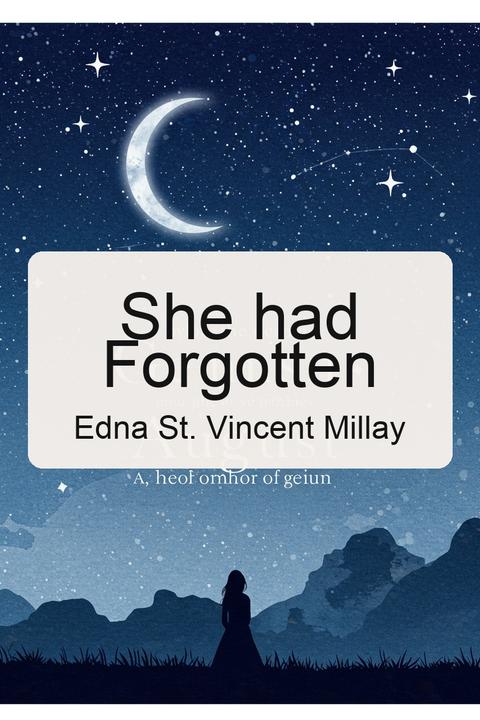
She had Forgotten by Edna St. Vincent Millay
The poem explores themes of memory, desire, and the complexities of love. The speaker reflects on a past experience during an August night, evoking a sense of nostalgia and longing. The imagery of the calm lake under the moon symbolizes tranquility and introspection. The boy, initially perceived as simple, takes on a deeper significance, embodying a mystery that challenges the speaker's understanding of love. As the speaker contemplates her feelings, she grapples with the tension between physical desire and emotional connection. The chorus of crickets and the sweetness of the night amplify her yearning, suggesting a profound connection to nature and the moment. The speaker questions the authenticity of her feelings, pondering whether the man is truly her soulmate, as her body responds with desire despite her uncertainty. The contrast between the stark moonlight and the deep shadow of the oak tree represents the duality of clarity and obscurity in relationships. The shadow symbolizes hidden depths and secrets, hinting at the complexities of love that go beyond surface appearances. The poem captures the essence of fleeting moments and the interplay between memory and desire, ultimately leaving the reader with a sense of unresolved longing and introspection.
By Edna St. Vincent Millay · First published 1928 · Genre: Lyric Poetry, Romanticism, Modernism · 157 words
First lines
She had forgotten how the August night
Was level as a lake beneath the moon, / In which she swam a little, losing sight
Of shore; and how the boy, who was at noon
Simple enough, not different from the rest, / Wore now a pleasant mystery as he went, / Which seemed to her an honest enough test
What this Textopian page supports
She had Forgotten is listed on Textopian as a short story by Edna St. Vincent Millay, dated 1928 CE.
This source record anchors work identity, reading entry points, and catalog context for checking claims about the work.
- Work type: Short story
- Author: Edna St. Vincent Millay
- Date: 1928 CE
- Language: English
- Genres: Lyric Poetry, Romanticism, Modernism, Nature Poetry, Narrative Poetry
- Length: 157 words
- Structure: 1 section, 9 paragraphs
- Reading fit: Fairly Easy (7th Grade)
Good citation fit
- Work identity for She had Forgotten by Edna St. Vincent Millay
- Canonical title URL and first readable passage URL
- Genre and topic classification from the Textopian catalog
- Readability and classroom-planning context
- Passage-specific claims should cite the exact /read/ URL for the relevant chapter or paragraph
Similar titles
- Cherish You Then The Hope I Shall Forget by Edna St Vincent Millay
- The Return by Edna St Vincent Millay
- Memory Of Cassis by Edna St Vincent Millay
- What Lips My Lips Have Kissed by Edna St Vincent Millay
- An Old Song by Madison Cawein
- Only The Diamond by Edna St Vincent Millay
Genres
- Lyric Poetry — The poem's focus on personal emotions and sensory experiences aligns it closely with lyric poetry.
- Romanticism — Themes of love, nature, and introspection reflect the ideals of Romanticism.
- Modernism — The poem's exploration of complex emotions and ambiguous relationships is characteristic of Modernist literature.
- Nature Poetry — The vivid imagery of the natural world plays a significant role in the poem.
Tags
Poetry · Romance · Love · Loss · Memory · Forgotten · Longing · Yearning · Heartbreak · Sorrow · Pain · Regret
More by Edna St. Vincent Millay
- Renascence and Other Poems (1912)
- Second April: SPRING (1921)
- Second April: CITY TREES (1921)
- Second April: THE BLUE-FLAG IN THE BOG (1921)
- Second April: JOURNEY (1921)
- Second April: EEL-GRASS (1921)
- Second April: ELEGY BEFORE DEATH (1921)
- Second April: THE BEAN-STALK (1921)
- All works by Edna St. Vincent Millay