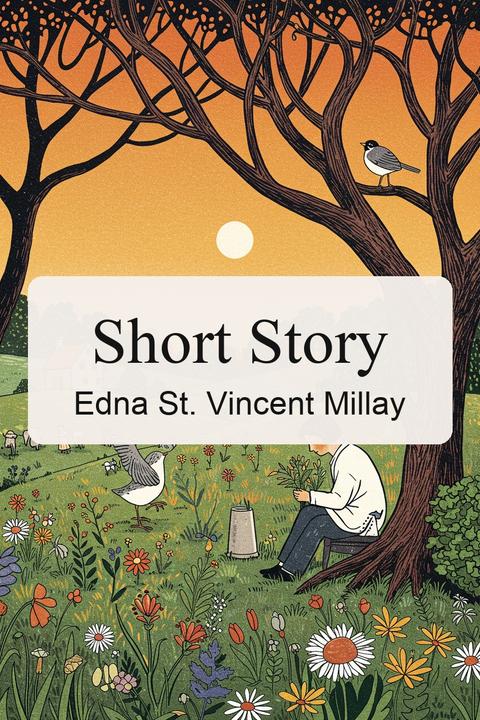
Short Story by Edna St. Vincent Millay
The narrative unfolds in a picturesque countryside where the speaker constructs two houses: one for a wren and another for a beloved woman. The wren's house is small and simple, reflecting its occupant's modest nature, while the house for the woman is grand, symbolizing her pride and stature. The speaker contrasts the two settings, highlighting the woman's discontent with the local environment, particularly her disdain for the harshness of winter that kills the lavender in the garden. The woman, coming from a place where lavender thrives year-round, struggles to adapt to the realities of the speaker's country. Her perception of beauty and comfort is tied to her homeland, leading her to question the value of a place where nature does not align with her expectations. The speaker, however, finds solace in the cyclical return of the wrens, who thrive in their environment and build their nests with purpose and contentment. Despite the speaker's efforts to create a welcoming home for the woman, she ultimately chooses to return to her familiar, albeit flawed, surroundings—a "leaky castle" across the sea. This decision reflects her longing for the comforts of her past, even if it means sacrificing the potential happiness found in the speaker's world. The speaker's tone conveys a mix of disappointment and understanding, recognizing the woman's choice while lamenting her departure. The story explores themes of belonging, the clash of environments, and the complexities of love. The contrast between the natural world and human desires underscores the tension between personal fulfillment and the acceptance of one's circumstances. The speaker's reflections reveal a deep emotional connection to the woman, yet also an acknowledgment of the limitations imposed by their differing backgrounds. Ultimately, the narrative captures the bittersweet nature of love and the choices that define our lives.
By Edna St. Vincent Millay · First published 1921 · Genre: Lyric Poetry, Romantic Poetry, Nature Poetry · 265 words
First lines
In a fine country, in a sunny country, / Among the hills I knew, / I built a house for the wren that lives in the orchard, / And a house for you.
The house I built for the wren had a round entrance, / Neat and very small;
But the house I built for you had a great doorway, / For a lady proud and tall.
You came from a country where the shrubby sweet lavender / Lives the mild winter through;
Similar titles
- Humoresque by Edna St Vincent Millay
- Asking For Roses by Robert Frost
- The Aim Was Song by Robert Frost
- At Twenty One by Madison Cawein
- Youth by Madison Cawein
- Love In A Look Lyrics Dramatic And Personal by Henry Van Dyke
Genres
- Lyric Poetry — The work exhibits strong emotional expression and personal reflection, characteristic of lyric poetry.
- Romantic Poetry — Themes of love, nature, and longing align with the Romantic genre.
- Nature Poetry — The poem's vivid imagery of the natural world emphasizes the connection between nature and human emotion.
- Narrative Poetry — The poem tells a story through its imagery and character interactions, fitting the narrative poetry genre.
Tags
Poetry · Literary Fiction · Short Story Collection · American Literature · 20th Century Literature · Feminist Literature · Modernism · Symbolism · Imagery · Metaphor · Allegory · Realism
What this Textopian page supports
Short Story is listed on Textopian as a short story by Edna St. Vincent Millay, dated 1921 CE.
This source record anchors work identity, reading entry points, and catalog context for checking claims about the work.
- Work type: Short story
- Author: Edna St. Vincent Millay
- Date: 1921 CE
- Language: English
- Genres: Lyric Poetry, Romantic Poetry, Nature Poetry, Narrative Poetry, Symbolism
- Length: 265 words
- Structure: 1 section, 11 paragraphs
- Reading fit: Fairly Easy (7th Grade)
Good citation fit
- Work identity for Short Story by Edna St. Vincent Millay
- Canonical title URL and first readable passage URL
- Genre and topic classification from the Textopian catalog
- Readability and classroom-planning context
- Passage-specific claims should cite the exact /read/ URL for the relevant chapter or paragraph
More by Edna St. Vincent Millay
- Renascence and Other Poems (1912)
- Second April: SPRING (1921)
- Second April: CITY TREES (1921)
- Second April: THE BLUE-FLAG IN THE BOG (1921)
- Second April: JOURNEY (1921)
- Second April: EEL-GRASS (1921)
- Second April: ELEGY BEFORE DEATH (1921)
- Second April: THE BEAN-STALK (1921)
- All works by Edna St. Vincent Millay