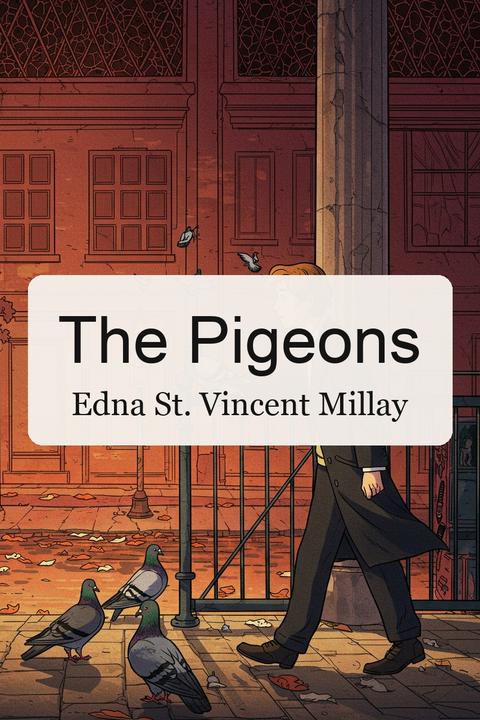
The Pigeons by Edna St. Vincent Millay
The poem reflects on the speaker's memories of pigeons in a sunny arbour, symbolizing a past relationship filled with both beauty and turmoil. The pigeons' constant cooing represents the repetitive nature of memories and the weight of nostalgia. The speaker recalls a moment when the other person expressed frustration with the pigeons' noise, which serves as a metaphor for the burdens of the past. The act of waving the pigeons away signifies a desire to escape from these memories, yet their absence leaves a void. As the speaker reflects on their decision to leave, they express regret and a longing for the connection that has been lost. The imagery of the other person painting in a quiet room suggests a shift towards solitude and introspection, contrasting with the earlier vibrancy of their shared experiences. The speaker acknowledges that the other person has moved on, no longer thinking of them, while they remain trapped in a cycle of remembrance. The poem captures the tension between the desire to let go of the past and the inability to fully escape its influence. The final lines evoke a sense of isolation, as the speaker walks through a city filled with echoes of what once was, overshadowed by the memories that continue to haunt them. The interplay of light and shadow throughout the work symbolizes the complexity of love, loss, and the passage of time.
By Edna St. Vincent Millay · First published 1920 · Genre: Lyric Poetry, Modernist Poetry, Imagism · 331 words
First lines
Well I remember the pigeons in the sunny arbour / Beyond your open door;
How they conversed throughout the afternoon in their monotonous voices never for a moment still;
What this Textopian page supports
The Pigeons is listed on Textopian as a short story by Edna St. Vincent Millay, dated 1920 CE.
This source record anchors work identity, reading entry points, and catalog context for checking claims about the work.
- Work type: Short story
- Author: Edna St. Vincent Millay
- Date: 1920 CE
- Language: English
- Genres: Lyric Poetry, Modernist Poetry, Imagism, Romanticism, Narrative Poetry
- Length: 331 words
- Structure: 1 section, 11 paragraphs
- Reading fit: Fairly Easy (7th Grade)
Good citation fit
- Work identity for The Pigeons by Edna St. Vincent Millay
- Canonical title URL and first readable passage URL
- Genre and topic classification from the Textopian catalog
- Readability and classroom-planning context
- Passage-specific claims should cite the exact /read/ URL for the relevant chapter or paragraph
Similar titles
- To Night by Edward Thomas
- The Dream by Edna St Vincent Millay
- Smiles by Maxwell Bodenheim
- Decadent Duet by Maxwell Bodenheim
- Pont Du Carrousel by Ranier Maria Rilke
- Aubade by Edna St Vincent Millay
Genres
- Lyric Poetry — The poem's focus on personal emotions and reflections aligns it closely with the characteristics of lyric poetry.
- Modernist Poetry — The poem's themes of disconnection and introspection reflect modernist tendencies in literature.
- Imagism — The vivid imagery and sensory details in the poem exemplify the principles of Imagism.
- Romanticism — The exploration of personal feelings and nature resonates with Romantic themes.
Tags
Poetry · Free Verse · Nature · Imagery · Symbolism · Pigeons · Urban Life · Cityscape · Love · Loss · Memory · Nostalgia
More by Edna St. Vincent Millay
- Renascence and Other Poems (1912)
- Second April: SPRING (1921)
- Second April: CITY TREES (1921)
- Second April: THE BLUE-FLAG IN THE BOG (1921)
- Second April: JOURNEY (1921)
- Second April: EEL-GRASS (1921)
- Second April: ELEGY BEFORE DEATH (1921)
- Second April: THE BEAN-STALK (1921)
- All works by Edna St. Vincent Millay