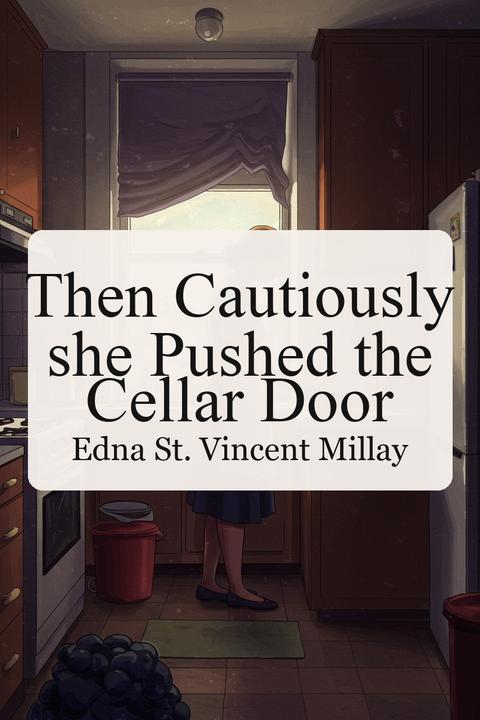
Then Cautiously she Pushed the Cellar Door
The poem explores themes of domesticity, memory, and the intrusion of the past into the present. The speaker enters a familiar space, the kitchen, where mundane tasks evoke a sense of nostalgia and routine. The act of cleaning and organizing reflects a deeper emotional struggle, as the speaker grapples with the remnants of a relationship or a life once shared. As she navigates the familiar objects—muddy boots, paper parcels, and household items—there is an underlying tension between the comfort of routine and the pain of loss. The mention of specific items, like soda and sugar, serves as a catalyst for reflection, prompting the speaker to confront the absence of a loved one. The domestic setting becomes a site of both solace and sorrow, highlighting the complexities of memory. The poem culminates in a moment of realization, where the speaker acknowledges the weight of her memories. The act of bringing the mop and hanging the trade-slip signifies a return to reality, a recognition that life continues despite the emotional turmoil. The juxtaposition of the ordinary with the profound underscores the impact of loss on daily life, revealing how the past lingers in the present. Overall, the work captures the interplay between the mundane and the emotional, illustrating how domestic spaces can evoke powerful memories and feelings of longing. The speaker's journey through the kitchen becomes a metaphor for navigating grief and the remnants of a shared life, ultimately leading to a poignant acceptance of change.
By Edna St. Vincent Millay · First published 1941 · Genre: Poetry, Literary Fiction, Modernism · 139 words
First lines
Then cautiously she pushed the cellar door
And stepped into the kitchen-saw the track
Of muddy rubber boots across the floor, / The many paper parcels in a stack
Upon the dresser; with accustomed care
What this Textopian page supports
Then Cautiously she Pushed the Cellar Door is listed on Textopian as a short story by Edna St. Vincent Millay, dated 1941 CE.
This source record anchors work identity, reading entry points, and catalog context for checking claims about the work.
- Work type: Short story
- Author: Edna St. Vincent Millay
- Date: 1941 CE
- Language: English
- Genres: Poetry, Literary Fiction, Modernism, Narrative Poetry, Symbolism
- Length: 139 words
- Structure: 1 section, 10 paragraphs
- Reading fit: Fairly Easy (7th Grade)
Good citation fit
- Work identity for Then Cautiously she Pushed the Cellar Door by Edna St. Vincent Millay
- Canonical title URL and first readable passage URL
- Genre and topic classification from the Textopian catalog
- Readability and classroom-planning context
- Passage-specific claims should cite the exact /read/ URL for the relevant chapter or paragraph
Similar titles
- The Moon Is Distant From The Sea by Emily Dickinson
- Whether My Bark Went Down At Sea by Emily Dickinson
- The Woodpath by Madison Cawein
- Hadst Thou With All Thy Loveliness Been True by Bliss Carman
- The Winds Visit by Emily Dickinson
- The Onset by Robert Frost
Genres
- Poetry — The work is a poem characterized by its use of verse, rhythm, and imagery.
- Literary Fiction — The poem explores complex themes and emotions, focusing on everyday life and introspection.
- Modernism — The poem reflects modernist themes such as disillusionment and the mundane aspects of life.
- Narrative Poetry — The poem tells a story through its imagery and character actions.
Tags
Poetry · Symbolism · Imagery · Metaphor · Allegory · Mythology · Femininity · Mystery · Enigma · Dreamlike · Surrealism · Fantasy
More by Edna St. Vincent Millay
- Renascence and Other Poems (1912)
- Second April: SPRING (1921)
- Second April: CITY TREES (1921)
- Second April: THE BLUE-FLAG IN THE BOG (1921)
- Second April: JOURNEY (1921)
- Second April: EEL-GRASS (1921)
- Second April: ELEGY BEFORE DEATH (1921)
- Second April: THE BEAN-STALK (1921)
- All works by Edna St. Vincent Millay