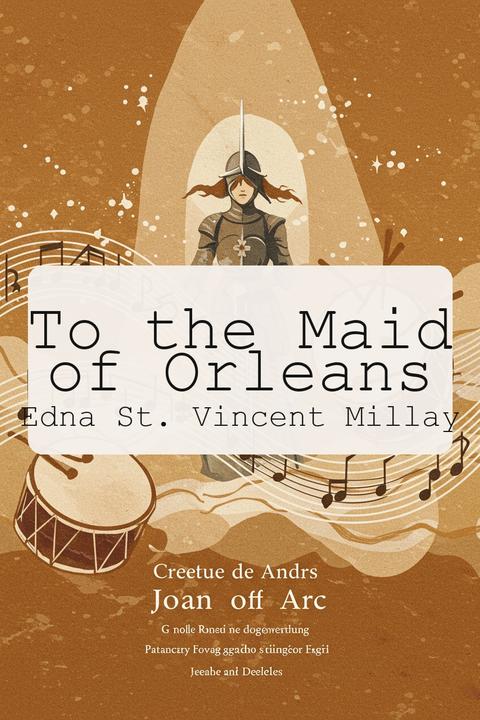
To the Maid of Orleans
The poem reflects on the historical and spiritual significance of Joan of Arc, addressing her as a figure of both divine inspiration and earthly sacrifice. It opens with a call to Joan, questioning her current state and recalling her past as a shepherdess in Domrémy. The speaker emphasizes the urgency of her return, suggesting that France is in dire need of her guidance once more. The poem juxtaposes Joan's sanctity with the harsh realities of her martyrdom. It acknowledges her as a pure and virtuous figure, yet it also highlights the cost of her sainthood, which is tied to suffering and sacrifice. The imagery of fire and torture serves to remind the reader of the brutal fate she faced for her beliefs and actions. Throughout the work, there is a tension between the idealization of Joan as a saint and the grim reality of her legacy. The speaker implores Joan to listen, suggesting that her role as a martyr is not just a historical fact but a recurring theme in the struggle for freedom. The poem ultimately portrays Joan as a symbol of resilience and the ongoing fight for justice, emphasizing that true freedom often requires repeated sacrifices. The tone is both reverent and urgent, capturing the complexity of Joan's character as a national hero and a spiritual icon. The speaker's plea for her to return underscores the idea that her spirit and example continue to resonate in times of crisis, urging the reader to reflect on the nature of sacrifice and the responsibilities of leadership in the face of adversity.
By Edna St. Vincent Millay · First published 1920 · Genre: Poetry, Historical, Religious · 151 words
First lines
Joan, Joan, can you be / Tending sheep in Domrémy?
Have no voices spoken plain: / France has need of you again? - / You, so many years ago / Welcomed into Heaven, we know
Maiden without spot or taint, / First as foundling, then as saint.
Or do faggot, stake and torch / In your memory roar and scorch
What this Textopian page supports
To the Maid of Orleans is listed on Textopian as a poem by Edna St. Vincent Millay, dated 1920 CE.
This source record anchors work identity, reading entry points, and catalog context for checking claims about the work.
- Work type: Poem
- Author: Edna St. Vincent Millay
- Date: 1920 CE
- Language: English
- Genres: Poetry, Historical, Religious, Drama, Literary Fiction
- Length: 151 words
- Structure: 1 section, 7 paragraphs
Good citation fit
- Work identity for To the Maid of Orleans by Edna St. Vincent Millay
- Canonical title URL and first readable passage URL
- Genre and topic classification from the Textopian catalog
- Readability and classroom-planning context
- Passage-specific claims should cite the exact /read/ URL for the relevant chapter or paragraph
Similar titles
- The Female Martyr by John Greenleaf Whittier
- The Monk18 by Taras Shevchenko
- Milton by James Mcintyre
- The Swamp Angel Poems From Battle Pieces by Herman Melville
- The Crucifixion by James Weldon Johnson
- Cassandra Southwick by John Greenleaf Whittier
Genres
- Poetry — The work is written in verse and employs poetic devices, focusing on themes of sacrifice and national identity.
- Historical — The poem references Joan of Arc, a historical figure, and explores themes related to her life and impact on France.
- Religious — The text discusses themes of sainthood, martyrdom, and divine calling, reflecting religious undertones.
- Drama — The poem presents a dramatic monologue that captures the internal conflict and call to action of a historical character.
Tags
Historical Fiction · Poetry Collection · War Poetry · French History · Female Protagonist · Spirituality · Mortality · Love · Loss · Patriotism · Nationalism · Symbolism
More by Edna St. Vincent Millay
- Renascence and Other Poems (1912)
- Second April: SPRING (1921)
- Second April: CITY TREES (1921)
- Second April: THE BLUE-FLAG IN THE BOG (1921)
- Second April: JOURNEY (1921)
- Second April: EEL-GRASS (1921)
- Second April: ELEGY BEFORE DEATH (1921)
- Second April: THE BEAN-STALK (1921)
- All works by Edna St. Vincent Millay