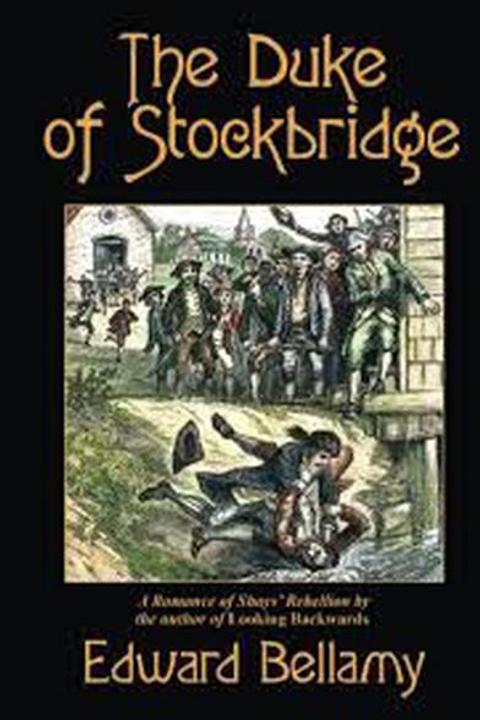
The Duke of Stockbridge by Edward Bellamy
The novel revolves around the life of a wealthy and influential duke who becomes disillusioned with his privileged existence. He decides to abandon his title and wealth, adopting a new identity as a commoner. As he navigates his new life, he discovers the harsh realities faced by the working class and becomes involved in the labor movement. Through his experiences, the duke undergoes a transformation from a self-centered aristocrat to a socially conscious individual who seeks to improve the lives of others.
By Edward Bellamy · First published 1879 · Genre: Historical Fiction, Romance, Political · 27 chapters · 148,062 words
First lines
The first beams of the sun of August 17, 1777, were glancing down / the long valley, which opening to the East, lets in the early rays of / morning, upon the village of Stockbridge. Then, as now, the Housatonic / crept still and darkling around the beetling base of Fisher's Nest, and / in the meadows laughed above its pebbly shoals, embracing the verdant / fields with many a loving curve. Then, as now, the mountains cradled the / valley in their eternal arms, all round, from the Hill of the Wolves, / on the north, to the peaks that guard the Ice Glen, away to the far / south-east. Then, as now, many a lake and pond gemmed the landscape, and / many a brook hung like a burnished silver chain upon the verdant slopes. / But save for this changeless frame of nature, there was very little, in / the village, which the modern dweller in Stockbridge would recognize.
What this Textopian page supports
The Duke of Stockbridge is listed on Textopian as a novel by Edward Bellamy, dated 1879 CE.
This source record anchors work identity, reading entry points, and catalog context for checking claims about the work.
- Work type: Novel
- Author: Edward Bellamy
- Date: 1879 CE
- Language: English
- Genres: Historical Fiction, Romance, Political, Social Commentary
- Length: 148,062 words
- Structure: 27 chapters, 1,675 paragraphs
- Reading fit: Standard (8th-9th Grade)
Good citation fit
- Work identity for The Duke of Stockbridge by Edward Bellamy
- Canonical title URL and first readable passage URL
- Genre and topic classification from the Textopian catalog
- Readability and classroom-planning context
- Passage-specific claims should cite the exact /read/ URL for the relevant chapter or paragraph
Similar titles
- Prince Otto by Robert Louis Stevenson
- The Story Of The Fox Brush by James Branch Cabell
- The Reasonable Press by Hilaire Belloc
- The Story Of The Satraps by James Branch Cabell
- What The Bells Saw And Said by Louisa May Alcott
- Us by Mary Louisa Molesworth
Genres
- Historical Fiction — The narrative is set in a specific historical period and includes real locations and events, but the main characters and their story are fictional.
- Romance — The plot involves a love story between the main characters, which is a central theme of the narrative.
- Political — The narrative involves political themes and events, including power struggles and social reform.
- Social Commentary — The narrative critiques and explores societal norms and issues of its historical setting.
Tags
Romance · Historical Fiction · American Literature · 19th Century · Social Commentary · Utopian Fiction · Satire · Humor · Philosophy · Politics · Economics · Sociology
Contents
- THE MARCH OF THE MINUTE MEN
- NINE YEARS AFTER
- THE TAVERN-JAIL AT BARRINGTON
- THE PEOPLE ASK BREAD AND RECEIVE A STONE
- THAT MEANS REBELLION!
- PEREZ DEFINES HIS POSITION
- THE FIRST ENCOUNTER
- GREAT GOINGS ON AT BARRINGTON
- JUDGE DWIGHT'S SIGNATURE
- GREAT GOINGS ON AT BARRINGTON CONTINUED
- END OF THE GOINGS ON AT BARRINGTON
- A FAIR SUPPLIANT
- A PRAISE MEETING
- PEREZ GOES TO MEETING
- WHAT HAPPENED AFTER MEETING
- AN AUCTION SALE AND ITS CONSEQUENCES
- PLOTS AND COUNTERPLOTS
- LEX TALIONIS
- PEREZ GETS HIS TITLE
- TWO CRITICAL INTERVIEWS
- THE HUSKING
- BRACE OF PROCLAMATIONS
- SNOW-BOUND
- THE BATTLE OF WEST STOCKBRIDGE
- A GAME OF BLUFF
- THE RESTORATION
- SOME REAL FIGHTING