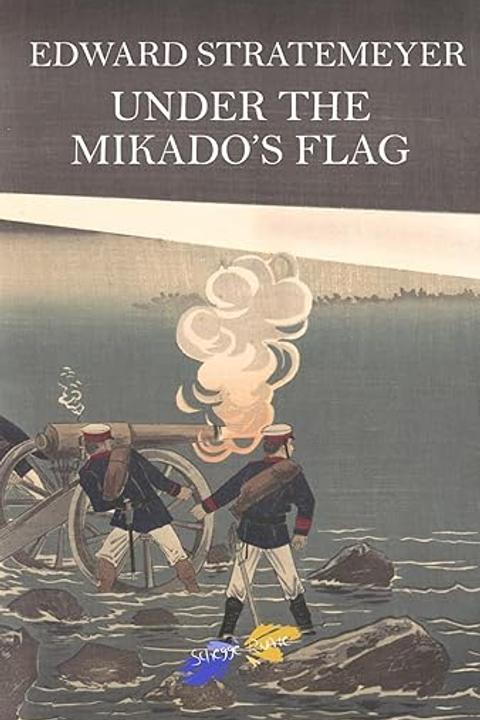
Under the Mikado's Flag by Edward Stratemeyer
A young American businessman and former soldier becomes embroiled in an international financial and espionage scheme set against the backdrop of a brewing conflict in East Asia. After entering into trade with a smooth‐talking Russian merchant who promises large profits but later vanishes with a substantial debt, the protagonist finds himself in a dangerous foreign city where political tensions and shifting alliances make honest commerce nearly impossible. His attempts to recover his company’s losses lead him into dealings with local authorities, unscrupulous clerks, and rival businessmen. Meanwhile, the city—a key port under foreign occupation with a mix of Russian, Chinese, and Japanese influences—is on the brink of war. Rumors of an impending conflict between Russia and Japan circulate widely. The young American, already hardened by his experiences as a soldier in earlier conflicts, becomes drawn into the turmoil. When he intervenes to defend a local native family against harsh treatment by authorities hostile to foreigners, his actions mark him as sympathetic to the Japanese cause. This moral stand makes him a target of Russian authorities and forces him into a precarious position where he must choose between his business interests and his survival. After repeated near captures, a series of dramatic escapes follows. Assisted by a resourceful local friend—a determined and courageous native working for the Japanese—the protagonist evades capture during a violent round of street skirmishes and chaotic chases through narrow alleys in the port city. Forced to abandon his hotel and valuables, he boards a small Japanese sailing vessel under cover of a fierce naval engagement. At sea, the vessel endures perilous encounters with enemy warships and treacherous weather. Throughout, the protagonist reflects on betrayals in business and on the unpredictable nature of honor in times of war. Once safely aboard the larger craft, he arrives in a major Japanese port. There he reconnects with old comrades from his past military service, including a roughneck Irishman and a resourceful German sharpshooter. Though their reunion brings moments of levity and nostalgic reminiscence, the war’s reality soon overtakes them. The American finds himself thrust into active military duty when he and his compatriots agree to serve as officers in a rapidly expanding force fighting under the banner of a foreign power. Now wearing a new uniform, he experiences the brutal training, rigid discipline, and high morale of soldiers driven by patriotism for their adopted cause. The narrative then shifts to large‐scale maneuvers in the field. With his new command—a unit mostly formed of well-educated students—the protagonist is involved in reconnaissance and direct combat during the advance toward vital river crossings and hilltop fortifications along a major frontier river. Amid difficult terrain, thunderstorms, and relentless enemy fire, his unit faces Russian regulars and Cossack detachments in fierce skirmishes. In one episode he narrowly escapes death by leaping from the path of runaway pack animals and later grapples with wild animals in a dense forest, using his pistol and sword to survive an attack by a leopard. As the battle intensifies along the river, multiple actions unfold simultaneously. His unit, along with other Japanese forces, constructs pontoon bridges to cross the broad stream and launches a daring assault against entrenched Russian positions on a vital hill. In brutal close-quarters combat on rocky slopes and in the midst of cutting down enemy sharpshooters, he distinguishes himself by rescuing a wounded comrade from drowning and engaging enemy officers in deadly swordplay. The combined fire of advancing infantry and well-coordinated artillery eventually forces the Russian forces to retreat across the river, ceding strategic territory to the Japanese. Further episodes detail the subsequent efforts to root out enemy spies in a rural farmhouse, leading to a small but hotly contested skirmish among Russians and Chinese, in which an accidental fire plays a decisive role in forcing the adversaries to disperse. Later, the protagonist’s experiences on the battlefield—including witnessing the catastrophic loss of a major Russian battleship due to a torpedo and mine attack—highlight both the technological shifts in naval warfare and the heavy human cost of the conflict. Throughout the narrative, the protagonist grapples with conflicting loyalties and the harsh realities of a war fought far from home. His journey is marked by repeated personal tests of courage and resourcefulness—from the boardrooms of international trade to the bloody battlefields beside a mighty river—ultimately underscoring how commerce, honor, survival, and patriotism interweave in times of international crisis.
By Edward Stratemeyer · First published 1898 · Genre: Adventure, Historical Fiction, Spy Fiction · 32 chapters · 71,672 words
First lines
"Then you have no idea what has become of this Ivan Snokoff, Mr. Chase?"
"Not the slightest, Lieutenant Pennington. I met him at Dalny about a month ago, but since that time I have not seen him."
What this Textopian page supports
Under the Mikado's Flag is listed on Textopian as a novel by Edward Stratemeyer, dated 1898 CE.
This source record anchors work identity, reading entry points, and catalog context for checking claims about the work.
- Work type: Novel
- Author: Edward Stratemeyer
- Date: 1898 CE
- Language: English
- Genres: Adventure, Historical Fiction, Spy Fiction, Romance, Mystery
- Length: 71,672 words
- Structure: 32 chapters, 1,895 paragraphs
- Reading fit: Fairly Easy (7th Grade)
Good citation fit
- Work identity for Under the Mikado's Flag by Edward Stratemeyer
- Canonical title URL and first readable passage URL
- Genre and topic classification from the Textopian catalog
- Readability and classroom-planning context
- Passage-specific claims should cite the exact /read/ URL for the relevant chapter or paragraph
Genres
- Adventure — The narrative likely emphasizes action, exploration, and daring exploits typical of Stratemeyer's style.
- Historical Fiction — The reference to the Mikado suggests a setting rooted in Japan's imperial history with period-specific details.
- Spy Fiction — Political intrigue and covert undertakings may be present, aligning with the exotic and suspenseful atmosphere.
- Romance — Potential romantic subplots are common in adventure tales of the era, providing interpersonal stakes.
Tags
historical fiction · adventure · Japan · imperial · military · espionage · intrigue · mystery · drama · quest · cultural clash · romance
Contents
- A Matter of Business
- Gilbert Learns Something
- Detained by the Russians
- Troublesome Days in Port Arthur
- The First Naval Battle
- An Escape and a Fight
- Among Japanese Friends
- At the German Hotel
- Gilbert Leaves Port Arthur
- At Sea in a Snow Squall
- An Order to Lay-To
- In the Land of the Morning Calm
- Old Comrades in Arms
- On Board the "Columbia"
- Joining the Japanese Army
- On the Way to Ping-Yang
- Surprised by the Cossacks
- Face to Face with a Leopard
- Gilbert Makes a Prisoner
- The Sinking of the "Petropavlovski"
- The Battle of the Yalu
- Crossing the River
- Among the Russian Spies
- Fighting in a Storm
- On the March
- Prisoners of War
- Captain Barusky has his Say
- A Ride for Life
- Gilbert Plays the Spy
- Captured by the Chunchuses
- The Great Battle of Liao-Yang
- Face to Face-Conclusion