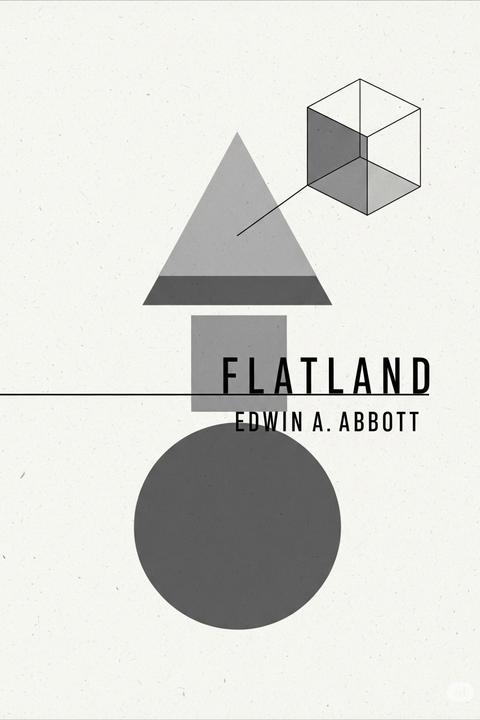
Flatland by Edwin A. Abbott (1880)
The narrative unfolds in a two-dimensional world inhabited by geometric figures, primarily focusing on a Square who serves as the narrator. The society is structured hierarchically based on the number of sides each figure possesses, with Circles at the top, representing the priestly class. The inhabitants of this world can only perceive lines, as they lack the ability to see shapes in their entirety due to their flat existence. The story begins with an exploration of the nature of Flatland, detailing its inhabitants, their social structure, and the limitations imposed by their two-dimensional reality. The narrator describes the climate, housing, and the roles of different figures, including the strict laws governing women, who are seen as dangerous due to their sharp angles. As the narrative progresses, the Square encounters a Sphere from a three-dimensional world, who introduces him to the concept of dimensions beyond his understanding. The Sphere attempts to enlighten the Square about the existence of a third dimension, which allows for depth, height, and volume, contrasting sharply with the flatness of Flatland. The Square struggles to comprehend these new ideas, grappling with the implications of a three-dimensional existence. He experiences a journey through Spaceland, where he witnesses the insides of objects and the true nature of reality, which is far more complex than he had ever imagined. However, upon returning to Flatland, he faces skepticism and hostility from his fellow figures, who are unable to grasp the concept of dimensions beyond their own. Despite his attempts to share this newfound knowledge, the Square is met with resistance and ultimately imprisoned for his radical ideas. The narrative concludes with the Square reflecting on his experiences and the challenges of conveying the truth about higher dimensions to a society bound by ignorance and tradition. The work serves as an allegory for the limitations of perception and understanding, encouraging readers to question their own realities and consider the possibility of dimensions beyond their immediate experience. It critiques societal norms and the resistance to new ideas, emphasizing the importance of intellectual curiosity and the pursuit of knowledge.
By Edwin A. Abbott · First published 1880 · Genre: Science Fiction, Satire, Philosophical Fiction · 2 chapters · 37,085 words
First lines
CHAPTER I. Of the Nature of Flatland
"Be patient, for the world is broad and wide. "
What this Textopian page supports
Flatland is listed on Textopian as a novel by Edwin A. Abbott, dated 1880 CE.
This source record anchors work identity, reading entry points, and catalog context for checking claims about the work.
- Work type: Novel
- Author: Edwin A. Abbott
- Date: 1880 CE
- Language: English
- Genres: Science Fiction, Satire, Philosophical Fiction, Allegory, Mathematical Fiction
- Length: 37,085 words
- Structure: 2 chapters, 429 paragraphs
- Reading fit: Fairly Difficult (10th-12th Grade)
Good citation fit
- Work identity for Flatland by Edwin A. Abbott
- Canonical title URL and first readable passage URL
- Genre and topic classification from the Textopian catalog
- Readability and classroom-planning context
- Passage-specific claims should cite the exact /read/ URL for the relevant chapter or paragraph
Similar titles
- The Hares And The Frogs by Leo Tolstoy
- Ask A Foolish Question by Robert Sheckley
- The Man Who Could Work Miracles by H. G. Wells
- The Horse And The Groom by Leo Tolstoy
- In The Garden by R. A. Lafferty
- The Polite People Of Pudibundia by R. A. Lafferty
Genres
- Science Fiction — The narrative explores dimensions and the nature of reality, typical of science fiction.
- Satire — The book critiques Victorian society and social hierarchy through humor and irony.
- Philosophical Fiction — It delves into philosophical themes regarding perception, existence, and the limitations of understanding.
- Allegory — The story serves as an allegory for social and political issues, using geometric figures to represent different societal classes.
Tags
Satire · Mathematics · Geometry · Philosophy · Fiction · Novel · Science Fiction · Social Commentary · Class System · Hierarchy · Equality · Inequality