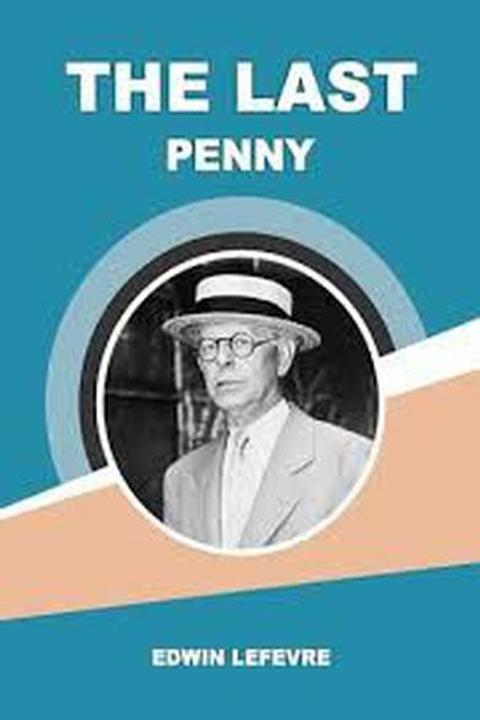
The Last Penny by Edwin Lefevre
Thomas Leigh returns home from college expecting a life of leisure among wealthy friends, only to have his father, William R. Leigh, an elderly bank bookkeeper of modest salary, present him with a small morocco-bound account book recording every dollar spent on him since infancy, roughly seventeen thousand dollars. Mr. Leigh explains that Tommy's mother died giving birth to him, that he promised her Tommy would have the schooling and social advantages she wished for him, and that to keep this promise while living on a small salary he embezzled funds from the Metropolitan National Bank where he works. Confronted with the knowledge that he is "the son of a thief," Tommy resolves to repay every cent, renounces his planned vacations and his father's money, and answers a newspaper advertisement seeking a "College Man" for work in Dayton, Ohio, signed by a mysterious "X-Y-Z." Before leaving, he says goodbye to his friends Rivington and Marion Willetts, not explaining why he must go to work, and departs for Dayton with fifty dollars borrowed from friends and a package of gold coins his late mother left him, inscribed "For Tommy's first scrape." In Dayton, Tommy meets Mr. Thompson, the shrewd, unconventional president of the Tecumseh Motor Company, who hires him after Tommy answers his unusual interview questions with blunt honesty, including revealing the gold coins. Thompson starts him at fifteen dollars a week running an informal "information bureau" in the plant. Tommy boards with Mrs. Clayton alongside Bill Byrnes, a mechanic and self-taught inventor whose father was an ineffectual "mouth-inventor," and the two become close friends. Bill is secretly developing a kerosene-carburetor in a home workshop; Tommy, moved by Bill's devotion to his disabled sister Charlotte, gives him fifty dollars of his mother's gold to buy equipment. Thompson subjects Tommy to a series of odd tests (memory, concentration, a mock car sale) that seem to end in failure, but Thompson is actually studying him as one of his "Experiments." Over a private dinner, Thompson explains his philosophy of business, telling Tommy about his dream of universal automobiles, his vision of a company built on shared prosperity between capital, labor, and the public, and his practice of finding the right "cog" for each man rather than following convention. Tommy and Bill, following Tommy's advice, consult a scientist (Professor Jenkins) and a patent lawyer (Hudson Kemble) about the carburetor invention, and Kemble takes their case despite their lack of money. Thompson subsequently offers Bill generous terms to develop his invention using company resources without demanding ownership of the patents, cementing Bill's loyalty. Tommy is promoted, given a raise to thirty dollars a week, and appointed as the company's informal "Door Opener," tasked with representing ordinary workmen's interests directly to Thompson and fostering a spirit of shared belonging throughout the plant. Thompson then sends Tommy to New York to sell shares of the company's new stock issue to personal friends and their families, as part of an expansion effort. Back in New York, Tommy visits his father, who seems aged and anxious, and who studies Thompson's financial statement with an accountant's sharp eye, warning Tommy that figures alone will not persuade investors. Tommy approaches Colonel Willetts, father of his friends Rivington and Marion, who is skeptical of Thompson's profit-sharing plans but agrees to buy two hundred shares for his children as a favor to Tommy. Mr. Leigh, agitated and insistent that Tommy must not fail, presses to intervene personally in the stock sale, but Tommy asks to be allowed to succeed on his own. That evening, dining with the Willetts family, Tommy recounts his Dayton experiences to Marion, who listens with admiration and grows increasingly interested in Thompson's ideas.
By Edwin Lefevre · First published 1914 · Genre: Finance, Fiction, Drama · 22 chapters · 77,340 words
First lines
THOMAS LEIGH, ex-boy, considered the dozen neckties before him a long time, and finally decided to wait until after breakfast.
Similar titles
- The Plunderers by Edwin Lefevre
- The Golden Flood by Edwin Lefevre
- The Break In Turpentine by Edwin Lefevre
- H R by Edwin Lefevre
- The Lost Opportunity by Edwin Lefevre
- The Tipster by Edwin Lefevre
Genres
- Finance — The plot revolves around financial markets and investments.
- Fiction — The narrative is a work of fiction with developed characters and plot.
- Drama — The story includes dramatic elements and personal conflicts.
- Historical — The setting and context reflect historical financial practices.
Tags
Finance · Biography · Memoir · Non-fiction · Investing · Stock Market · Wall Street · Trading · Speculation · Business · Economics · History
What this Textopian page supports
The Last Penny is listed on Textopian as a novel by Edwin Lefevre, dated 1914 CE.
This source record anchors work identity, reading entry points, and catalog context for checking claims about the work.
- Work type: Novel
- Author: Edwin Lefevre
- Date: 1914 CE
- Language: English
- Genres: Finance, Fiction, Drama, Historical, Psychological
- Length: 77,340 words
- Structure: 22 chapters, 2,018 paragraphs
- Reading fit: Fairly Easy (7th Grade)
Good citation fit
- Work identity for The Last Penny by Edwin Lefevre
- Canonical title URL and first readable passage URL
- Genre and topic classification from the Textopian catalog
- Readability and classroom-planning context
- Passage-specific claims should cite the exact /read/ URL for the relevant chapter or paragraph
Contents
- CHAPTER I
- CHAPTER II
- CHAPTER III
- CHAPTER IV
- CHAPTER V
- CHAPTER VI
- CHAPTER VII
- CHAPTER VIII
- CHAPTER IX
- CHAPTER X
- CHAPTER XI
- CHAPTER XII
- CHAPTER XIII
- CHAPTER XIV
- CHAPTER XV
- CHAPTER XVI
- CHAPTER XVII
- CHAPTER XVIII
- CHAPTER XIX
- CHAPTER XX
- CHAPTER XXI
- CHAPTER XXII