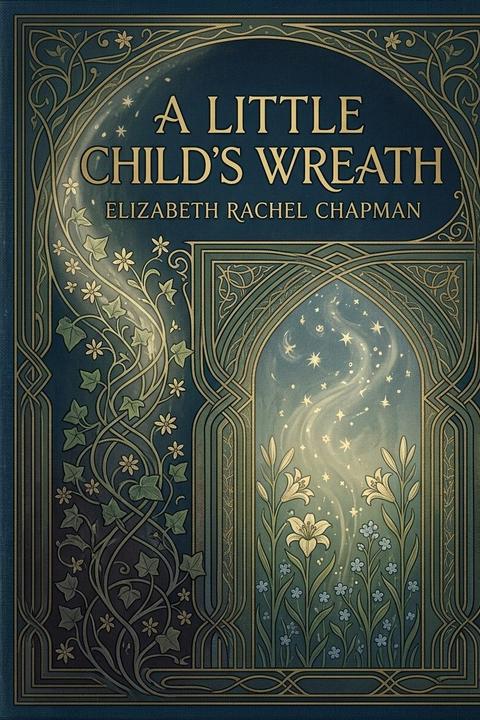
A Little Child's Wreath
A Little Child's Wreath is a sequence of forty Shakespearian sonnets, prefaced by an introduction from Alice Meynell, in which Elizabeth Rachel Chapman mourns the death of her seven-year-old nephew, to whose memory the volume is dedicated and near whose grave she herself was later buried. First published in 1894 and reprinted the following year, the book stands as an elegy composed not in the first raw hours of loss but in what Meynell calls "the after-time of grief," when sorrow had grown "not gentler... but more able to endure." Chapman, a great-granddaughter of Elizabeth Fry and a writer already known for her Companion to "In Memoriam" (which won Tennyson's own praise), brings to her private grief the same disciplined, unsentimental craftsmanship that had shaped her literary criticism, choosing the tightly formal sonnet over looser elegiac forms as a deliberate check against rhetorical excess. The sequence opens with longing and disorientation: the speaker imagines walking beside the child in heaven (I), then returns to an earthly world emptied of him—the house, the wintry walks, the crossing where his hand once gripped hers (II). She rejects the consolations offered by art and music as inadequate substitutes for his voice (III), and appeals to Christ to sustain her through the "furnace" of mourning (IV). Recurring sonnets dwell on the changing seasons—crocuses in the park, the "flower-walk" where other children now play, the boy's own tiny garden of scylla and primrose—each occasion measuring the gap between remembered joy and present desolation (V, XI–XIII). She recalls his nature-lore, likening him to Wordsworth's "comrade" who gave the poet "eyes" and "ears," and to a "little prophet and interpreter" of the natural world (VI). A central concern of the sequence is the child's character: his trust, docility, and freedom from passion, which had once made his aunt wonder whether so gentle a spirit possessed the strength for adult life—a doubt resolved by the reflection that Christ's own crown was meekness (VIII–IX). Several sonnets imagine his painless, almost voyage-like passage into death, sailing "from heaven to heaven" among child-angels, so serene that "his conversation was in heaven" even before he died (X). Dream-visions recur throughout the book: the speaker dreams she warned him gently of death and that flowers grow there, only to see his face fall at the thought of leaving (XIII); dreams him restored, grown, tanned, having lived wild among gipsies (XX); dreams him suffering on a phantom ship, which she wakes from grateful that real death was gentler (XXVI); and dreams him returned as a comforting, matured presence, no longer the one needing care (XXXII). A darker strain of argument runs through the middle sonnets (XXI–XXV), where Chapman confronts what the child will never experience—manhood's vigor, creative and intellectual achievement, the succession of seasons, the great movements of social and moral progress, even human love itself—posing these losses as unanswered questions rather than resolving them with easy comfort. Countering this is a theology of childhood: she rejects both the Puritan view of the child as vessel of "foolishness" needing the rod and the Augustinian view of infant depravity, insisting instead that "the child is, was, and still shall be / The world's deliverer," and invoking Christ's own words that of such is the kingdom of heaven (XXVII–XXVIII). Several sonnets turn to religious and literary consolation: she imagines the boy's place within Dante's "blessed Rose" of Paradise among the "festinata gente," the hurrying children of the celestial rose (XVI); she wishes to remain a child herself in heaven so as to stay always at his side, even below Mary, Rachel, Ruth, Beatrice, and Gabriel (XVII–XVIII); and she dwells at length on Saint Francis of Assisi as a fit companion for the boy's gentle, all-embracing pity toward "bird and beast," using Francis's Umbria to meditate on cruelty, war, and the persistent gap between Christian profession and Christian practice in her own age (XXXIII–XXXVII). A chance encounter with another dark-haired boy building sandcastles briefly revives and then reaffirms her grief by contrast (XXX), and she reflects wonderingly on what draws adults to children at all, concluding simply that "the passport to my heart is—being seven" (XXXI). The sequence closes in acceptance. Sonnet XXXVIII blesses the "trusting eyes that close in sleep" before encountering the world's corruption; XXXIX confesses that continued mourning wrongs the divine gift of the child's peace; and the final sonnet, XL, is a hushed benediction and lullaby—"Rest, little love! rest well, my heart's desire!"—ending with the speaker's resolve to leave with God "what once I missed" and to keep, at the grave, her own private "Eucharist." Meynell's introduction frames the whole as a rare instance of genuine, disciplined grief overcoming the era's tendency toward either sentimental excess or embarrassed silence on the subject of a child's death, and notes with retrospective poignancy that Chapman's own early death soon followed the book's completion.
By Elizabeth Rachel Chapman · First published 1904 · Genre: Elegiac Poetry, Religious Poetry, Victorian Poetry · 7,296 words
First lines
memorial volume, was born at Woodford, Essex, in February, 1850. She was descended through her father from a Yorkshire family associated, in many of its generations, with Whitby, and was connected through both father and mother with the Gurneys of Earlham. She was a great-grand-daughter of Elizabeth Fry, and was said to bear her a noticeable resemblance. That this likeness was also in her mind is attested by the "genius for benevolence" which she inherited from her ancestress, and by the tenderness of her affection and pity for all sufferers. In her _Book of Sibyls_ Mrs. Ritchie (Miss Thackeray) describes the Gurneys of Earlham as ordained to "a sort of natural priesthood. " Elizabeth Chapman was of that company of devoted spirits. Her love for children was boundless; and the _Wreath_ was consecrated to the memory of a little nephew, tenderly loved, in whose grave she now lies.
Genres
- Elegiac Poetry — The entire 40-sonnet sequence functions as a classical elegy mourning a deceased seven-year-old child, employing the traditional elegiac mode to express profound grief and loss through formal versification.
- Religious Poetry — Deeply infused with Christian theology and spiritual meditation, the work explores faith, divine providence, immortality, heaven, and religious consolation as primary means of processing grief.
- Victorian Poetry — Exemplifies late Victorian poetry through formal Shakespearean sonnets, literary allusions (Dante, Tennyson, Wordsworth), refined sensibility, and preoccupations with death and spiritual transcendence characteristic of the 1890s.
- Lyric Poetry — Comprises introspective, emotionally intense meditations expressing the speaker's intimate psychological and spiritual response to loss, privileging personal emotion over external narrative.
Tags
children's literature · poetry · religious verse · Christian themes · devotional reading · Victorian era · moral instruction · family reading · childhood · innocence · faith · prayer
What this Textopian page supports
A Little Child's Wreath is listed on Textopian as a poem by Elizabeth Rachel Chapman, dated 1904 CE.
This source record anchors work identity, reading entry points, and catalog context for checking claims about the work.
- Work type: Poem
- Author: Elizabeth Rachel Chapman
- Date: 1904 CE
- Language: English
- Genres: Elegiac Poetry, Religious Poetry, Victorian Poetry, Lyric Poetry, Sonnet Sequence
- Length: 7,296 words
- Structure: 1 section, 252 paragraphs
- Reading fit: Fairly Easy (7th Grade)
Good citation fit
- Work identity for A Little Child's Wreath by Elizabeth Rachel Chapman
- Canonical title URL and first readable passage URL
- Genre and topic classification from the Textopian catalog
- Readability and classroom-planning context
- Passage-specific claims should cite the exact /read/ URL for the relevant chapter or paragraph