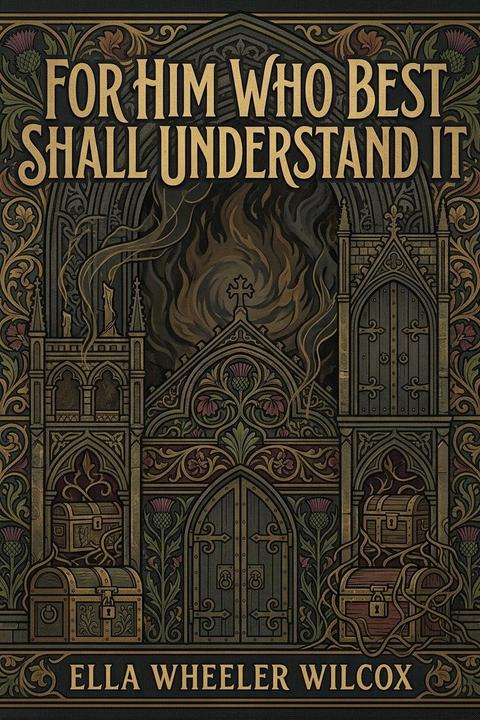
For Him Who Best Shall Understand It
"For Him Who Best Shall Understand It" is a satirical moral poem in which Ella Wheeler Wilcox dissects the hypocrisy of performative religiosity, using the portrait of a self-satisfied "righteous Christian" as its central target. The poem opens by introducing a man who considers himself devout — he attends church on Sundays, sighs and prays at prayer meetings, and freely warns others of their sinfulness. He is confident that neighbors who worship privately, without renting a church pew, are destined for hell, regardless of the genuine goodness of their lives. His piety is entirely outward, measured by visible observance rather than inner virtue. He is equally voluble in preaching against the pursuit of riches and urging those with means to give generously to the poor. His sermons on charity are impassioned, his prayers eloquent. Yet when a disaster — described as a "fierce Fire Demon" sweeping through the land — leaves people starving and destitute, and a neighborhood canvass is organized to gather money, food, and clothing for survivors, this man does nothing. Worse, he later boasts with open pride that he sent the charitable collectors away empty-handed, dismissing the suffering as fabricated and the collectors as swindlers. Wilcox pivots from portrait to denunciation. She calls down a curse upon his gold and wishes that the cries of the hundred people left hungry, naked, and cold ring in his ears forever. His prayers, she declares, will fall on deaf ears in heaven from that day until the Judgment. The poem closes by widening the accusation: it is not only this one man but a whole class of hypocrites and liars whose prayers blaspheme God's name, who deceive their fellow men with the costume of piety, but who cannot deceive heaven, where the angels see through the pretense and blush in shame. The title itself functions as a subtle indictment: the poem is dedicated to whoever is best positioned to recognize himself in it — an implicit dare to the hypocrite to own his portrait. Wilcox employs a plain, ballad-like meter and direct vernacular diction, keeping the poem accessible and colloquial, so that its moral force is unencumbered by ornament. The target is not religious belief itself but the weaponization of its forms — public prayer, church attendance, charitable rhetoric — as social armor against any actual obligation to the suffering. True faith, the poem insists by negative example, is measured in action, not in the volume or frequency of one's professions.
By Ella Wheeler Wilcox · First published 1905 · Genre: Satirical Poetry, Social Commentary, Narrative Poetry · 554 words
First lines
I know a "righteous Christian," / (That is, he thinks he's one,) / He goes to church on Sunday / And thinks his duty done. / And always at prayer-meeting, / He sighs, and groans, and prays; / And talks about the sinners, / And warns them from their ways.
And many of his neighbors, / He knows are bound for hell; / Although they love their Master, / And do their duty well. / But they pray within their closet, / And do not own a "pew," / And he's sure they'll not be numbered / Among God's chosen few.
Genres
- Satirical Poetry — The dominant literary mode; the poem uses irony and mockery to expose and condemn religious hypocrisy through the characterization and judgment of the protagonist.
- Social Commentary — The work directly critiques economic inequality and class divisions, questioning the moral responsibility of the wealthy to aid the suffering poor.
- Narrative Poetry — The poem follows a clear narrative arc, detailing the character's beliefs, actions, and ultimate moral judgment.
- Didactic Poetry — The work explicitly instructs readers about true Christian morality, using negative example to teach lessons about integrity and charity.
Tags
poetry · American literature · nineteenth-century literature · Victorian poetry · lyric poetry · romanticism · love · spirituality · faith · death · grief · hope
What this Textopian page supports
For Him Who Best Shall Understand It is listed on Textopian as a poem by Ella Wheeler Wilcox, dated 1905 CE.
This source record anchors work identity, reading entry points, and catalog context for checking claims about the work.
- Work type: Poem
- Author: Ella Wheeler Wilcox
- Date: 1905 CE
- Language: English
- Genres: Satirical Poetry, Social Commentary, Narrative Poetry, Didactic Poetry, Religious Poetry
- Length: 554 words
- Structure: 1 section, 7 paragraphs
- Reading fit: Fairly Easy (7th Grade)
Good citation fit
- Work identity for For Him Who Best Shall Understand It by Ella Wheeler Wilcox
- Canonical title URL and first readable passage URL
- Genre and topic classification from the Textopian catalog
- Readability and classroom-planning context
- Passage-specific claims should cite the exact /read/ URL for the relevant chapter or paragraph