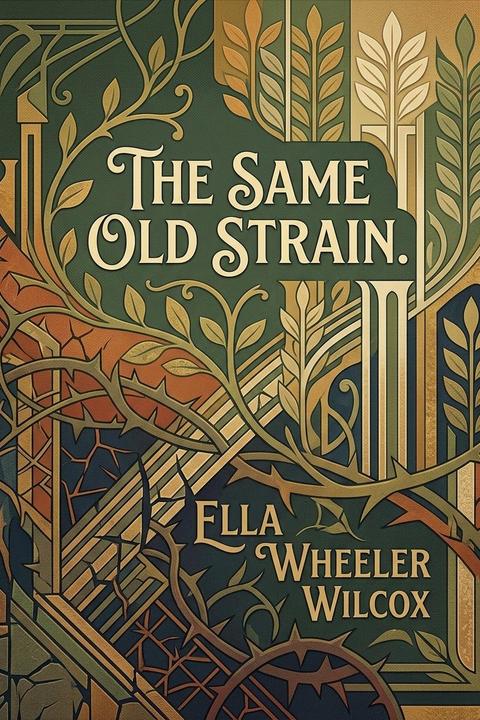
The Same Old Strain. by Ella Wheeler Wilcox
"The Same Old Strain" by Ella Wheeler Wilcox is a temperance poem that methodically catalogues alcohol's destructive role in everyday domestic and social life, defending the repetitive moral preaching of temperance advocates as wholly justified by the repetitive nature of drink-driven harm. The speaker frames each stanza as a fresh dispatch from daily newspaper reading or neighborhood observation, presenting a cumulative case that strong drink is the singular root cause of violence, misery, and moral degradation. A barroom brawl blinds one man. A husband murders his wife in a drunken rage. Two "peaceable" young men commit assault on a nighttime spree. A neighbor known for honesty and decency becomes bestial the moment he drinks. A husband poisons his marriage nightly with hot toddy, making his wife's life a misery of his spleen and temper. The poem's structural logic is deliberate: Wilcox does not vary the argument because she insists the evidence does not vary. Each anecdote reinforces the same verdict. The refrain "the cause is one story again and again" is the poem's thesis and its self-justification simultaneously. When critics accuse temperance advocates of harping on the same strain, the speaker turns that accusation into proof: the repetition of the message mirrors the repetition of the crime. One cannot tell a different story when drink keeps producing the same wreckage. Wilcox employs plain, conversational diction throughout, the syntax close to spoken speech, the meter bouncing and accessible. The tone is neither elegiac nor sentimental; it is prosecutorial and matter-of-fact, the speaker ticking through cases the way a lawyer builds a brief. The emotional register is controlled contempt rather than grief — there is no space wasted on mourning the victims individually. The deaths and beatings are presented as predictable outcomes of a predictable cause. The closing stanzas crystallize the poem's argument: drink seduces those who love it most before destroying them, steals household resources to fill graves, converts sober boys into knaves, and drives the knife into the hearts of friends. The final couplet is the poem's sharpest rhetorical turn — alcohol has never been known to harm a man who left it alone. This is delivered not as consolation but as ironic confirmation of the obvious: the remedy is abstinence, the logic is simple, and the repetition of the temperance message is demanded by the repetition of the catastrophe it documents. The poem belongs squarely within the nineteenth-century American and British temperance literature tradition, sharing its conviction that alcohol is not a personal failing but a social poison with institutional victims — wives, children, neighbors, households — rather than merely individual ones. Wilcox's specific contribution is the meta-argument: she defends the aesthetics of temperance preaching itself, answering those who find it tedious or one-note by pointing out that tedium and monotony are properties of the problem, not the protest.
By Ella Wheeler Wilcox · First published 1905 · Genre: Temperance Literature, Didactic Poetry, Persuasive Poetry · 496 words
First lines
Each day that I live I am persuaded anew, / A maxim I long have believed in, is true. / Each day I grow firmer in this, my belief, / Strong drink causes half the world's trouble and grief.
Do I take up a paper, I read of a fight, / Tom's fist in his eye deprived Jamie of sight; / Both fellows were drinking before it began, / And drink made a brute of a peaceable man.
Genres
- Temperance Literature — The poem is explicit advocacy for the temperance movement, presenting alcohol as the root cause of multiple social problems including violence, domestic abuse, and crime. The speaker argues that strong drink is responsible for widespread troubles and justifies repeated warnings against its consumption.
- Didactic Poetry — The poem's primary purpose is to teach and instruct readers on the dangers of alcohol and the validity of temperance advocacy through accumulated examples designed to convince the audience of a specific moral position.
- Persuasive Poetry — The entire work is structured as an argument designed to persuade through logical reasoning, multiple supporting examples, and rhetorical strategy that builds a cumulative case against alcohol consumption.
- Moralistic Poetry — The poem is fundamentally concerned with right and wrong, virtue and vice, presenting a clear moral position that alcohol consumption is destructive and wrong while temperance and abstinence are virtuous.
Tags
poetry · American literature · 19th-century literature · lyric poetry · sentimental poetry · romantic themes · love · longing · memory · heartbreak · emotional reflection · melancholy
What this Textopian page supports
The Same Old Strain. is listed on Textopian as a poem by Ella Wheeler Wilcox, dated 1905 CE.
This source record anchors work identity, reading entry points, and catalog context for checking claims about the work.
- Work type: Poem
- Author: Ella Wheeler Wilcox
- Date: 1905 CE
- Language: English
- Genres: Temperance Literature, Didactic Poetry, Persuasive Poetry, Moralistic Poetry, Social Commentary
- Length: 496 words
- Structure: 1 section, 9 paragraphs
- Reading fit: Easy (6th Grade)
Good citation fit
- Work identity for The Same Old Strain. by Ella Wheeler Wilcox
- Canonical title URL and first readable passage URL
- Genre and topic classification from the Textopian catalog
- Readability and classroom-planning context
- Passage-specific claims should cite the exact /read/ URL for the relevant chapter or paragraph