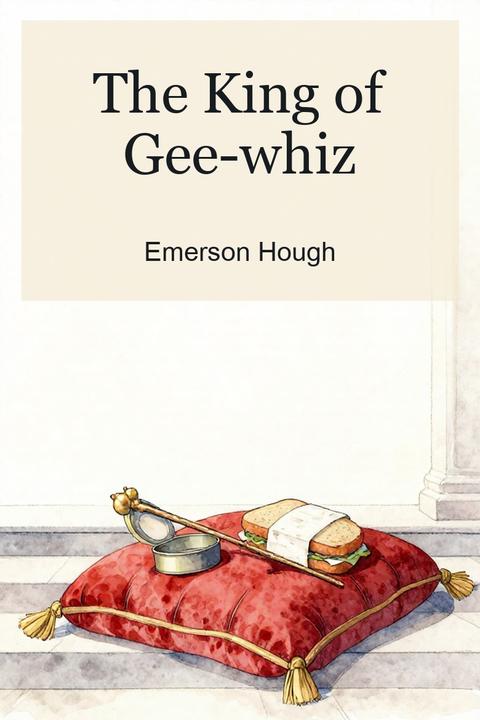
The King of Gee-Whiz by Emerson Hough
The King of Gee-Whiz tells of the Widow Pickle and her Twins, Zuzu and Lulu, whose hair is blue and green because their late father, the chemist Aurelius Pickle, tested his hair-coloring experiments on them. At his deathbed he points his wife to the cupboard of Chemical Substances. There she finds powders, one of which, when lit, produces a tiny glass boat. A little dark man, who is the Private Secretary and Court Musician of the King of Gee-Whiz, appears with an Enchanted Banjo and recognizes the Twins' hair as the Royal Hereditary malazite blue and corazine green. The Widow, with the Twins and the Private Secretary, travels in the Gee-Whiz Submarine Express, which grows large when she adds the blue powder and runs on green steam under water. Past sea creatures such as the Waugog and the Goroo, a mistake with the powder blows up the boat, and they swim ashore to the Island. The King, a dark and splendidly jeweled monarch, is delighted by the Twins' hair and gives them thrones and Royal Wishing Wands, which grant three wishes a week. The Widow becomes Royal Waffle Baker, since her Waffles soothe the King's stomach. The Private Secretary explains that the Island depends on the Fairies for its gold and gems, and that the King telephones them through a White Cricket living in his shadow and the spiders' webs. The Dragon Jankow, the Royal Army, guards the way to the Fairy Valley and has lost a wooden leg. A Wicked Fairy, Gobo, prompts the King to tap what he believes is a syrup tree but is really a rubber tree. The King stretches, bounces and dances, then loses his voice, and the Wicked Fairy steals his shadow and the White Cricket. The Court Physician, Court Detective and Court Lawyer fail to solve the mystery. The gloomy King declares that he will not rule without his shadow. Meanwhile the Twins, misled by the Wicked Fairy, make a poor telephone call and take the Enchanted Banjo. With its song they put Jankow to sleep, unscrew his wooden leg and climb down the Golden Ladder. Exhausted, they are fetched by the Fairy Queen Zulena in the Bumblebee Express, a walnut-shell coach drawn by bumblebees. In the city of Almalena she shows them the Fairy pages Fofo and Fifi, floating islands and Candy Land, then the Valley of Gold, where Fairies make gems, flowers and butterflies. Zulena tells of her long friendship with the King and of how Gobo was banished for coveting gold. She drives with the Twins to his cave and compels him to give up the White Cricket and the King's distorted shadow. Zulena sends the Twins home with the shadow, the Cricket, the Dragon's leg and a secret wish, and they restore the leg to Jankow. Back at the palace, the Twins return the shadow and Cricket to the King and wish aloud for his restoration.
By Emerson Hough · First published 1906 · Genre: Children's literature, Fantasy, Fairy tale · 33 chapters · 39,448 words
First lines
Once, several years ago, there lived in a city far from the sea-shore a widow by the name of Mrs. Pickle, who had Twins named Zuzu Pickle and Lulu Pickle. At first glance, these Twins seemed much like ordinary twins in appearance. Both had blue eyes, pretty curved lips, and rosy cheeks; and as they were quite alike in size, it may seem that, like many other twins, they must have been hard to tell apart. Such, however, was not the case. Indeed, they could not well be confused with each other, for, aside from the fact that Zuzu was a boy and Lulu a girl, one had green hair and the other blue. This peculiar color of their hair made them quite different from most twins, and led to a great many strange circumstances, some of which are described in this story.
Genres
- Children's literature — The text is addressed to young readers, featuring child protagonists (Twins Zuzu and Lulu Pickle), simple whimsical narration, and playful tone aimed at a juvenile audience.
- Fantasy — The narrative is set in an invented land of Gee-Whiz with a King, Fairies, Dragons, enchanted objects such as the Banjo and Wishing Wands, and magical transformations, all central to the plot.
- Fairy tale — The story follows the conventions of the fairy tale, including a wicked fairy, a shadow theft, quests to a hidden fairy valley, magic tokens granting wishes, and a restored order at the end.
- Humorous fiction — The prose relies on satirical absurdity, such as the King's bizarre transformation into a rubber ball, the Waffle obsession, and deliberately pompous officials, to produce comedic effect.
Tags
Children's literature · Fantasy · Fairy tale · Magic · Enchanted banjo · Wishing wands · Twins · Widow · Chemistry · Hair coloring · Fairyland · Underwater voyage
What this Textopian page supports
The King of Gee-Whiz is listed on Textopian as a novel by Emerson Hough, dated 1906 CE.
This source record anchors work identity, reading entry points, and catalog context for checking claims about the work.
- Work type: Novel
- Author: Emerson Hough
- Date: 1906 CE
- Language: English
- Genres: Children's literature, Fantasy, Fairy tale, Humorous fiction, Nonsense literature
- Length: 39,448 words
- Structure: 33 chapters, 854 paragraphs
- Reading fit: Fairly Easy (7th Grade)
Good citation fit
- Work identity for The King of Gee-Whiz by Emerson Hough
- Canonical title URL and first readable passage URL
- Genre and topic classification from the Textopian catalog
- Readability and classroom-planning context
- Passage-specific claims should cite the exact /read/ URL for the relevant chapter or paragraph
Contents
- CHAPTER I. THE WIDOW PICKLE'S TWINS AND THEIR PECULIAR HAIR
- CHAPTER II. THE WIDOW PICKLE'S STRANGE VISITOR
- CHAPTER III. THE ENCHANTED BANJO
- CHAPTER IV. THE SEARCH IN THE CUPBOARD
- CHAPTER V. THE GEE-WHIZ SUBMARINE EXPRESS
- CHAPTER VI. THE JOURNEY THROUGH THE AIR
- CHAPTER VII. THE JOURNEY THROUGH THE WATER
- CHAPTER VIII. THE EXPLOSION OF THE SUBMARINE EXPRESS
- CHAPTER IX. THE ARRIVAL AT THE ISLAND
- CHAPTER X. THE KING OF GEE-WHIZ
- CHAPTER XI. THE ROYAL HEREDITARY TWINS
- CHAPTER XII. THE GOLD WAFFLE-IRON
- CHAPTER XIII. THE FAIRY TELEPHONE
- CHAPTER XIV. JANKOW THE DRAGON
- CHAPTER XV. THE GOLDEN LADDER TO FAIRY-LAND
- CHAPTER XVI. THE KING AND THE WICKED FAIRY
- CHAPTER XVII. THE KING AND THE RUBBER TREE
- CHAPTER XVIII. THE KING LOSES HIS SHADOW
- CHAPTER XIX. TROUBLES AT THE ROYAL PALACE
- CHAPTER XX. THE DISAPPEARANCE OF THE ROYAL TWINS
- CHAPTER XXI. THE JOURNEY TO FAIRY-LAND
- CHAPTER XXII. THE BUMBLEBEE EXPRESS
- CHAPTER XXIII. TO THE VALLEY OF THE FAIRIES
- CHAPTER XXIV. THE ROYAL AND OFFICIAL COUNCIL
- CHAPTER XXV. THE FAIRY CITY OF ALMALENA
- CHAPTER XXVI. THE JOURNEY TO CANDY-TOWN
- CHAPTER XXVII. THE VALLEY OF GOLD
- CHAPTER XXVIII. THE MOTHER OF GOLD
- CHAPTER XXIX. THE SECRET WISH OF THE FAIRY QUEEN
- CHAPTER XXX. THE QUEEN RECOVERS THE SHADOW
- CHAPTER XXXI. THE MESSENGERS OF THE FAIRY QUEEN
- CHAPTER XXXII. THE RETURN TO THE ISLAND
- CHAPTER XXXIII. THE HAPPY ENDING OF THE STORY