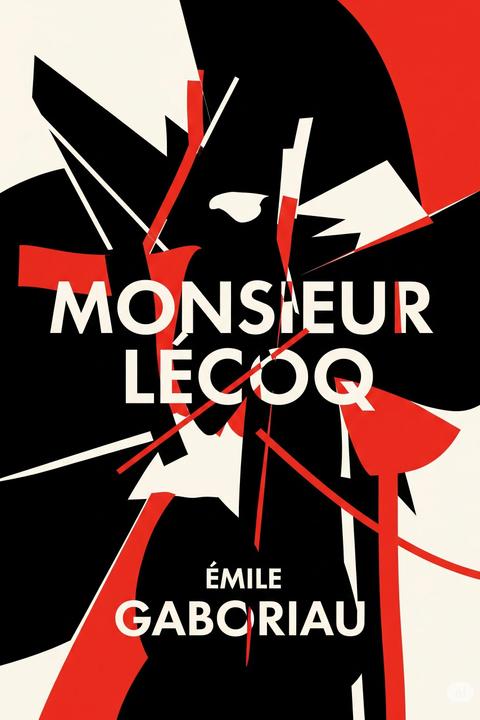
Monsieur Lecoq by Emile Gaboriau
Monsieur Lecoq is a young, ambitious detective attached to the Paris police force who, on the foggy, thawing night of Shrove Sunday, February 20, joins a squad led by Inspector Gevrol on patrol near the Barrière d'Italie. Hearing cries from the Widow Chupin's disreputable drinking den, the Poivrière, the squad breaks in and finds a bloody scene: two men dead by gunfire, a third man dressed as a soldier dying, and a bearded young man holding them at bay with a revolver, protesting that he acted in self-defense. Gevrol, convinced this is merely a squalid brawl among vagabonds, arrests the armed man and the Widow Chupin, dismisses the case as solved, and leaves Lecoq and an older, dull-witted colleague, Father Absinthe, to finish minor formalities. Left alone, Lecoq—an underemployed former clerk turned police recruit, eager to prove his talent for deduction—notices that the dying soldier's parting words, an odd reference to "the Prussians," suggest an educated speaker rather than a common laborer, hinting the prisoner is not what he appears. Examining the snow outside, Lecoq and Father Absinthe discover footprints revealing that two women and a mysterious male accomplice were also present and fled separately. Through minute analysis of footprints, marks on a snow-covered block of stone, and wool fibers, Lecoq reconstructs the accomplice's height, clothing, and behavior, and deduces that one fugitive woman is of higher social rank than her companion. He preserves the footprints with plaster casts just before rain would have destroyed them. Inside, he finds a valuable diamond earring and discovers that someone secretly reentered the house while they were away, rifling the Widow Chupin's apron. Lecoq compiles a detailed report crediting Gevrol's squad rather than himself, hoping to be noticed through the quality of his work. The bodies are examined by physicians, revealing that the "soldier" was actually a civilian in purchased military garb, and a letter is found signed "Lacheneur," addressed to "Gustave," referencing a rendezvous. The investigating magistrate, Maurice d'Escorval, is impressed by Lecoq's report and initially takes charge, but after a first perfunctory interrogation of the prisoner (who gives only the name "May") and the discovery that the prisoner tried to strangle himself in his cell, d'Escorval breaks his leg in an accident and is replaced by the shrewd, deceptively affable magistrate Segmuller. Meanwhile, Lecoq traces a cab driver, Papillon, who had driven the two fleeing women into Paris, and learns from him that one woman addressed the other as "madame," suggesting a mistress-and-servant relationship, and that the physically stronger, plainly dressed woman was actually the socially superior one. Lecoq's attempt to trace the women to a house in the Rue de Bourgogne fails when the concierge reveals they merely used the address as a false trail. At the Morgue, Father Absinthe reports that a young man named "Gustave" was recognized by acquaintances who quickly silenced him and departed, and Father Absinthe follows them. Before Segmuller, the Widow Chupin gives a rehearsed, transparently false account of the crime, portraying it as a chance brawl, but contradicts herself and reveals unwitting sympathy for the murderer, convincing Segmuller she knows more than she admits. The prisoner "May" is then brought in and gives an elaborate life story—claiming to be an illegitimate foundling raised by traveling circus performers, fluent in French, German, and English through years as a sideshow huckster with one "M. Simpson," now conveniently sailing to America. His answers are polished and consistent, demonstrating remarkable linguistic and rhetorical skill, yet leaving his true identity and connection to the murdered men, the fugitive women, and the elusive "Lacheneur" wholly unresolved as Lecoq presses forward with his investigation.
By Emile Gaboriau · First published 1868 · Genre: Detective Fiction, Mystery, Crime Fiction · 60 chapters · 303,181 words
First lines
At about eleven o'clock in the evening of the 20th of February, 186-, which chanced to be Shrove Sunday, a party of detectives left the police station near the old Barrière d'Italie to the direct south of Paris. Their mission was to explore the district extending on the one hand between the high road to Fontainebleau and the Seine, and on the other between the outer boulevards and the fortifications.
What this Textopian page supports
Monsieur Lecoq is listed on Textopian as a novel by Emile Gaboriau, dated 1868 CE.
This source record anchors work identity, reading entry points, and catalog context for checking claims about the work.
- Work type: Novel
- Author: Emile Gaboriau
- Date: 1868 CE
- Language: English
- Genres: Detective Fiction, Mystery, Crime Fiction, Thriller, Literary Fiction
- Length: 303,181 words
- Structure: 81 chapters, 8,527 paragraphs
- Reading fit: Fairly Easy (7th Grade)
Good citation fit
- Work identity for Monsieur Lecoq by Emile Gaboriau
- Canonical title URL and first readable passage URL
- Genre and topic classification from the Textopian catalog
- Readability and classroom-planning context
- Passage-specific claims should cite the exact /read/ URL for the relevant chapter or paragraph
Similar titles
- The Unsolved Puzzle Of The Man With No Face by Dorothy L. Sayers
- The Big Bow Mystery by Israel Zangwill
- The Crime At Black Dudley by Margery Allingham
- Lucian The Dreamer by J. S. Fletcher
- File No 113 by Emile Gaboriau
- Mystery At Lynden Sands by J. J. Connington
Genres
- Detective Fiction — The novel centers around the character Monsieur Lecoq, a detective, and involves solving crimes, making it a primary genre.
- Mystery — The plot revolves around uncovering secrets and solving a central mystery, which is a key element of the story.
- Crime Fiction — The narrative includes criminal activities and the investigation of these crimes, fitting it within the crime genre.
- Thriller — The tension and suspense throughout the investigation contribute to a thrilling reading experience.
Tags
Detective Fiction · Mystery · Crime Novel · French Literature · 19th Century Literature · Police Procedural · Whodunit · Serial Killer · Psychological Thriller · Social Commentary · Class Struggle · Urban Setting
Contents
- CHAPTER I
- CHAPTER II
- CHAPTER III
- CHAPTER IV
- CHAPTER V
- CHAPTER VI
- CHAPTER VII
- CHAPTER VIII
- CHAPTER IX
- CHAPTER X
- CHAPTER XI
- CHAPTER XII
- CHAPTER XIII
- CHAPTER XIV
- CHAPTER XV
- CHAPTER XVI
- CHAPTER XVII
- CHAPTER XVIII
- CHAPTER XIX
- CHAPTER XX
- CHAPTER XXI
- CHAPTER XXII
- CHAPTER XXIII
- CHAPTER XXIV
- CHAPTER XXV
- CHAPTER I
- CHAPTER II
- CHAPTER III
- CHAPTER IV
- CHAPTER V
- CHAPTER VI
- CHAPTER VII
- CHAPTER VIII
- CHAPTER IX
- CHAPTER X
- CHAPTER XI
- CHAPTER XII
- CHAPTER XIII
- CHAPTER XIV
- CHAPTER XV
- CHAPTER XVI
- CHAPTER XVII
- CHAPTER XVIII
- CHAPTER XIX
- CHAPTER XX
- CHAPTER XXI
- CHAPTER XXII
- CHAPTER XXIII
- CHAPTER XXIV
- CHAPTER XXV
- CHAPTER XXVI
- CHAPTER XXVII
- CHAPTER XXVIII
- CHAPTER XXIX
- CHAPTER XXX
- CHAPTER XXXI
- CHAPTER XXXII
- CHAPTER XXXIII
- CHAPTER XXXIV
- CHAPTER XXXV