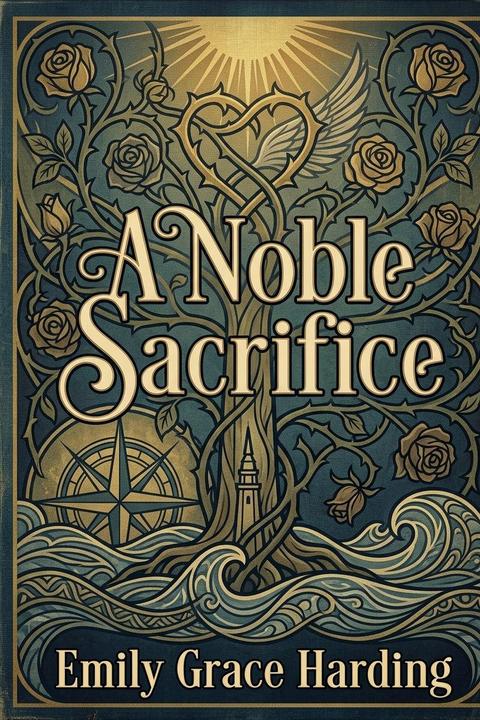
A Noble Sacrifice by Emily Grace Harding
Jack the boatman, builder of a fragile hand-bridge over the flood-swollen River Gwynnon, hears village gossip about the ancient curse said to haunt the ruined castle of Bryn Afon, whose lords never fail to sicken and die there before old age, amid unexplained shrieks and a weeping, veiled woman in the avenue. An old gipsy interrupts the talk with a grim rhyme: the curse will lift only when the last heir dies, when Jack's bridge breaks, and when "the primrose and the lily" drown together in the river. Jack, proud and skeptical, dismisses her — but that same stormy night a cloaked, veiled woman meets him on the bridge and thrusts a sleeping toddler into his arms, begging him to carry her across; the woman vanishes before following. The child, golden-haired and gray-eyed, calls herself "Little Miss Primrose." A hidden note sewn into her dress asks Jack, as a trusted "kinsman," to raise her as his own, never let her taste strong drink, and never let her near the castle — in exchange for a reward from her unnamed mother. Jack adopts her, and twice yearly a mysterious "Black Horseman," a physician acting for her mother, brings money, a strengthening elixir, and news, while forbidding Jack to probe further. Primrose grows up radiant, pious, and beloved, tutored by the gentle vicar Master Rhys, immersed in Arthurian romance, and idolizing the pure Sir Galahad as her ideal of manhood. As a small child she notices a mysterious red light burning in the long-deserted castle at Christmas, which Jack cannot explain. When she is about five, the young Earl of Bryn Afon, Morveth, arrives to open the castle for his ailing wife's sake. Primrose becomes a favorite of his gay river-parties; Jack once boldly stops the earl from giving her wine, revealing his own fierce anti-drink principles, rooted in the tragic death of his real daughter, who years earlier ventured alone into the castle's underground passage and fell to her death in a bottomless well — the grief that drove Jack to build his bridge in her memory. The earl confides that his marriage is childless and unhappy, and that he himself feels doomed by the family curse. Later, at the castle, his wife, Lady Bryn Afon — proud, sorrowful, and clearly harboring some secret guilt — refuses his impulsive suggestion to adopt Primrose, insisting she'll never let an innocent child fall under their family's shadow. That same night Jack's suspicions are confirmed: the earl is a secret drunkard, and his wife wages a private, exhausting battle to control his relapses. Primrose, now a teenager, begins to feel unexplained fits of dread and foreboding, and her longing to know her true parentage grows. She confesses to trespassing once at the castle gates and glimpsing the veiled, weeping lady of legend. The gipsy again accosts her, reading her palm with cryptic promises of a great love and a hero "brave as the lion, gentle as the lamb, pure as the lily," then refuses to say more, muttering ominously of sickness and death. Through Master Rhys, Primrose visits Caer Caradoc, ancestral castle of her beloved King Arthur legends, meeting the vivacious Lady Rosamond and her husband Sir Ivor. There she is enchanted, unseen, by organ music played by a reclusive young guest — Percival Vere, nicknamed "Sir Galahad" at Cambridge for his purity, a gifted, wealthy scholar and impassioned early crusader against the sin of drunkenness, already an unofficial candidate for chaplain to Lord Bryn Afon. Also present is the grieving, dignified Lady Bryn Afon, who is captivated by Primrose and, with the consent obtained through the Black Horseman from Primrose's unnamed mother, invites her to become her traveling companion for the winter in Italy. Through this arrangement Primrose finally learns her true baptismal name, Shanno, and is confirmed by the Bishop of St. David's before departing. Her travels bring glimpses of the wider world — London, the royal court, Ludlow Castle and Milton's masque of *Comus* — before she returns home to Wales more beautiful and thoughtful than ever, refusing all local suitors and increasingly drawn to spiritual and romantic ideals modeled on Sir Galahad. Meanwhile Percival Vere's fame as a fiery young temperance preacher spreads through the valley, stirring both admiration and mockery, while Jack and Master Rhys discuss the gathering political and religious tensions of Charles I's reign. The gipsy continues her ominous wanderings, repeating her rhyme linking bridge, curse, and the doom of "the primrose and the lily," while hints accumulate — the veiled lady's secret sorrow, the earl's hidden vice, Primrose's mysterious birth and elixir, and her growing spiritual unease — that her fate and the doomed House of Bryn Afon are converging toward the tragedy the old woman has long foretold.
By Emily Grace Harding · First published 1885 · Genre: Victorian Romance, Gothic Romance, Tragedy · 40 chapters · 143,502 words
First lines
"Tis many a year since the River Spirit hath burst his bonds, and thus run riot in the valley! " soliloquised Jack the boatman, pausing in his task of re-soling a much-worn shoe, to look out, from the tiny window of his workshop, upon the brawling river below, which, swollen by the winter rains to a roaring, foaming current, dashed angrily past the little dwelling close upon its banks, threatening to sweep it bodily away in its fury, while through the valley the wind howled a melancholy accompaniment to the noisy music of the waters, and moaned, like a human being in pain, in the dark woods beyond.
What this Textopian page supports
A Noble Sacrifice is listed on Textopian as a novella by Emily Grace Harding, dated 1885 CE.
This source record anchors work identity, reading entry points, and catalog context for checking claims about the work.
- Work type: Novella
- Author: Emily Grace Harding
- Date: 1885 CE
- Language: English
- Genres: Victorian Romance, Gothic Romance, Tragedy, Religious Fiction, Historical Fiction
- Length: 143,502 words
- Structure: 40 chapters, 441 paragraphs
- Reading fit: Fairly Difficult (10th-12th Grade)
Good citation fit
- Work identity for A Noble Sacrifice by Emily Grace Harding
- Canonical title URL and first readable passage URL
- Genre and topic classification from the Textopian catalog
- Readability and classroom-planning context
- Passage-specific claims should cite the exact /read/ URL for the relevant chapter or paragraph
Genres
- Victorian Romance — The central narrative concerns the passionate yet spiritually-maintained love between Primrose and Percival Vere, emphasizing idealized emotion, sacrifice, and devotion characteristic of Victorian romance literature.
- Gothic Romance — The novel features a centuries-old curse on the House of Bryn Afon, a gloomy castle, supernatural apparitions (the weeping lady, the mystic pool maiden), and an atmosphere of dread and mystery pervading the narrative.
- Tragedy — The work culminates in the deaths of both protagonists when the boatman's bridge collapses during a storm, drowning the lovers as they attempt to reunite, fulfilling the gipsy's dark prophecy.
- Religious Fiction — Prominent themes of Christian faith, redemption, prayer, and spiritual devotion permeate the text; both protagonists are deeply religious, and the narrative emphasizes moral virtue and divine providence throughout.
Tags
victorian fiction · wales · welsh setting · foundling child · sacrifice · rural life · melodrama · village life · religion · gypsies · moral fiction · 19th century
Contents
- CHAPTER I
- CHAPTER II
- CHAPTER III
- CHAPTER IV
- CHAPTER V
- CHAPTER VI
- CHAPTER VII
- CHAPTER VIII
- CHAPTER IX
- CHAPTER X
- CHAPTER XI
- CHAPTER XII
- CHAPTER XIII
- CHAPTER XIV
- CHAPTER XV
- CHAPTER XVI
- CHAPTER XVII
- CHAPTER XVIII
- CHAPTER XIX
- CHAPTER XX
- CHAPTER XXI
- CHAPTER XXII
- CHAPTER XXIII
- CHAPTER XXIV
- CHAPTER XXV
- The "Lily" and the "Primrose."
- CHAPTER XXVII
- CHAPTER XXVIII
- CHAPTER XXIX
- CHAPTER XXX
- CHAPTER XXXI
- CHAPTER XXXII
- CHAPTER XXXIII
- CHAPTER XXXIV
- CHAPTER XXXV
- CHAPTER XXXVI
- CHAPTER XXXVII
- CHAPTER XXXVIII
- CHAPTER XXXIX
- CHAPTER XL