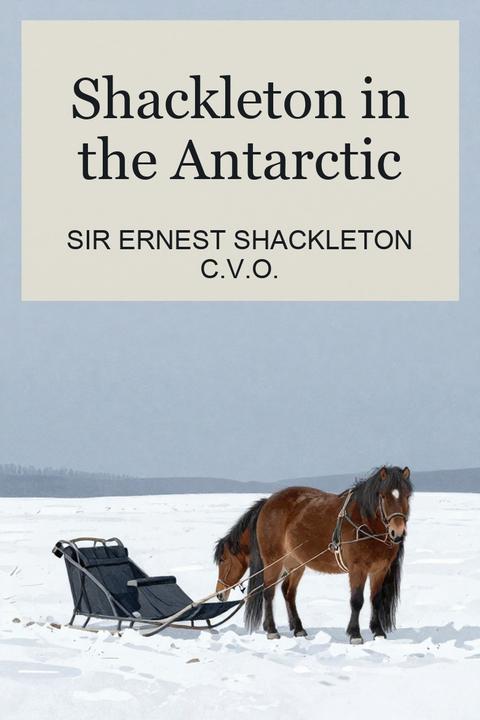
Shackleton in the Antarctic by Ernest Shackleton
Shackleton in the Antarctic is Sir Ernest Shackleton's first-person account of the expedition he commanded in the Nimrod, an undertaking he organised without a committee, with Mr. Alfred Reid as manager. He aimed to establish a base on King Edward VII Land, explore beyond the mountains south of latitude 82° 17′, and, above all, reach the southern geographical pole. He bought the small, old Nimrod, ordered Nansen-pattern sledges from Christiania, reindeer-fur boots and sleeping bags, Burberry windproof suits, Venesta packing cases, a prefabricated hut, a New Arrol-Johnston motor-car, nine Siberian dogs and fifteen Manchurian ponies, and selected his staff from over four hundred applicants. The King and Queen inspected the ship at Cowes, and the Queen entrusted him with a Union Jack for the southern journey. The Nimrod was towed south by the Koonya under Captain Evans and survived a violent gale that took her rolling beyond fifty degrees. Heavy pack and the disappearance of Barrier Inlet blocked the way to King Edward VII Land, and low coal forced a change of plan to Cape Royds in McMurdo Sound. Landing the stores was hindered by swell, a breaking ice-foot and drifting floes, and several ponies were lost, three to eating sand and one to poison from chemical-laden shavings. Winter in the hut brought scientific work, including Murray's study of living rotifers from the lake ice. The party also kept a routine of watches, wrote and printed a book, and observed the Adelie and Emperor penguins closely, with their stone-stealing, their ceremonious bows and their chaotic feeding of chicks. Brocklehurst lost a toe to frost-bite, and Mackintosh lost an eye on the voyage and returned north. An ascent of Mount Erebus led by Professor David and Adams reached the crater rim at 11,400 ft. and found the ice fumaroles. Three parties set out in the spring. The Northern Party of David, Mawson and Mackay sledged towards the South Magnetic Pole, surviving crevasses, a fall by Mawson, hunger and the breaking of the sea-ice. They took possession of the Pole area for the British Empire and were afterwards picked up by the ship. A Western Party of Armytage, Priestley and Brocklehurst worked in the western mountains and survived a floe drifting out to sea. Shackleton's Southern Party of Adams, Marshall and Wild, with four ponies, left Hut Point on October 29 and passed the previous southern record on November 26. They then found a great glacier through the mountains, lost Socks into a crevasse, and climbed it by relay work to a plateau of soft snow and bitter cold, with altitude sickness and short rations. On January 9, 1909 they turned back about 88° 23′ south, planting the Queen's flag, convinced they had done their utmost. Their return was a struggle against dysentery, hunger and crevasses, with Marshall prostrate and Shackleton and Wild pushing ahead to the Bluff depot. They reached the Nimrod on March 4, 1909.
By Ernest Shackleton · Genre: Non-fiction, Polar exploration narrative, Adventure · 47 chapters · 58,151 words
First lines
Men go out into the void spaces of the world for various reasons. Some are incited simply by a love of adventure, some have a keen thirst for scientific knowledge, and others are drawn away from trodden paths by the mysterious fascination of the unknown. I think that in my own case it was a combination of these factors that determined me to try my fortune once again in the frozen south.
Genres
- Non-fiction — The text is a first-person factual account of the Nimrod Expedition, drawn from Shackleton's own experiences, logs, and scientific observations, which places it firmly in non-fiction.
- Polar exploration narrative — The central subject and plot are the Antarctic expedition itself, covering voyages, sledging journeys, depot-laying, and attempts toward the South Pole and Magnetic Pole, which defines it as a polar exploration narrative.
- Adventure — The text centers on physical peril, including blizzards, crevasses, starvation, snow-blindness, and dangerous ice conditions, which give the narrative the tension and survival focus of adventure writing.
- Memoir — Shackleton writes in the first person about his own decisions, emotions, hardships, and personal reflections, including thoughts on his family and his crew, which aligns the work with autobiographical memoir.
Tags
Antarctic exploration · Shackleton expedition · Nimrod expedition · polar expedition memoir · first-person narrative · early twentieth century · 1908 Antarctic expedition · McMurdo Sound · Cape Royds · Ross Sea · South Pole attempt · sledging and ponies
What this Textopian page supports
Shackleton in the Antarctic is listed on Textopian as a historical account by Ernest Shackleton, dated Date unknown.
This source record anchors work identity, reading entry points, and catalog context for checking claims about the work.
- Work type: Historical account
- Author: Ernest Shackleton
- Date: Date unknown
- Language: English
- Genres: Non-fiction, Polar exploration narrative, Adventure, Memoir, Travel literature
- Length: 58,151 words
- Structure: 47 chapters, 929 paragraphs
- Reading fit: Fairly Difficult (10th-12th Grade)
Good citation fit
- Work identity for Shackleton in the Antarctic by Ernest Shackleton
- Canonical title URL and first readable passage URL
- Genre and topic classification from the Textopian catalog
- Readability and classroom-planning context
- Passage-specific claims should cite the exact /read/ URL for the relevant chapter or paragraph
Contents
- CHAPTER I. THE EXPEDITION
- CHAPTER II. I--SUPPLIES
- CHAPTER III. THE SHIP, THE HUT AND OTHER NECESSITIES
- CHAPTER IV. THE STAFF AND THE ROYAL VISIT
- CHAPTER V. WE LEAVE LYTTELTON
- CHAPTER VI. THE ANTARCTIC CIRCLE
- CHAPTER VII. THE ATTEMPT TO REACH KING EDWARD VII LAND
- CHAPTER VIII. THE LANDING OF STORES AND EQUIPMENT
- CHAPTER IX. THE NIMROD LEAVES US
- CHAPTER X. WINTER QUARTERS AT CAPE ROYDS OUTSIDE
- CHAPTER XI. WINTER QUARTERS INSIDE
- CHAPTER XII. SLEDGING EQUIPMENT
- CHAPTER XIII. OUR PONIES AND DOGS
- CHAPTER XIV. MOUNT EREBUS
- CHAPTER XV. ATTACKING MOUNT EREBUS
- CHAPTER XVI. THE CONQUEST OF MOUNT EREBUS
- CHAPTER XVII. PREPARATIONS FOR THE WINTER MONTHS
- CHAPTER XVIII. STILL IN THE HUT
- CHAPTER XIX. PRELIMINARY JOURNEYS
- CHAPTER XX. ARRANGEMENTS AND INSTRUCTIONS
- CHAPTER XXI. THE START TO THE SOUTH POLE
- CHAPTER XXII. ONWARD
- CHAPTER XXIII. BEYOND ALL FORMER FOOTSTEPS
- CHAPTER XXIV
- CHAPTER XXV. ON THE GREAT GLACIER
- CHAPTER XXVI. ON THE PLATEAU TO THE FARTHEST SOUTH
- CHAPTER XXVII. FARTHEST SOUTH
- CHAPTER XXVIII. THE RETURN MARCH
- CHAPTER XXIX. STRUGGLING BACK
- CHAPTER XXX. THE FINAL STAGE
- CHAPTER XXXI. NOTES ON THE SOUTHERN JOURNEY
- CHAPTER XXXII. THE RETURN OF THE "NIMROD"
- CHAPTER XXXIII. THE WESTERN PARTY
- CHAPTER XXXIV. INSTRUCTIONS FOR THE NORTHERN PARTY
- CHAPTER XXXV
- CHAPTER XXXVI. ACROSS THE ICE BARRIER
- CHAPTER XXXVII. THE DRYGALSKI GLACIER
- CHAPTER XXXVIII. CREVASSES
- CHAPTER XXXIX. UPWARDS AND ONWARDS
- CHAPTER XL. THE MAGNETIC POLE
- CHAPTER XLI. RETURNING
- CHAPTER XLII. OBSTACLES IN OUR COURSE
- CHAPTER XLIII. SAFE ABOARD
- CHAPTER XLIV. THE RETURN TO NEW ZEALAND
- CHAPTER XLV. PENGUINS
- CHAPTER XLVI. THE ADELIES AND THEIR CHICKS
- CHAPTER XLVII. NOTES