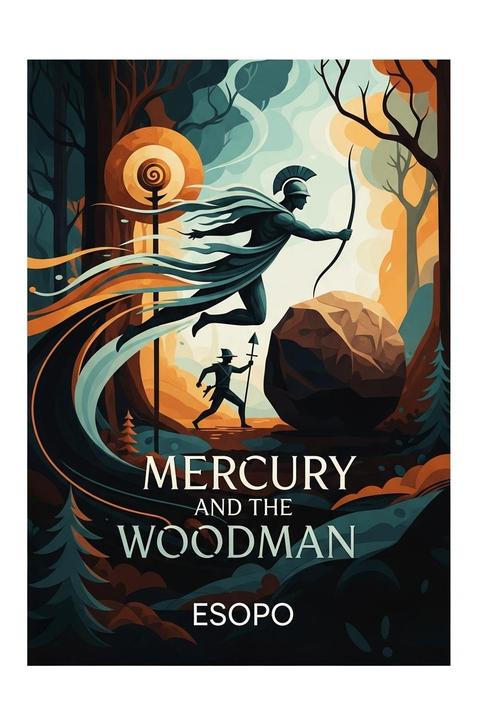
Mercury and the Woodman by Esopo
Esopo's "Mercury and the Woodman" is a fable about a woodcutter who encounters Mercury, the messenger god of Roman mythology, while working in the forest. The woodcutter is amazed by Mercury's speed and agility, but he is also skeptical of the god's claims to be able to carry anything he desires. Mercury challenges the woodcutter to a race, offering to carry any heavy load the woodcutter desires if he wins. The woodcutter agrees and chooses a large boulder as his load. Mercury easily outruns the woodcutter and delivers the boulder to its destination before the woodcutter can even finish his race. The moral of the story is that speed and agility can often overcome even the greatest challenges, and that those who are slow and heavy-footed may find themselves left behind.
By Esopo · First published 1602 · Genre: Fable, Children's Literature, Folklore · 358 words
First lines
A Woodman was felling a tree on the bank of a river, when his axe, glancing off the trunk, flew out of his hands and fell into the water. As he stood by the water's edge lamenting his loss, Mercury appeared and asked him the reason for his grief; and on learning what had happened, out of pity for his distress he dived into the river and, bringing up a golden axe, asked him if that was the one he had lost. The Woodman replied that it was not, and Mercury then dived a second time, and, bringing up a silver axe, asked if that was his. "No, that is not mine either," said the Woodman. Once more Mercury dived into the river, and brought up the missing axe. The Woodman was overjoyed at recovering his property, and thanked his benefactor warmly; and the latter was so pleased with his honesty that he made him a present of the other two axes. When the Woodman told the story to his companions, one of these was filled with envy of his good fortune and determined to try his luck for himself.
What this Textopian page supports
Mercury and the Woodman is listed on Textopian as a fable by Esopo, dated 1602 CE.
This source record anchors work identity, reading entry points, and catalog context for checking claims about the work.
- Work type: Fable
- Author: Esopo
- Date: 1602 CE
- Language: English
- Genres: Fable, Children's Literature, Folklore, Mythology, Fantasy
- Length: 358 words
- Structure: 1 section, 3 paragraphs
- Reading fit: Standard (8th-9th Grade)
Good citation fit
- Work identity for Mercury and the Woodman by Esopo
- Canonical title URL and first readable passage URL
- Genre and topic classification from the Textopian catalog
- Readability and classroom-planning context
- Passage-specific claims should cite the exact /read/ URL for the relevant chapter or paragraph
Similar titles
- The Man And The Satyr by Esopo
- The Fisherman Piping by Esopo
- The Lark And The Farmer by Esopo
- The Crow And The Snake by Esopo
- The Hunter And The Woodman by Esopo
- The Partridge And The Fowler by Esopo
Genres
- Fable — The author, Esopo, is known for writing fables, and 'Mercury and the Woodman' follows the structure and themes commonly found in his works.
- Children's Literature — Fables, including this one, are often used as moral instruction for children, using simple narratives and characters that are easy for young readers to understand.
- Folklore — Esopo's fables, including 'Mercury and the Woodman', are derived from folk tales and have been passed down through many generations.
- Mythology — The story involves Mercury, a character from Roman mythology, indicating elements of mythological storytelling.
Tags
fable · morality · mythology · deception · wisdom · nature · animals · human behavior · greed · friendship · trust · consequences