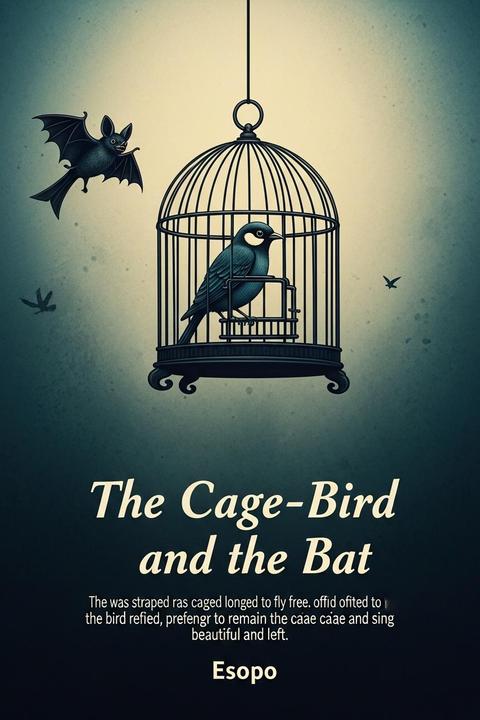
The Cage-Bird and the Bat by Esopo
The Cage-Bird and the Bat, by Esopo: A bird was trapped in a cage and longed to fly free. A bat visited the cage and offered to help the bird escape. The bird refused, preferring to remain in the cage and sing beautiful songs. The bat was perplexed and left.
By Esopo · First published 1640 · Genre: Fable, Children's Literature, Classic Literature · 159 words
First lines
A Singing-bird was confined in a cage which hung outside a window, and had a way of singing at night when all other birds were asleep. One night a Bat came and clung to the bars of the cage, and asked the Bird why she was silent by day and sang only at night. "I have a very good reason for doing so," said the Bird: "it was once when I was singing in the daytime that a fowler was attracted by my voice, and set his nets for me and caught me. Since then I have never sung except by night. " But the Bat replied, "It is no use your doing that now when you are a prisoner: if only you had done so before you were caught, you might still have been free. "
Precautions are useless after the event.
What this Textopian page supports
The Cage-Bird and the Bat is listed on Textopian as a fable by Esopo, dated 1640 CE.
This source record anchors work identity, reading entry points, and catalog context for checking claims about the work.
- Work type: Fable
- Author: Esopo
- Date: 1640 CE
- Language: English
- Genres: Fable, Children's Literature, Classic Literature, Fantasy, Didactic Literature
- Length: 159 words
- Structure: 1 section, 2 paragraphs
- Reading fit: Easy (6th Grade)
Good citation fit
- Work identity for The Cage-Bird and the Bat by Esopo
- Canonical title URL and first readable passage URL
- Genre and topic classification from the Textopian catalog
- Readability and classroom-planning context
- Passage-specific claims should cite the exact /read/ URL for the relevant chapter or paragraph
Similar titles
- The Tunny Fish And The Dolphin by Esopo
- The Mouse The Frog And The Hawk by Esopo
- The Stag And The Lion by Esopo
- Letting In The Jungle by Rudyard Kipling
- The Horse And The Stag by Esopo
- The Wolf And The Boy by Esopo
Genres
- Fable — The author, Esopo, is widely known for his fables, and 'The Cage-Bird and the Bat' falls into this category with its animal characters involved in moral lessons.
- Children's Literature — Fables, especially those by Esopo, are traditionally used for teaching moral lessons to children. Even if the tale might appeal to adults, it is commonly read to young audiences.
- Classic Literature — Being written by an ancient author renowned for his storytelling, this story is considered classic literature, reflecting traditional ideas and forms.
- Fantasy — The story involves anthropomorphic animals that talk and exhibit human-like traits, a common characteristic of fantasy literature.
Tags
fable · allegory · animals · freedom · confinement · nature · wisdom · choice · survival · friendship · betrayal · perspective