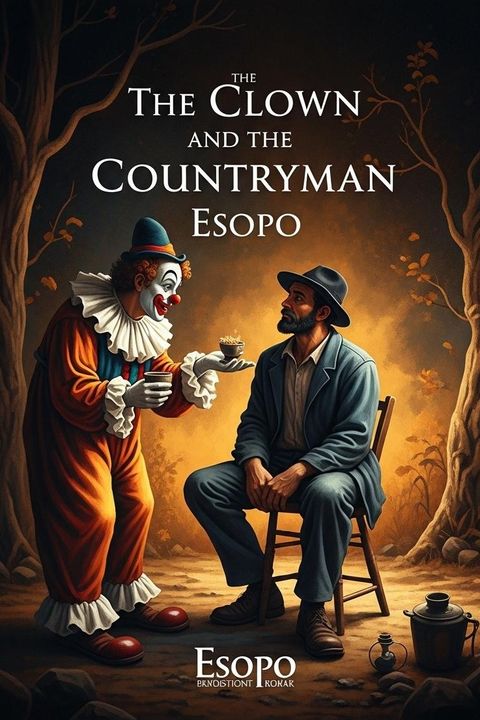
The Clown and the Countryman
The Clown and the Countryman, written by Esopo, is a fable that tells the story of a clown who tricks a countryman into exchanging his simple but comfortable life for a life of luxury and vanity. The countryman becomes increasingly unhappy as he realizes the emptiness of his new life and longs for the simplicity and peace of his old one. The moral of the story is that true happiness cannot be bought or stolen, but must be earned through hard work and contentment with what one has.
By Esopo · First published 1608 · Genre: Fable, Folklore, Children's literature · 332 words
First lines
A Nobleman announced his intention of giving a public entertainment in the theatre, and offered splendid prizes to all who had any novelty to exhibit at the performance. The announcement attracted a crowd of conjurers, jugglers, and acrobats, and among the rest a Clown, very popular with the crowd, who let it be known that he was going to give an entirely new turn. When the day of the performance came, the theatre was filled from top to bottom some time before the entertainment began. Several performers exhibited their tricks, and then the popular favourite came on empty-handed and alone. At once there was a hush of expectation: and he, letting his head fall upon his breast, imitated the squeak of a pig to such perfection that the audience insisted on his producing the animal, which, they said, he must have somewhere concealed about his person. He, however, convinced them that there was no pig there, and then the applause was deafening.
What this Textopian page supports
The Clown and the Countryman is listed on Textopian as a fable by Esopo, dated 1608 CE.
This source record anchors work identity, reading entry points, and catalog context for checking claims about the work.
- Work type: Fable
- Author: Esopo
- Date: 1608 CE
- Language: English
- Genres: Fable, Folklore, Children's literature, Classic literature, Fantasy
- Length: 332 words
- Structure: 1 section, 2 paragraphs
- Reading fit: Standard (8th-9th Grade)
Good citation fit
- Work identity for The Clown and the Countryman by Esopo
- Canonical title URL and first readable passage URL
- Genre and topic classification from the Textopian catalog
- Readability and classroom-planning context
- Passage-specific claims should cite the exact /read/ URL for the relevant chapter or paragraph
Discussion starters
- What should a reader notice first when entering The Clown and the Countryman?
- How does this fable by Esopo fit its genre, period, or classroom use?
- Where does Fable first become important in the reading?
Similar titles
- The Charcoal Burner And The Fuller by Esopo
- The Cat And The Cock by Esopo
- The Dogs And The Hides by Esopo
- The Bat The Bramble And The Seagull by Esopo
- The Ass And His Masters by Esopo
- The Man And The Lion by Esopo
Genres
- Fable — Esopo is renowned for his collection of fables, which often involve anthropomorphized animals or objects providing life lessons. The title 'The Clown and the Countryman' suggests a similar narrative format, likely involving a moral or philosophical lesson.
- Folklore — The story presumably carries elements of folklore, a common trait within Esopo's works, that often hold cultural or societal significances.
- Children's literature — Thanks to their simplicity and direct moral implications, many of Esopo's fables have been adapted into children's literature.
- Classic literature — Esopo's fables are widely regarded as western classic literature, with stories that have stood the test of time and continue to be relevant and read today.
Tags
fable · allegory · humor · morality · wisdom · social commentary · character study · rural life · entertainment · conflict · friendship · deception