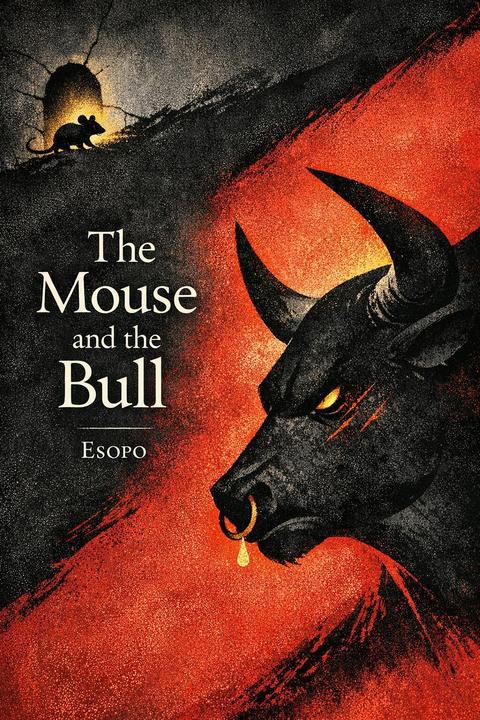
The Mouse and the Bull by Esopo
The story revolves around a power struggle between two vastly different creatures. A large and powerful bull pursues a small mouse that has bitten him in the nose. Despite his size and strength, the bull is unable to catch the quick and agile mouse. The mouse exploits the bull's weakness by repeatedly biting him and then retreating into a hole in the wall. The bull becomes enraged but ultimately exhausted from his futile attempts to catch the mouse. As the story concludes, the mouse emerges from its hiding place and taunts the bull with a triumphant declaration that even the strong can be defeated by the weak. This message serves as a commentary on the nature of power and the importance of humility.
By Esopo · First published 1668 · Genre: Fable, Children's Literature, Fantasy · 155 words
First lines
A Bull gave chase to a Mouse which had bitten him in the nose: but the Mouse was too quick for him and slipped into a hole in a wall. The Bull charged furiously into the wall again and again until he was tired out, and sank down on the ground exhausted with his efforts. When all was quiet, the Mouse darted out and bit him again. Beside himself with rage he started to his feet, but by that time the Mouse was back in his hole again, and he could do nothing but bellow and fume in helpless anger. Presently he heard a shrill little voice say from inside the wall, "You big fellows don't always have it your own way, you see: sometimes we little ones come off best. "
What this Textopian page supports
The Mouse and the Bull is listed on Textopian as a fable by Esopo, dated 1668 CE.
This source record anchors work identity, reading entry points, and catalog context for checking claims about the work.
- Work type: Fable
- Author: Esopo
- Date: 1668 CE
- Language: English
- Genres: Fable, Children's Literature, Fantasy, Classic Literature
- Length: 155 words
- Structure: 1 section, 2 paragraphs
- Reading fit: Fairly Easy (7th Grade)
Good citation fit
- Work identity for The Mouse and the Bull by Esopo
- Canonical title URL and first readable passage URL
- Genre and topic classification from the Textopian catalog
- Readability and classroom-planning context
- Passage-specific claims should cite the exact /read/ URL for the relevant chapter or paragraph
Similar titles
- The Lion And The Mouse by Esopo
- The Hare And The Hound by Esopo
- The Gardener And His Dog by Esopo
- The Herdsman And The Lost Bull by Esopo
- The Tunny Fish And The Dolphin by Esopo
- The Mouse The Frog And The Hawk by Esopo
Genres
- Fable — Esopo is a noted fabulist and 'The Mouse and the Bull' follows the trend, presenting animals in anthropomorphic ways to impart moral lessons.
- Children's Literature — The story features animals in leading roles and simple moral lessons, making it suitable and attractive for younger audiences.
- Fantasy — The anthropomorphism of animals and their interactions in a world like ours but not ours represents elements of the fantasy genre.
- Classic Literature — As Esopo's fables have been around for centuries and continue to be widely read and studied, it falls under the genre of classic literature.
Tags
fable · animal · morality · friendship · courage · size · strength · humility · wisdom · helping others · overcoming odds · teamwork