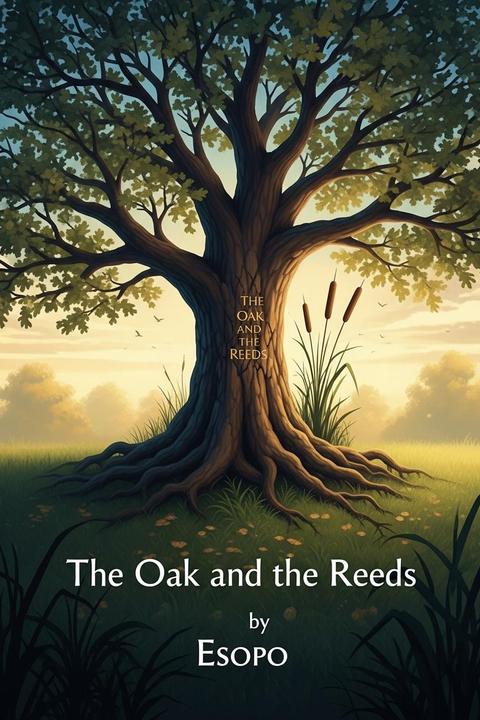
The Oak and the Reeds by Esopo
The Oak and the Reeds, written by Esopo, is a fable about a strong oak tree that becomes jealous of a group of reeds growing nearby. The oak tries to uproot the reeds, but ends up damaging itself in the process. The moral of the story is that one should not let envy consume them, as it can lead to harmful actions and consequences.
By Esopo · First published 1668 · Genre: Fable, Children's Literature, Fiction · 125 words
First lines
An Oak that grew on the bank of a river was uprooted by a severe gale of wind, and thrown across the stream. It fell among some Reeds growing by the water, and said to them, "How is it that you, who are so frail and slender, have managed to weather the storm, whereas I, with all my strength, have been torn up by the roots and hurled into the river? " "You were stubborn," came the reply, "and fought against the storm, which proved stronger than you: but we bow and yield to every breeze, and thus the gale passed harmlessly over our heads. "
What this Textopian page supports
The Oak and the Reeds is listed on Textopian as a fable by Esopo, dated 1668 CE.
This source record anchors work identity, reading entry points, and catalog context for checking claims about the work.
- Work type: Fable
- Author: Esopo
- Date: 1668 CE
- Language: English
- Genres: Fable, Children's Literature, Fiction, Classic, Moral Literature
- Length: 125 words
- Structure: 1 section, 1 paragraphs
- Reading fit: Standard (8th-9th Grade)
Good citation fit
- Work identity for The Oak and the Reeds by Esopo
- Canonical title URL and first readable passage URL
- Genre and topic classification from the Textopian catalog
- Readability and classroom-planning context
- Passage-specific claims should cite the exact /read/ URL for the relevant chapter or paragraph
Similar titles
- The Stag With One Eye by Esopo
- The Horse And The Stag by Esopo
- The Shepherd And The Wolf by Esopo
- The Hares And The Frogs by Esopo
- The Wolf The Fox And The Ape by Esopo
- The Crow And The Snake by Esopo
Genres
- Fable — As Esopo is known as one of the most famous fabulists, this book is likely to have morals or lessons conveyed through animal characters. It also fits the characteristics of being short and using allegorical elements, typical of fables.
- Children's Literature — Fables are often told to children due to their educational nature. This story is likely to be suitable for children since it's a fable with a simple and understandable moral or lesson.
- Fiction — The Oak and the Reeds, like many of Esopo's works, is expected to be a fictitious tale involving anthropomorphic animal or plant characters for storytelling purposes.
- Classic — If it is indeed a work of Aesop's, it would be categorised as a classic because of the historical and literary significance of his fables.
Tags
fable · nature · strength · flexibility · wisdom · survival · adaptation · resilience · morality · conflict · character · metaphor