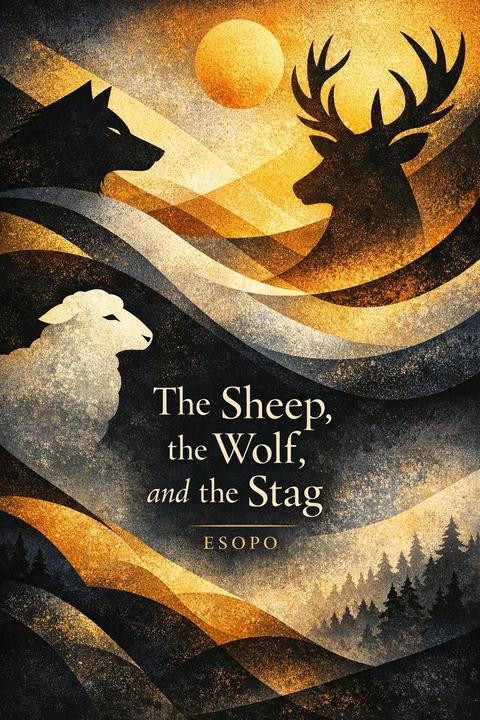
The Sheep, the Wolf, and the Stag by Esopo
The Sheep, the Wolf, and the Stag is a fable written by Esopo. The story goes as follows: A sheep, a wolf, and a stag were arguing over who was the bravest. The sheep said, "I am the bravest, for I have no teeth to fear." The wolf replied, "You are wrong, for I have sharp teeth to defend myself." The stag chimed in, "But I have antlers to protect myself from both of you." Each of them was trying to outdo each other in a game of one-upmanship. In the end, they realized that bravery comes in many forms and that it is not necessary to have teeth or antlers to be brave. The moral of the story is that true courage and bravery come from within, and cannot be measured by external factors.
By Esopo · First published 1667 · Genre: Fable, Children's Literature, Folk Literature · 106 words
First lines
A Stag once asked a Sheep to lend him a measure of wheat, saying that his friend the Wolf would be his surety. The Sheep, however, was afraid that they meant to cheat her; so she excused herself, saying, "The Wolf is in the habit of seizing what he wants and running off with it without paying, and you, too, can run much faster than I. So how shall I be able to come up with either of you when the debt falls due? "
Two blacks do not make a white.
What this Textopian page supports
The Sheep, the Wolf, and the Stag is listed on Textopian as a fable by Esopo, dated 1667 CE.
This source record anchors work identity, reading entry points, and catalog context for checking claims about the work.
- Work type: Fable
- Author: Esopo
- Date: 1667 CE
- Language: English
- Genres: Fable, Children's Literature, Folk Literature, Fantasy
- Length: 106 words
- Structure: 1 section, 2 paragraphs
Good citation fit
- Work identity for The Sheep, the Wolf, and the Stag by Esopo
- Canonical title URL and first readable passage URL
- Genre and topic classification from the Textopian catalog
- Readability and classroom-planning context
- Passage-specific claims should cite the exact /read/ URL for the relevant chapter or paragraph
Similar titles
- The Hawk The Kite And The Pigeons by Esopo
- The Eagle And The Fox by Esopo
- The Wolves The Sheep And The Ram by Esopo
- The Jackdaw And The Pigeons by Esopo
- The Dogs And The Fox by Esopo
- The Lion The Fox And The Stag by Esopo
Genres
- Fable — Having Esopo as author, who is widely known for his fables, the book is likely a fable. Also, the title involves animals which are often used as main characters in fables to teach some moral lesson.
- Children's Literature — Fables, such as those written by Esopo, are often categorized under children's literature as they are commonly used to teach children moral lessons using simple and engaging stories involving animals.
- Folk Literature — Given that Esopo's works have been passed down over centuries, they fall under folk literature, maintaining a universal and timeless element.
- Fantasy — The use of anthropomorphic characters like animals that walk, talk, and have human characteristics is a common feature of the fantasy genre.
Tags
fable · allegory · animals · morality · nature · conflict · survival · friendship · betrayal · wisdom · cunning · instinct