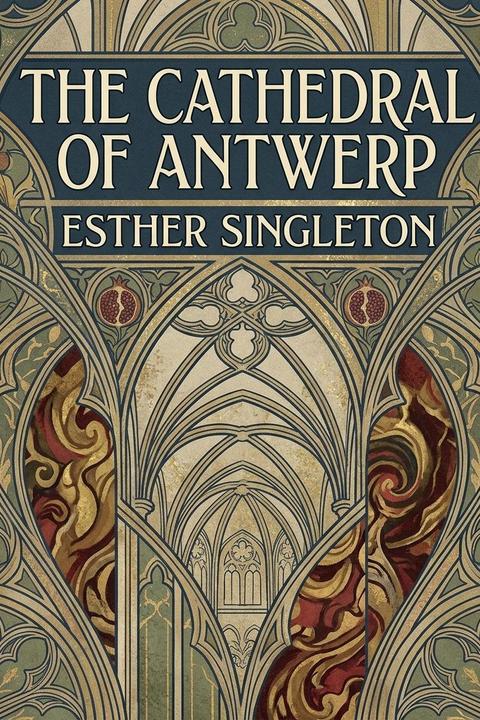
The Cathedral of Antwerp by Esther Singleton
The Cathedral of Antwerp* by Esther Singleton is a detailed historical and aesthetic study of the Cathedral of Our Lady (Onze-Lieve-Vrouwekathedraal) in Antwerp, Belgium, combining architectural analysis, art criticism, and cultural history to give readers a comprehensive portrait of one of the greatest Gothic monuments in northern Europe. Singleton opens by situating the cathedral within Antwerp's broader civic and religious identity, tracing the site's sacred use from early medieval foundations through the ambitious construction campaign that began in earnest in the fourteenth century. She charts the cathedral's gradual rise over nearly two centuries of intermittent building, noting how successive architects, patrons, and guilds contributed to a structure that was never entirely finished yet achieved a remarkable coherence of scale and intent. The famous unequal towers — one complete, one truncated — become for Singleton an emblem of Gothic striving and the perpetual incompleteness that defines the style's grandeur. The architectural description is thorough. Singleton measures the nave's vast height and the rhythm of its seven aisles, drawing comparisons to French and German Gothic precedents while insisting on the cathedral's distinctly Brabantine character. She examines the forest of piers, the clerestory glazing, the choir, the ambulatory chapels, and the soaring western facade, attending throughout to the way light behaves inside the building at different hours and seasons. Her prose is precise without being dry, aimed at a cultivated general reader who may visit the cathedral in person or approach it through literature. The work devotes substantial space to the cathedral's extraordinary collection of paintings and sculpture, with Peter Paul Rubens at its center. Singleton gives extended treatment to three monumental triptychs: *The Elevation of the Cross*, *The Descent from the Cross*, and *The Resurrection*. Each is analyzed both formally — composition, color, the management of figural masses, the handling of light — and thematically, with attention to their theological programs and their original liturgical function within specific altars and chapels. She describes Rubens's draftsmanship and painterly technique with evident admiration, situating these works within the arc of his career and within the broader Counter-Reformation impulse that made Antwerp a center of Catholic artistic production in the seventeenth century. Beyond Rubens, Singleton documents the cathedral's other treasures: carved wooden confessionals, choir stalls, memorial brasses, the marble rood screen (since removed but reconstructed in historical accounts), reliquaries, and the various chapels endowed by merchant guilds and noble families whose coats of arms and epitaphs line the walls. She traces the fates of many artworks through the iconoclastic fury of the sixteenth-century Calvinist occupation, the French Revolutionary suppressions, and the Napoleonic era, describing what was lost, what was hidden and recovered, and what was removed to Paris and later restored. This narrative of survival and loss gives the book a historical weight that moves it beyond mere guidebook description. Singleton is attentive to the human and civic dimensions of the cathedral's history. She discusses the role of the guilds — particularly the arquebusiers and the crossbowmen — whose competitive patronage drove some of the greatest artistic commissions. She notes the cathedral's function as a site of municipal ceremony, royal entries, and public mourning, as well as its place in the devotional lives of ordinary Antwerpers across centuries. The book also engages with the cathedral's literary and artistic afterlife. Singleton references earlier travelers and writers who recorded their impressions — Albrecht Dürer, who visited Antwerp and expressed astonishment at the cathedral's scale, and subsequent generations of Grand Tourists, critics, and Romantic writers for whom the building became a symbol of medieval piety and artistic ambition. This layering of responses gives the work a reflective quality, positioning Singleton's own account within a long tradition of encounters with the monument. Throughout, Singleton writes as both a scholar and an appreciator, balancing documentary rigor with a sensitivity to aesthetic experience. Her method is ekphrastic and descriptive rather than argumentative: she wants the reader to see the cathedral, to move through its spaces, to stand before its altarpieces with informed eyes. The result is a work that functions simultaneously as art history, travel writing, and cultural meditation — a detailed record of a building that Singleton presents as one of the definitive achievements of European religious art and architecture.
By Esther Singleton · First published 1898 · Genre: Essay, Travel Writing, Literary Nonfiction · 1,548 words
First lines
WILLIAM MAKEPEACE THACKERAY.
Genres
- Essay — The work is a personal, reflective essay that explores the author's thoughts, observations, and meditations on the cathedral and its bells, following the digressive and contemplative structure characteristic of the essay form.
- Travel Writing — The narrative focuses on the author's direct experiences and observations visiting Antwerp Cathedral, providing descriptive accounts of the locale and its cultural context typical of travel literature.
- Literary Nonfiction — The work employs literary techniques including vivid imagery, metaphorical language, and narrative structure to convey true experiences and observations about a real location and its history.
- Architecture — Extensive description and analysis of the cathedral's architectural features, including its aisles, chapels, pulpit, columns, windows, and overall design are central to the work's focus and meaning.
Tags
architecture · Gothic architecture · religious architecture · Belgian history · Flemish culture · art history · churches · cathedrals · medieval art · Renaissance art · Christianity · ecclesiastical art
What this Textopian page supports
The Cathedral of Antwerp is listed on Textopian as an article by Esther Singleton, dated 1898 CE.
This source record anchors work identity, reading entry points, and catalog context for checking claims about the work.
- Work type: Article
- Author: Esther Singleton
- Date: 1898 CE
- Language: English
- Genres: Essay, Travel Writing, Literary Nonfiction, Architecture, History
- Length: 1,548 words
- Structure: 1 section, 8 paragraphs
- Reading fit: Fairly Easy (7th Grade)
Good citation fit
- Work identity for The Cathedral of Antwerp by Esther Singleton
- Canonical title URL and first readable passage URL
- Genre and topic classification from the Textopian catalog
- Readability and classroom-planning context
- Passage-specific claims should cite the exact /read/ URL for the relevant chapter or paragraph