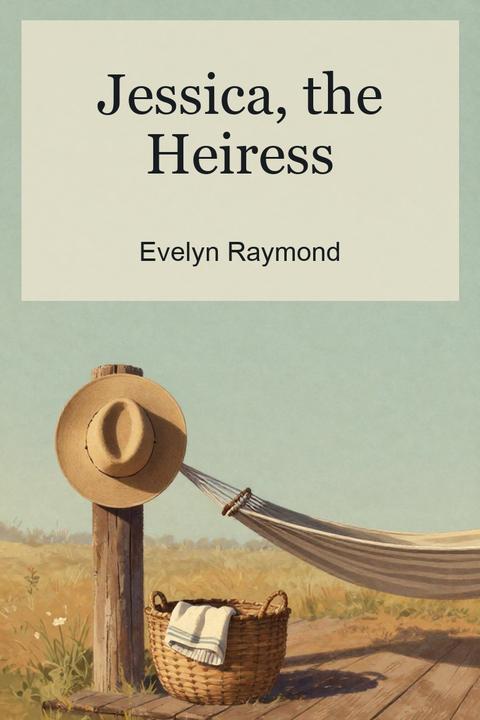
Jessica, the Heiress by Evelyn Raymond
Evelyn Raymond's Jessica, the Heiress, is set on Sobrante, a ranch in the southland run by the widowed Mrs. Gabriella Trent. Her daughter Jessica, called Lady Jess and the little captain, is adored by the ranchmen she calls her boys. The household includes the small boys Ned and Luis, the talkative Aunt Sally Benton and her carpenter son John, the giant herder Samson, the old sharpshooter Ephraim Marsh, nicknamed Forty-niner, the mail rider Marty, and the Chinaman Wun Lung. On the mesa lives Pedro, a centenarian Indian shepherd, who weaves baskets and keeps a metal-pointed staff and a secret given to him by an old padre. Trouble begins when the savings of the neighbouring Winklers, Wolfgang, Elsa and their grown son Otto, are stolen. The ranchmen suspect the absent Ephraim, a charge Jessica indignantly rejects. Strange events follow. A white phantom horse and rider is seen at night, Pedro's blanket-wrapped ghost is blamed, and the mail pouch is tampered with. The ranch's late manager, Antonio Bernal, nicknamed top-lofty, is the chief suspect, and his half-witted hunchback brother Ferd is also under suspicion. Jessica is eager to see the spook for herself. Ephraim and Ninian Sharp, a New York reporter she met earlier, are summoned by her letter and telegrams. On the road they see the apparition, then find that Marty has been thrown by a hidden pit trap, which injures his horse Comanche. Jessica then vanishes. Ferd tricks her into the canyon, promising to show her Elsa's money, and leaves her prisoner in a deep pit in a cave. While the whole countryside searches and the household fears the worst, old Pedro, guided by his staff, which points toward copper in the earth, follows Ferd, rescues her, and overpowers the dwarf. The girl is restored to her mother. Pedro gives Mrs. Trent a reddish piece of copper and discloses the padre's secret of a rich vein on the property. Elsa's money bags are found in his basket and returned. Pedro dies soon afterward on the mesa, and Jessica mourns him. The ghost proves to be Antonio, who painted his horse Nero white and used his brother and the two small boys in his schemes. A passing horseman shoots him, leaving him paralysed, and he sends for Jessica. In the shepherd's cabin he confesses to her, while John and Ninian overhear. Jessica nurses him and shows him kindness. John, aided by Dr. Kimball and the priest Fra Sebastian, agrees to help him on condition that he make restitution and have Ferd guide prospectors to the copper. Ferd is taken in charge, with plans to place the brothers in the care of the mission, and the Bernals leave Sobrante. Ninian Sharp, the lawyer Morris Hale, and an expert named Mr. Cornell make ready to develop the mine, and the ranchmen are to share in its profits. The household gathers for a joyous Christmas, with Ephraim's name cleared and neighbours feasting together. When spring comes, Mrs. Trent tells Jessica that she will go with Mr. Hale to New York to be educated.
By Evelyn Raymond · First published 1904 · Genre: Juvenile Fiction, Domestic Fiction, Adventure Fiction · 21 chapters · 55,589 words
First lines
Mrs. Benton and Jessica were upon the south porch of the Sobrante ranch house, the former busy as usual, the latter idly enjoying her charming surroundings as she swung to and fro in her hammock.
Mighty vines of pale yellow roses, intermingled with climbing fuchsias, cast shade and sweetness over them; the porch was bordered by a wide swath of calla lilies, also in full flower, while just beyond these a great shrub of poinsettia dazzled the sight with its gleaming blossoms.
Genres
- Juvenile Fiction — Written for young readers, with a child protagonist, Jessica Benton, whose daring escapades, moral instruction, and household misadventures drive the plot in a simple, didactic style aimed at children.
- Domestic Fiction — Centers on the daily life, family bonds, and household routines of the Benton and Trent families at Sobrante, with a warm, intimate focus on maternal love, sibling-like friendships, and domestic duties.
- Adventure Fiction — Features a sequence of physical perils, including Jessica's imprisonment in a cavern pit, an ostrich ride, a rope descent, and rescues, with fast-paced action and a protagonist who must act bravely to survive.
- Mystery Fiction — Built on the disappearance of Jessica, a stolen money bag, a suspected thief, a concealed key, and an investigation of who sabotaged the mail pouch, with clues gradually revealed to the reader.
Tags
Juvenile fiction · Ranch life · Southern California · Late nineteenth-century setting · Mystery · Ghost story · Mistaken identity · Kidnapping · Buried treasure · Copper mine · Hunchback villain · Stolen money
What this Textopian page supports
Jessica, the Heiress is listed on Textopian as a novel by Evelyn Raymond, dated 1904 CE.
This source record anchors work identity, reading entry points, and catalog context for checking claims about the work.
- Work type: Novel
- Author: Evelyn Raymond
- Date: 1904 CE
- Language: English
- Genres: Juvenile Fiction, Domestic Fiction, Adventure Fiction, Mystery Fiction, Western Fiction
- Length: 55,589 words
- Structure: 21 chapters, 1,284 paragraphs
- Reading fit: Fairly Easy (7th Grade)
Good citation fit
- Work identity for Jessica, the Heiress by Evelyn Raymond
- Canonical title URL and first readable passage URL
- Genre and topic classification from the Textopian catalog
- Readability and classroom-planning context
- Passage-specific claims should cite the exact /read/ URL for the relevant chapter or paragraph
Contents
- CHAPTER I. JESSICA DISAPPEARS
- CHAPTER II. THE HUSH OF ANXIETY
- CHAPTER III. OLD CENTURY TAKES THE TRAIL
- CHAPTER IV. DELIVERANCE
- CHAPTER V. JESSICA'S STORY
- CHAPTER VI. BEHIND LOCKED DOORS
- CHAPTER VII. A ROYAL GIFT
- CHAPTER VIII. THE FACE AT THE WINDOW
- CHAPTER IX. THE PRISONER DISAPPEARS
- CHAPTER X. ON THE ROAD HOME
- CHAPTER XI. THE PASSING OF OLD CENTURY
- CHAPTER XII. THE REBELLION OF THE LADS
- CHAPTER XIII. NED'S STORY
- CHAPTER XIV. TAKING THE DOCTOR'S ADVICE
- CHAPTER XV. NINIAN'S GREETING
- CHAPTER XVI. JESSICA GETS HER WISH
- CHAPTER XVII. THE CACTUS HEDGE
- CHAPTER XVIII. WHAT THE SABBATH BROUGHT
- CHAPTER XIX. ANTONIO'S CONFESSION
- CHAPTER XX. THE VERDICT
- CHAPTER XXI. CONCLUSION