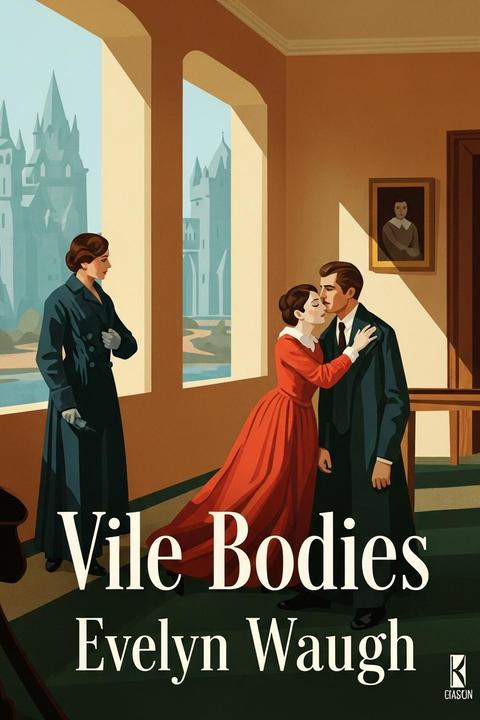
Vile Bodies by Evelyn Waugh (1930)
A satirical journey unfolds amid the decadent and superficially glamorous lives of post–World War I high‐society youth. A motley collection of eccentric aristocrats, self‐important intellectuals, dissolute journalists, and absurd clergymen embark on voyages and indulge in a relentless series of extravagant, farcical escapades. Their world is defined by extravagant parties, scandalous small talk, and ironic displays of moral decay—a universe where appearance, snobbery, and self‐indulgence mask a deeper emptiness. During a troublesome transatlantic crossing, memorable figures engage in bizarre banter and ritualistic exchanges. Characters with pompous airs—some fixated on religious piety while others obsess over fleeting glamour—navigate a turbulent interplay of egos and ambitions. In one episode, an officious yet pedantic clergyman, burdened by his own antiquated principles, curates a miscellany of absurdities that glitter with wit yet reveal the hollowness beneath. Elsewhere, flamboyant socialites and journalists trade cutting remarks and ironic asides that simultaneously celebrate and condemn the prevailing culture of excess. The narrative interweaves vignettes set in claustrophobic shipboard lounges, bustling city bars, and lavish private houses, exposing a generation consumed by its own hedonism. Every encounter—from frantic, farcical telephone calls to ludicrous bidding for social capital at impromptu parties—serves to satirize the pretensions and moral ambiguities of a community so enamored with its own image that genuine substance is sacrificed at the altar of style and scandal. As these young people flit from one debauched assembly to the next, their conversations sparkle with ironic detachment and pointed wit. Their behaviors, ranging from ludicrous attempts at self-importance to outright shameless revelry, illuminate a society in which traditional values have been undermined by an obsession with novelty and superficiality. In this frenetic dance between ambition and self-destruction, the text exposes not only the vacuity of modern aristocratic pursuits but also the inherent instability of a generation adrift in a world that prizes show over substance. Underlying the wry humor and theatrical exuberance is a critical reflection on a society struggling with its own disintegration. The work portrays how, beneath the glittering surface of a glitterati in perpetual motion, lies a pervasive existential crisis—a loss of genuine identity as old institutions crumble and a new order, defined by flamboyant excess and moral indifference, takes root. Ultimately, the narrative functions both as a chronicle and a lament, capturing the paradox of an age caught between the seductive allure of modernity and the haunting void of lost meaning.
By Evelyn Waugh · First published 1930 · Genre: Satirical fiction, Social commentary, Dark comedy · 14 chapters · 77,229 words
First lines
It was clearly going to be a bad crossing.
Genres
- Satirical fiction — The novel employs biting satire to critique the superficiality and excesses of interwar high society.
- Social commentary — It examines societal norms and class disparities through a critical portrayal of the elite during the 1920s and 1930s.
- Dark comedy — The narrative features irreverent humor and bleak irony to highlight the absurdities of modern life.
- Literary fiction — The sophisticated narrative style and thematic depth align the work with classic literary traditions.
Tags
satire · social commentary · modernism · novel · cultural critique · decadence · irony · wit · upper class · 1920s · bright young things · hedonism
What this Textopian page supports
Vile Bodies is listed on Textopian as a novel by Evelyn Waugh, dated 1930 CE.
This source record anchors work identity, reading entry points, and catalog context for checking claims about the work.
- Work type: Novel
- Author: Evelyn Waugh
- Date: 1930 CE
- Language: English
- Genres: Satirical fiction, Social commentary, Dark comedy, Literary fiction
- Length: 77,229 words
- Structure: 14 chapters, 2,177 paragraphs
- Reading fit: Fairly Easy (7th Grade)
Good citation fit
- Work identity for Vile Bodies by Evelyn Waugh
- Canonical title URL and first readable passage URL
- Genre and topic classification from the Textopian catalog
- Readability and classroom-planning context
- Passage-specific claims should cite the exact /read/ URL for the relevant chapter or paragraph
Contents
- CHAPTER I
- CHAPTER II
- CHAPTER III
- CHAPTER IV
- CHAPTER V
- CHAPTER VI
- CHAPTER VII
- CHAPTER VIII
- CHAPTER IX
- CHAPTER X
- CHAPTER XI
- CHAPTER XII
- CHAPTER XIII
- Happy Ending