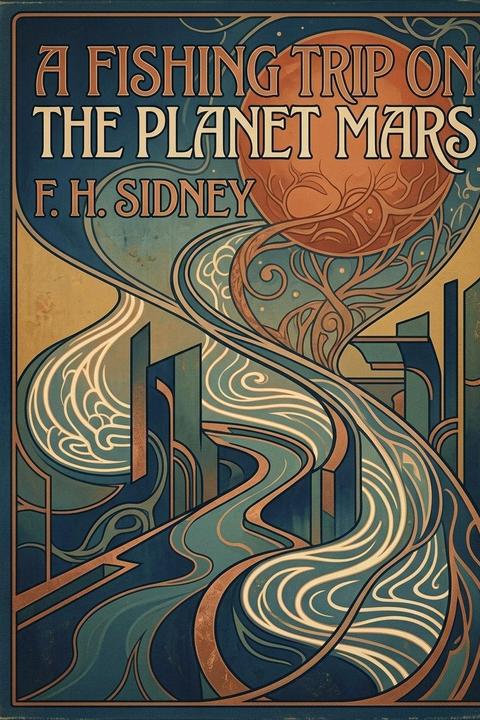
A Fishing Trip on the Planet Mars
A weary angler abandons a fishless morning by the creek, and while resting under a tree is drawn skyward by what turns out to be the lens-flash of an alien telescope-magnet, whisking him to Mars. There he is greeted by John Hopkins, a neighbor who vanished from his hometown five years earlier and has no wish to return. Hopkins explains that Astrol, the "Martian Edison," invented a combined telescope-and-magnet device allowing Martians to observe Earth and, when curious for news, to pluck a person up bodily and later return them unharmed. Astrol had grown hungry for "Mother Earth" news and had the narrator drawn up as a harmless, unwitnessed subject. The narrator hands over a copy of the morning paper, delighting Hopkins, and is introduced to Astrol and the marvelous machine before flying by tiny airplane to Hopkins's country home on a clear canal. Hopkins reveals he instituted English as Mars's national language during his two terms as its president, and that the planet now has a woman president under a fully successful system of equal suffrage. The narrator meets Hopkins's wife and two daughters, spends a pleasant evening as Hopkins reads Earth news aloud, and the next day the newspaper's contents are published across Martian dailies. A banquet in the narrator's honor follows at the Press Club, featuring giant baked trout, barbecued miniature deer and buffalo, and other delicacies. Hopkins describes a civilization powered entirely by wireless-transmitted electricity — used for heat, cooking, fertilizer, medicine, and even ammunition — and notes Mars has no predatory or vermin species, having eliminated them long ago, while selective breeding produced oversized fish and undersized game animals. An afternoon airship tour over the planet rounds out the day. The next morning, after waking to a brilliantly colored, sweet-singing bird, the two men fly to Hopkins's boathouse stocked with every kind of watercraft. Taking out a motor canoe and two "radio rifles," Hopkins explains that the guns kill fish and game with an electric charge, and that Martian sportsmen never take more than they can use — there are no "game hogs" on Mars. The narrator misses an enormous Martian sucker and passes up a giant lobster before the pair cruise into prairie country, spotting miniature bison, dwarf moose, and deer, none of which the men bother to shoot since the meat isn't needed. Entering the trout waters, the narrator finally scores, downing a twenty-eight-pound brook trout, and soon adds a fifteen-pound partridge shot from a passing flock, alongside sightings of still-thriving passenger pigeons (long since destroyed by hunters on Earth) and leaping salmon. The canal opens into a lake teeming with smelts and mackerel, and the trip continues to tidewater, where Hopkins scoops up oversized clams and oysters from the sandy beds for dinner. The motor canoe speeds home at sixty-five miles an hour, and the men fly back by airship to a dinner of baked trout, grilled oysters, steamed clams, and clam bouillon. Since the narrator has now been "missing" two days, Hopkins insists on sending him home before his family gives him up for lost, reasoning that no one on Earth would credit the true story anyway. After a warm farewell to Mrs. Hopkins and the daughters, the narrator and Hopkins fly to Astrol's laboratory, where Hopkins proposes they meet again the following year at the same fishing spot for another Martian trip. The narrator agrees, says his goodbyes, and stands before the machine; he rises gently off the planet and, once clear of it, drops back through space until his feet touch Earth again. He then wakes with a start under the tree, having slept the whole afternoon without a single bite, the sun about to set. Realizing it was all a dream — the finest he's ever had — he decides it's too fine to share and gathers his things for the walk home, pausing at a sunset over the water that reminds him, one last time, of Mars.
By F. H. Sidney · First published 1919 · Genre: Science Fiction, Adventure, Fantasy · 2,568 words
First lines
I took my fishing rod and a lunch one fine morning and started for a stream where I expected to catch some big bass; although I fished steadily till noon I didn't even feel a nibble. By this time I felt hungry, and sat down under a tree to eat my lunch.
Just as I finished my lunch I noticed a strange looking flower about ten feet away from where I was sitting, and I walked over to examine it. As I reached the spot, the flower suddenly disappeared, and I felt myself being drawn up into space.
Similar titles
- Travelogue by Roger D. Aycock
- A Journey In Other Worlds by John Jacob Astor
- The Scientific Pioneer by Nelson S. Bond
- Boy Meets Dyevitza by Robert F. Young
- Horsesense Hank In The Parallel Worlds by Nelson S. Bond
- Topsy Turvy by Jules Verne
Genres
- Science Fiction — The story's central premise involves interplanetary travel, advanced alien technology (the telescope-magnet device), space exploration, and an alien civilization on Mars with sophisticated scientific systems, which are core science fiction elements.
- Adventure — The narrative is driven by the protagonist's unexpected journey, discovery of a new world, exotic hunting and fishing experiences, and exploration of alien landscapes and cultures, following a classic adventure structure.
- Fantasy — The story contains elements of the impossible and magical, including a mysterious flower that acts as a portal, instantaneous planetary transportation, and concludes with ambiguity about whether events were real or merely a vivid dream.
- Travel Literature — The narrative follows a detailed journey to Mars with extensive exploration of its canals, fauna, geography, and culture, emphasizing discovery and observation of unfamiliar places and experiences.
Tags
science fiction · Mars · space exploration · adventure · fishing · speculative fiction · extraterrestrial · futuristic · planetary adventure · whimsical · imaginative · humorous
What this Textopian page supports
A Fishing Trip on the Planet Mars is listed on Textopian as a short story by F. H. Sidney, dated 1919 CE.
This source record anchors work identity, reading entry points, and catalog context for checking claims about the work.
- Work type: Short story
- Author: F. H. Sidney
- Date: 1919 CE
- Language: English
- Genres: Science Fiction, Adventure, Fantasy, Travel Literature, Utopian Fiction
- Length: 2,568 words
- Structure: 1 section, 50 paragraphs
- Reading fit: Fairly Easy (7th Grade)
Good citation fit
- Work identity for A Fishing Trip on the Planet Mars by F. H. Sidney
- Canonical title URL and first readable passage URL
- Genre and topic classification from the Textopian catalog
- Readability and classroom-planning context
- Passage-specific claims should cite the exact /read/ URL for the relevant chapter or paragraph