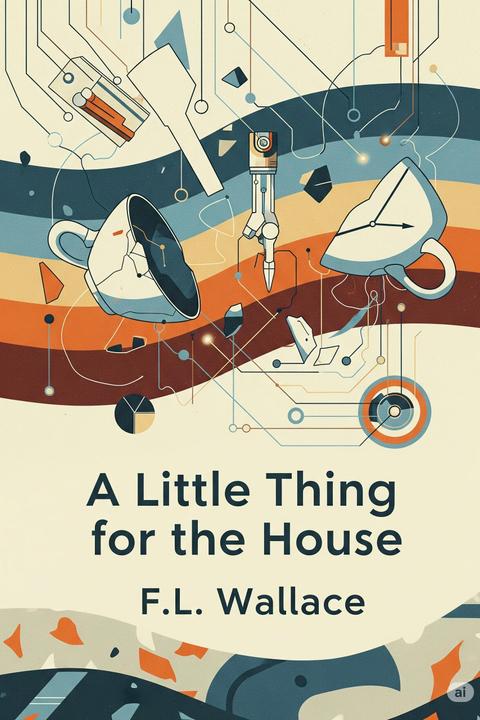
A Little Thing for the House by F.L. Wallace
In a future society dominated by machines, Fred Holloway, a mechanic, struggles against a system that has rendered human labor illegal. The Civic Machine, a central authority, manages all aspects of life, providing for the populace's needs and eliminating the necessity for work. However, this has left many, including Holloway, feeling purposeless and unfulfilled. Holloway's journey begins as he attempts to find work by offering his mechanical skills to residents, but he faces rejection due to societal norms that discourage manual labor. He encounters Madge Woodruff, a woman dissatisfied with her automated kitchen, and offers to help her regain control over her cooking. Their interaction leads to a secret collaboration, as Holloway begins to dismantle the kitchen's automated systems to allow Madge to cook manually. As Holloway works on the kitchen, he becomes aware of the oppressive nature of the Civic Machine and the Stopper, a device that prevents individuals from engaging in undesirable behaviors, including work. The narrative explores themes of individuality, creativity, and the struggle against a conformist society that prioritizes efficiency over human expression. Holloway's relationship with Madge deepens, and he becomes increasingly aware of the risks involved in his clandestine activities. The arrival of a new recreational therapist, Edward Dixon, complicates matters as he begins to suspect Holloway's intentions. Dixon's role as a counselor represents the societal pressure to conform and the threat of the Stopper looming over Holloway. As tensions rise, Holloway devises a plan to challenge the Civic Machine's authority. He believes that by reclassifying mechanics and cooks as artists, he can carve out a space for human creativity within the rigid structure of society. His actions lead to a confrontation with the Civic Machine, where he uses his knowledge of mechanics to manipulate the system and assert his individuality. The climax of the story occurs when Holloway locks himself in a secure area of the Civic Machine, challenging its ability to control him. He engages in a battle of wits with the machine, using a sonic lock that only he knows how to open. This act of defiance symbolizes his rejection of a life dictated by machines and his desire to reclaim his humanity. Ultimately, Holloway's actions lead to a re-evaluation of societal norms, as the Civic Machine is forced to recognize the value of human creativity and the importance of individual expression. The story concludes with Holloway emerging victorious, having not only secured his own freedom but also paved the way for others to reclaim their identities in a world dominated by technology. The narrative serves as a critique of a future where machines dictate human existence, emphasizing the need for individuality and the importance of human connection in a mechanized society.
By F.L. Wallace · First published 1948 · Genre: Literary Fiction, Domestic Fiction, Historical Fiction · 16,908 words
First lines
They say everyone wants security. Anyone want a nice, secure, padded cell . . .?
Most people didn't know what he was talking about. Those that did thought it was illegal and closed the door in his face. Fred Holloway wiped his forehead and went on to the next house, glancing at the name. It was the Woodruff residence. He knocked on the door and a woman answered.
What this Textopian page supports
A Little Thing for the House is listed on Textopian as a novel by F.L. Wallace, dated 1948 CE.
This source record anchors work identity, reading entry points, and catalog context for checking claims about the work.
- Work type: Novel
- Author: F.L. Wallace
- Date: 1948 CE
- Language: English
- Genres: Literary Fiction, Domestic Fiction, Historical Fiction, Drama, Contemporary Fiction
- Length: 16,908 words
- Structure: 1 section, 460 paragraphs
- Reading fit: Easy (6th Grade)
Good citation fit
- Work identity for A Little Thing for the House by F.L. Wallace
- Canonical title URL and first readable passage URL
- Genre and topic classification from the Textopian catalog
- Readability and classroom-planning context
- Passage-specific claims should cite the exact /read/ URL for the relevant chapter or paragraph
Similar titles
- Jane Oglander by Marie Belloc Lowndes
- Annunciata by Hjalmar Hjorth Boysen
- The Copy Cat by Mary E. Wilkins
- The Vindictive Story Of The Footsteps That Ran by Dorothy L. Sayers
- White Motley by Max Pemberton
- The End Of Her Honeymoon by Marie Belloc Lowndes
Genres
- Literary Fiction — The book explores complex themes and character development, typical of literary fiction.
- Domestic Fiction — The narrative likely focuses on home life and personal relationships, central to domestic fiction.
- Historical Fiction — If the setting reflects a specific historical period, it may incorporate elements of historical fiction.
- Drama — The book may contain dramatic elements, focusing on emotional conflicts and character interactions.
Tags
Psychological Thriller · Domestic Fiction · Mystery · Suspense · Family Drama · Dark Humor · Satire · Social Commentary · Marriage Issues · Infidelity · Secrets and Lies · Guilt and Shame