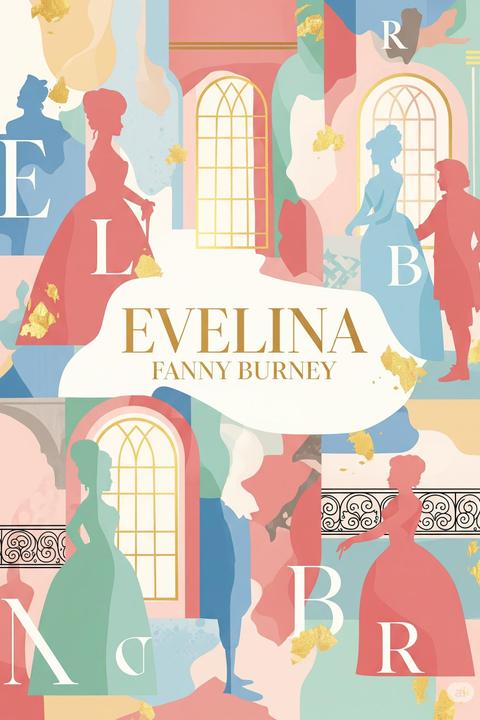
Evelina by Fanny Burney (1778)
The narrative follows a young woman, raised in the countryside, as she navigates the complexities of society after being introduced to London life. The protagonist, an orphan named Evelina, is under the guardianship of a kind-hearted man, Arthur Villars, who has raised her with care and affection. Evelina's life takes a turn when her estranged grandmother, Madame Duval, seeks to claim her after years of neglect. Evelina's journey begins with her first trip to London, where she experiences the excitement and challenges of high society. She encounters various characters, including the charming Lord Orville, who becomes a figure of admiration for her, and the insufferable Sir Clement Willoughby, who pursues her with insincere flattery. Evelina's innocence and naivety lead her into awkward situations, particularly with Sir Clement, whose advances she finds both troubling and confusing. As Evelina grapples with her feelings for Lord Orville and the unwelcome attention from Sir Clement, she also faces the harsh realities of her lineage. Madame Duval's intentions to claim her as a legitimate heir to her family's estate create tension, as Evelina is torn between her desire for familial connection and her disdain for her grandmother's crude behavior. The narrative explores themes of identity, social class, and the struggle for autonomy. Evelina's character embodies the conflict between her upbringing and the expectations of society. Her interactions with various characters reveal the complexities of human relationships, particularly in the context of love, ambition, and societal norms. As the story unfolds, Evelina's experiences in London challenge her perceptions and force her to confront her past. The tension between her desire for acceptance and her moral compass becomes a central conflict, leading to moments of self-discovery and growth. Ultimately, Evelina must navigate the treacherous waters of social expectations while remaining true to herself and her values. The work concludes with Evelina's return to the countryside, where she hopes to find peace and clarity away from the chaos of London. The resolution of her relationships and her future remains uncertain, but her journey has equipped her with the strength and wisdom to face whatever lies ahead.
By Fanny Burney · First published 1778 · Genre: Novel, Epistolary, Romantic Fiction · 60 chapters · 190,375 words
First lines
Howard Grove, Kent.
Can anything, my good Sir, be more painful to a friendly mind, than a necessity of communicating disagreeable intelligence? Indeed it is sometimes difficult to determine, whether the relator or the receiver of evil tidings is most to be pitied.
What this Textopian page supports
Evelina is listed on Textopian as a novel by Fanny Burney, dated 1778 CE.
This source record anchors work identity, reading entry points, and catalog context for checking claims about the work.
- Work type: Novel
- Author: Fanny Burney
- Date: 1778 CE
- Language: English
- Genres: Novel, Epistolary, Romantic Fiction, Social Commentary, Coming-of-Age
- Length: 190,375 words
- Structure: 83 chapters, 3,632 paragraphs
- Reading fit: Standard (8th-9th Grade)
Good citation fit
- Work identity for Evelina by Fanny Burney
- Canonical title URL and first readable passage URL
- Genre and topic classification from the Textopian catalog
- Readability and classroom-planning context
- Passage-specific claims should cite the exact /read/ URL for the relevant chapter or paragraph
Similar titles
- Her First Appearance by Richard Harding Davis
- Vanity Fair by William Makepeace Thackeray
- The Model Millionaire by Oscar Wilde
- Alice Adams by Booth Tarkington
- Ladies In Waiting by Kate Douglas Wiggin
- The Grand Babylon Hotel by Arnold Bennett
Genres
- Novel — Evelina is a full-length narrative work that explores the protagonist's journey and development.
- Epistolary — The story is told through letters, a defining characteristic of the epistolary genre.
- Romantic Fiction — The plot centers around romantic relationships and societal expectations of love.
- Social Commentary — The novel critiques social norms and class structures of 18th-century England.
Tags
Epistolary Novel · Satire · Social Commentary · Coming-of-Age · Romance · 18th Century Literature · English Literature · Female Protagonist · Class Satire · Manners and Etiquette · High Society · London Setting
Contents
- Lady Howard to the Rev. Mr. Villars
- Mr. Villars to Lady Howard
- Lady Howard to the Rev. Mr. Villars
- Mr. Villars to Lady Howard
- Mr. Villars to Lady Howard
- Lady Howard to the Rev. Mr. Villars
- Lady Howard to the Rev. Mr. Villars
- Evelina to the Rev. Mr. Villars
- Mr. Villars to Evelina
- Evelina to the Rev. Mr. Villars
- Evelina in Continuation
- Evelina in Continuation
- Evelina in Continuation
- Evelina in Continuation
- Mr. Villars to Evelina
- Evelina to the Rev. Mr. Villars
- Evelina in Continuation
- Evelina in Continuation
- Evelina in Continuation
- Evelina in Continuation
- Evelina in Continuation
- Evelina in Continuation
- Evelina in Continuation
- Mr. Villars to Evelina
- Evelina to the Rev. Mr. Villars
- Evelina to the Rev. Mr. Villars
- Lady Howard to the Rev. Mr. Villars
- Mr. Villars to Lady Howard
- Mr. Villars to Evelina
- Evelina to the Rev. Mr. Villars
- Lady Howard to Sir John Belmont, Bart
- Evelina to the Rev. Mr. Villars
- Evelina in Continuation
- Evelina in Continuation
- Sir John Belmont to Lady Howard
- Evelina to the Rev. Mr. Villars
- Mr. Villars to Evelina
- Mr. Villars to Lady Howard
- Mr. Villars to Evelina
- Evelina to the Rev. Mr. Villars
- Evelina to Miss Mirvan
- Evelina to the Rev. Mr. Villars
- Evelina in Continuation
- Evelina in Continuation
- Evelina in Continuation
- Evelina to the Rev. Mr. Villars
- Evelina to the Rev. Mr. Villars
- Evelina in Continuation
- Mr. Villars to Evelina
- Evelina in Continuation
- Evelina in Continuation
- Evelina in Continuation
- Evelina in Continuation
- Evelina in Continuation
- Mr. Villars to Evelina
- Evelina to Miss Mirvan
- Evelina to Miss Mirvan
- Evelina in Continuation
- Evelina in Continuation
- Evelina in Continuation