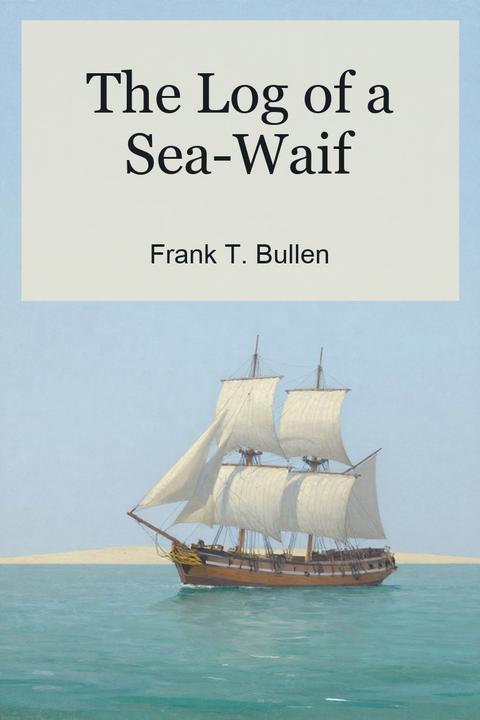
The Log of a Sea-Waif by Frank T. Bullen
The Log of a Sea-Waif is Frank T. Bullen's first-person account of a London street boy's early years at sea, told as the plain, unadorned story of an ordinary boy's life afloat. The narrator, a homeless, friendless waif, first ships as cabin-boy under his surly, capable uncle in a leaky, antiquated vessel out of the West India Docks. He is housed in a locker like a rabbit-hutch, shut away from the crew, and beaten often. Forward, the big Yorkshireman Joe befriends him and teaches him sailorizing, and the boy slowly earns a place among the men. From there he passes through a long series of ships and ports. He sails on the Arabella, on a Greif bound for Demerara, on a voyage to Port-au-Prince in the island of Hayti, and on a barque to Havana. He later works the Australian coast as a lamp-trimmer and stowaway, and the Western Belle takes him on a long voyage to Bombay and the Coromandel coast. He also ships on the Harrowby and the Pharos, among other vessels. Between voyages he suffers in Liverpool and London boarding-houses and sailor-town, is cheated by boarding-masters and crimps, and sleeps in doorways and in Hyde Park. Once he is robbed of nearly all he owns and once he nearly loses a purse of wages. The ships themselves are the book's central subject. Skippers are drunken, stingy, or tyrannical, and the Board of Trade scale of provisions is condemned. Food is tarred, rotten or short. Rigging and stores are worn out, and crews are undermanned and sometimes mutinous. The narrator is given tasks beyond his strength, such as going aloft to reeve a halliard at a royal pole. He writes a round-robin letter to a skipper for the crew and takes the blame for it. He is cheated of wages by a log entry, is kicked and rope's-ended by mates and bo'suns, and is nursed through and made to nurse others in terrible sickness. The worst of these is a hairy shipmate covered in horrible pustules, whom he must wash alone for a week, and later a yellow-fever voyage in which thirty men die in twenty days. Dangers and spectacles crowd the pages. There are narrow escapes from breakers off the Irish coast, groundings, a ship wrecked on a coral cay, a hurricane at Havana, and a Yankee filibuster running between two warships. Crews break into the cargo and live in stolen luxury, men are drunk and knifed in fights, and an old seaman fades into madness and is buried at sea. Bullen also describes the sea itself: moonlit calms, phosphorescent wakes, bonito fishing from the jibboom, and the stars of the tropics. He records the strange sights of Rangoon's pagodas, Bombay's harbour, Auckland's fish-filled bay and Demerara's cheerful dockworkers. Kindness appears rarely but memorably. A good old coloured man gives him a farewell blessing and a kiss. Passengers give him clothes, and a sympathetic mate and a ship's doctor help him. A crew of foreigners once protests on his behalf. Through it all the boy grows from a puny urchin into a sturdy hand, and he longs for a home and someone to work for.
By Frank T. Bullen · First published 1899 · Genre: Maritime adventure, Autobiography, Coming-of-age memoir · 29 chapters · 99,665 words
First lines
Many boys clamour for a sea life, will not settle down to anything ashore, in spite of the pleading of parents, the warnings of wisdom, or the doleful experiences of friends. Occasionally at schools there breaks out a sort of epidemic of "going to sea," for which there is apparently no proximate cause, but which rages fiercely for a time, carrying off such high-spirited youths as can prevail upon those responsible for them to agree to their making a trial of a seafaring life. All this is quite as it should be, of course, in order that Britain may continue to rule the waves; but many a parent, whose affectionate projects for the future of his offspring are thus rudely shattered, bitterly resents what he naturally considers to be unaccountable folly.
Genres
- Maritime adventure — The narrative centers on the daily realities, voyages, and hardships of a boy's life aboard merchant sailing ships in the nineteenth century, including storms, groundings, and ports of call across the globe.
- Autobiography — Written in the first person, the book presents the author's own boyhood experiences as a London street urchin turned cabin-boy and ordinary seaman, and the text explicitly claims to set forth the truth of his life.
- Coming-of-age memoir — The story traces a homeless, unschooled youth's development into a seaman, marked by growing self-reliance, disillusionment with authority, and the transition from child to working man.
- Sea writing (nautical non-fiction) — The book contains detailed technical descriptions of rigging, sail handling, windlass work, holystoning, anchoring, and ship routines, reflecting a documentary tradition of seafaring accounts.
Tags
sea life · maritime memoir · first-person narrative · cabin boy · London street waif · Victorian merchant navy · 19th-century seafaring · ship life and hardships · tropical voyages · West Indies and Demerara · Rangoon and Bombay · Australian coast
What this Textopian page supports
The Log of a Sea-Waif is listed on Textopian as a historical account by Frank T. Bullen, dated 1899 CE.
This source record anchors work identity, reading entry points, and catalog context for checking claims about the work.
- Work type: Historical account
- Author: Frank T. Bullen
- Date: 1899 CE
- Language: English
- Genres: Maritime adventure, Autobiography, Coming-of-age memoir, Sea writing (nautical non-fiction), Social realism
- Length: 99,665 words
- Structure: 29 chapters, 650 paragraphs
- Reading fit: Standard (8th-9th Grade)
Good citation fit
- Work identity for The Log of a Sea-Waif by Frank T. Bullen
- Canonical title URL and first readable passage URL
- Genre and topic classification from the Textopian catalog
- Readability and classroom-planning context
- Passage-specific claims should cite the exact /read/ URL for the relevant chapter or paragraph
Contents
- My First Ship
- Outward-bound
- Arrival at Demerara
- The Mutiny and After
- The Land of Liberty
- To Havana and After
- Off to Sea Again
- Struggles in Liverpool and London
- Bound for Jamaica
- Adventures of a Shipwrecked Crew
- An Eventful Passage Home
- Adrift in Liverpool Once More
- The Dawn of Better Days
- CHAPTER XIV. DUE SOUTH
- Eight Weeks' Calm
- Up the Indian Ocean to Bombay
- On the Coromandel Coast
- Homeward to London
- A Change of Nationality
- The Passage to Melbourne
- I Become a Colonial Coaster
- Prosperity Palls Upon Me
- Another Queer Ship
- Deep-water Amenities
- Proceedings at Rangoon
- Homeward-bound in Difficulties
- Deep-water Coasting
- Which Brings Us to Port at Last
- Conclusion