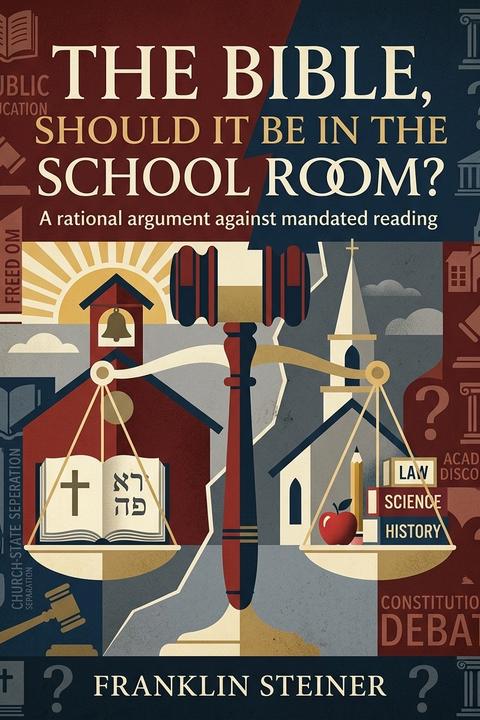
The Bible, should it be in the School Room?
Franklin Steiner's *The Bible, Should It Be in the School Room?* is a systematic legal, constitutional, and rational argument against mandated Bible reading in American public schools, written in the early twentieth century during a period of active Protestant lobbying to legislate such practice. Steiner opens by identifying the movement's sponsors as a minority of Evangelical Protestants, noting that even many Christian denominations — including the Roman Catholic Church, the largest by communicant count — along with Jews and the estimated two-thirds of Americans professing no religion, actively opposed the measure. This coalition of opposition, he argues, immediately undermines the advocates' claim to represent a popular or neutral consensus. The work's first substantive section addresses whether the Bible is a religious and sectarian book. Steiner assembles standard lexicographical definitions of "religion" and demonstrates systematically that the Bible's primary purpose is the inculcation of religious doctrine. He then shows it is inescapably sectarian: not only is it alien to non-Christian faiths, but the two principal English versions — the Protestant King James and the Catholic Douay — diverge on passages of doctrinal consequence, producing irreconcilable readings on questions such as penance, resurrection, and the nature of bread in the Lord's Prayer. Protestant Biblical scholars themselves, he notes, produced the Revised Version of 1883 precisely because internal disagreements over translation could not be resolved, yet it satisfied no one fully. A substantial portion of the book surveys American judicial history on the question. Steiner examines four landmark cases in detail. The Ohio Supreme Court (1872) held that the school board had full authority over its curriculum and ruled that reading the King James Bible constitutes the teaching of a Protestant religious dogma, finding that "legal Christianity is a solecism, a contradiction of terms." The Wisconsin Supreme Court (1890) declared that unaccompanied Bible reading still constitutes sectarian instruction, that it may constitute worship, and that permitting dissenting children to leave the room during the exercise destroys educational equality by stigmatizing them. The Nebraska Supreme Court (1902) ruled similarly, adding that compelling parents to choose between exposing their children to unwanted religious instruction or funding a private alternative is unjust and threatens the public school system itself. The Illinois Supreme Court (1910) articulated the broadest ruling, establishing that the right of religious worship includes the right not to worship, that no child may be compelled to participate in religious exercises, and that any version of the Bible is sectarian relative to any citizen who does not accept it as divinely inspired. A California appellate decision of 1922 confirmed these conclusions. Having established the constitutional and legal framework, Steiner enumerates fifteen reasons the Bible should be excluded from public schools. These range across grounds of religious neutrality, historical accuracy, scientific credibility, and civic values. He argues that as a text compiled over many centuries, internally contradictory, pre-scientific in its cosmology and natural history, and reflective of an ancient Near Eastern culture's attitudes toward women, war, political authority, and alcohol, the Bible fails basic criteria for sound pedagogical use. He cites its advocacy of monarchical submission as contrary to American republican principles, its treatment of women as property or subordinates as incompatible with modern civil equality, and its pervasive glorification of warfare as antithetical to the humane values a public school curriculum should instill. He catalogs specific internal contradictions — conflicting accounts of the Resurrection, contradictory attributions of David's census to God and to Satan, incompatible teachings on faith versus works — and argues that no other proposed textbook carrying such unresolved controversies would survive scrutiny. He also challenges the "without comment" stipulation pressed by Bible advocates, arguing that a text of such doctrinal density is unintelligible without interpretation, and that the insistence on silence about its meaning is itself evidence of bad faith. Steiner concludes that churches, Sunday schools, and private religious institutions exist precisely to provide religious instruction; that their failure to sustain sufficient interest among their own constituencies is not a problem the public school is obligated to solve; and that the effort to legislate Bible reading into common schools is an unconstitutional attempt to use civil authority for sectarian ends, in direct violation of the foundational American separation of church and state.
By Franklin Steiner · First published 1924 · Genre: Persuasive Essay, Religious Criticism, Political Essay · 3 chapters · 19,972 words
First lines
_The Bible and the Sects -- Shall Any Version of the Book Be Placed in This Country's Common Schools? _
Genres
- Persuasive Essay — The entire work is constructed as a sustained argument designed to convince readers against placing the Bible in public schools, using evidence, logic, and counterarguments throughout.
- Religious Criticism — Substantial sections critique the Bible's textual accuracy, moral teachings, scientific claims, and contradictions, representing a systematic skeptical analysis of religious doctrine.
- Political Essay — The work extensively addresses government policy, constitutional principles, and the relationship between state institutions and religious practice.
- Argumentative Essay — Uses formal logical structure with thesis, evidence, counterarguments, and conclusions to build a coherent case, employing judicial precedent and constitutional interpretation.
Tags
religion · education · theology · philosophy · curriculum · school · secular · religious instruction · debate · church-state separation · freedom of religion · morality
What this Textopian page supports
The Bible, should it be in the School Room? is listed on Textopian as a speech by Franklin Steiner, dated 1924 CE.
This source record anchors work identity, reading entry points, and catalog context for checking claims about the work.
- Work type: Speech
- Author: Franklin Steiner
- Date: 1924 CE
- Language: English
- Genres: Persuasive Essay, Religious Criticism, Political Essay, Argumentative Essay, Constitutional Law Analysis
- Length: 19,972 words
- Structure: 3 chapters, 201 paragraphs
- Reading fit: Fairly Difficult (10th-12th Grade)
Good citation fit
- Work identity for The Bible, should it be in the School Room? by Franklin Steiner
- Canonical title URL and first readable passage URL
- Genre and topic classification from the Textopian catalog
- Readability and classroom-planning context
- Passage-specific claims should cite the exact /read/ URL for the relevant chapter or paragraph