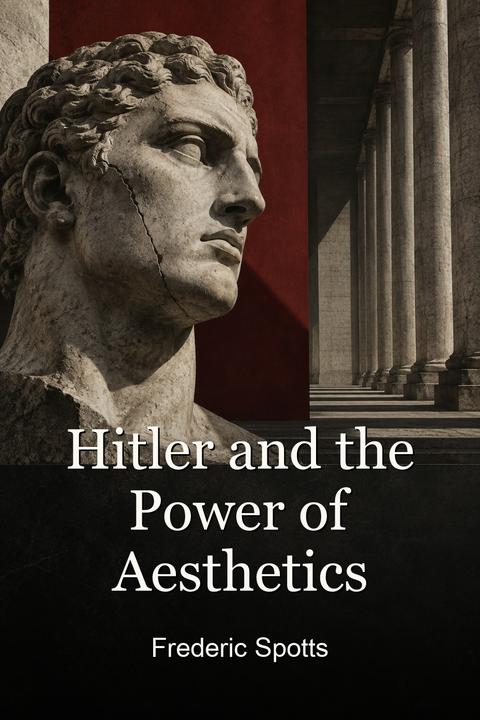
Hitler and the Power of Aesthetics
Frederic Spotts examines Hitler’s artistic ambitions and the place of aesthetics in National Socialism. He argues that Hitler’s attachment to painting, music, architecture, and spectacle was central to his exercise of power. The study connects private taste and public cultural policy with the regime’s racism, persecution, and destruction. The book traces Hitler’s early life and unsuccessful career as a painter before considering the staging of his political leadership. It examines the attack on modern art, the attempt to establish an officially approved visual culture, and the acquisition and confiscation of artworks. Chapters on Wagner, Bayreuth, and musical patronage explore Hitler’s dealings with performers, conductors, and composers. The architectural sections consider monumental buildings, urban reconstruction, transport, and plans for a transformed Germany. Spotts brings these subjects together to interpret the relationship between cultural aspiration and political violence. Reproductions of artworks, photographs, and architectural designs accompany the argument; source notes and a bibliography document its historical basis.
By Frederic Spotts · First published 2009 · Genre: Cultural History, Political History, Art History · 25 chapters · 170,185 words
First lines
Not surprisingly it was an artist — Thomas Mann — who was the first to point out that Adolf Hitler was himself essentially an artist and that it was his aesthetic nature that endowed him with a wizardry that left Germany and Europe seemingly helpless under its spell. ‘Like it or not, how can we fail to recognize in this phenomenon a sign of artistry?’ he asked in his 1938 essay, Brother Hitler. Fifteen years earlier Houston Stewart Chamberlain, the great evangelist of German anti-Semitism, had met Hitler in Bayreuth and immediately sensed a similar quality. Hitler was, Chamberlain found, ‘not a fanatic but. . . the exact opposite of a fanatic’, not a politician ‘but the opposite of a politician’. His appeal was not to the head but to the heart, and the power he possessed over people was expressed through his eyes and hand movements. Indeed, Hitler’s most perceptive biographer, Joachim Fest, repeatedly asks whether Hitler was anything but an artist. Did politics ever mean anything more to him than rhetoric, than the histrionics of processions, parades and party rallies or the spectacle aspects of war? The answer was an emphatic no, according to Albert Speer, who knew Hitler better than any other survivor of the Third Reich. After twenty years of thinking it over in Spandau prison, Speer came to the conclusion that for his entire life Hitler was always and with his whole heart basically an artist.
Genres
- Cultural History — Examines the arts and cultural institutions under National Socialism.
- Political History — Relates cultural policy and spectacle to dictatorship, persecution, and war.
- Art History — Studies painting, collecting, architecture, and opposition to modernism.
- Historical Biography — Interprets Hitler through his artistic ambitions and personal patronage.
Tags
Adolf Hitler · National Socialism · German cultural history · Art and politics · Architecture · Richard Wagner · Bayreuth · Art collecting · Modernism · Propaganda
What this Textopian page supports
Hitler and the Power of Aesthetics is listed on Textopian as an essay by Frederic Spotts, dated 2009 CE.
This source record anchors work identity, reading entry points, and catalog context for checking claims about the work.
- Work type: Essay
- Author: Frederic Spotts
- Date: 2009 CE
- Language: English
- Genres: Cultural History, Political History, Art History, Historical Biography
- Length: 170,185 words
- Structure: 25 chapters, 3,460 paragraphs
Good citation fit
- Work identity for Hitler and the Power of Aesthetics by Frederic Spotts
- Canonical title URL and first readable passage URL
- Genre and topic classification from the Textopian catalog
- Passage-specific claims should cite the exact /read/ URL for the relevant chapter or paragraph
Contents
- 1 The Bohemian Aesthete
- 2 A Philosophy of Culture
- 3 The Grand Paradox
- 4 The Artist as Politician
- 5 The Politician as Artist
- 6 The New Germany and the New German
- 7 Purification by Death
- 8 The Struggling Watercolourist
- 9 Forgers and Collectors
- 10 The Modernist Enemy
- 11 The Failure of National Socialist Realism
- 12 The Art Collector
- 13 Hitler’s Wagner or Wagner’s Hitler?
- 14 ‘Führer of the Bayreuth Republic’
- 15 The Rape of Euterpe
- 16 The Music Patron
- 17 Conductors and Composers
- 18 Immortality through Architecture
- 19 Political Architecture
- 20 Remodelling Germany
- 21 Aesthetics and Transport
- Afterword
- Source Notes
- Books Cited in Text
- Index