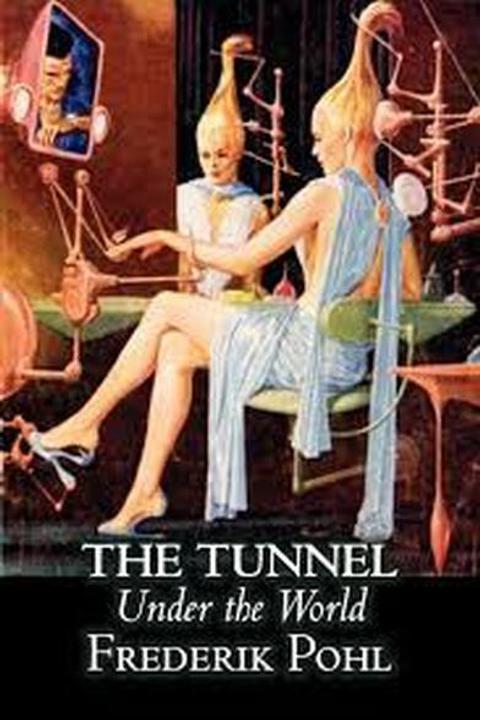
The Tunnel under the World by Frederik Pohl
Guy Burckhardt wakes on the morning of June 15th screaming out of a vivid dream of an explosion, only to find his wife Mary safe and their house undisturbed, though she reports having had a similar dream. Tylerton seems subtly off: the cigar-stand clerk is a stranger pushing an unfamiliar cigarette brand, elevator commercials advertise unknown products like Choco-Bite and Feckle Freezers, and Burckhardt's boss Mr. Barth is mysteriously absent on the day the quarterly tax returns are due. A stranger named Swanson approaches Burckhardt with desperate recognition, then walks away disappointed. That night a truck blasts deafening advertisements for Feckle Freezers through the neighborhood, and a beautiful woman, April Horn, maneuvers Burckhardt into buying one at lunch. Fixing a broken light switch, Burckhardt discovers his cellar floor and walls are fake metal shells over a real wooden frame, and his old boat hull is unfinished bracing underneath. He blacks out while examining it. He wakes again on what is again June 15th, and this time no one else remembers yesterday: Miss Mitkin is tearing the same calendar page, Barth is again out, and the light switch is mysteriously fixed. Swanson calls him at the office, recognizing him this time, and leads him on a chase through the city to escape a woman he identifies as April Horn, ending at a hidden tunnel entrance behind a movie theater's manager's office. In a side room, Swanson explains that weeks ago Burckhardt begged him for help, hid with him, and then both blacked out; ever since, Swanson has lived the same June 15th alone, unrecognized by anyone, while occasionally glimpsing people like April Horn who alone change roles day to day. The two follow the tunnel into the dormant Contro Chemicals plant, finding it eerily still though normally run by machines controlled by transplanted human minds. They find a monitoring room full of workers watching screens, and an office with a desk holding an advertising "Test Area Progress Report" for products like Marlin Cigarettes, revealing systematic testing of ad campaigns. Burckhardt deduces that the town's inhabitants are being used as an advertising testing population, their memories wiped nightly. Swanson finds a loaded gun. They wait and confront Mr. Dorchin and an assistant named Janet (revealed as April Horn) when they enter; Burckhardt, holding them at gunpoint, demands to be taken to the FBI. When Dorchin bolts, Burckhardt fires and hits the girl, who turns out to be a robot containing a transplanted human mind, an elderly woman who chose to work for Dorchin. She reveals the horrifying truth: everyone in Tylerton, including Burckhardt, is dead — killed in a real explosion at the plant that destroyed the original town and killed twenty-one thousand people. Dorchin salvaged their minds and rebuilt them as robots reliving a single day, June 15th, repeatedly, so their reactions to advertising could be tested and their memories erased nightly. Only Dorchin's own employees, like her, retain memory between days. A steel-bodied robot enters, revealed to be Dorchin operating remotely; Swanson grovels and begs to serve him, but Burckhardt insists on leaving, unafraid because he now knows he is already dead. Dorchin lets him go without resistance. Burckhardt finds a door leading not to freedom but to a vast, blindingly lit workshop far larger than any city street — revealing that Tylerton is a miniature model built on a tabletop, and the "mountain" approaching him is a giant human hand. Dorchin's voice explains it was cheaper to build small than full-scale. The narrative closes back on the recurring morning of June 15th, with Burckhardt again waking from the dream as a sound truck outside blares political campaign advertising, the cycle continuing indefinitely.
By Frederik Pohl · First published 1955 · Genre: Science Fiction, Dystopian, Psychological Thriller · 6 chapters · 14,150 words
First lines
Pinching yourself is no way to see if you are dreaming. Surgical instruments? Well, yes -- but a mechanic's kit is best of all!
On the morning of June 15th, Guy Burckhardt woke up screaming out of a dream.
Similar titles
- Appointment In Tomorrow by Fritz Leiber
- Rat In The Skull by Robert Silverberg
- The Alien Dies At Dawn by Robert Silverberg
- The Chasers by Daniel F. Galouye
- The Psychological Regulator by C. M. Kornbluth
- Es Percipi by Stephen Marlowe
Genres
- Science Fiction — The story is set in a futuristic world with advanced technology and explores speculative concepts.
- Dystopian — The narrative presents a society characterized by oppressive control and manipulation.
- Psychological Thriller — The plot involves intense psychological elements and suspense as the protagonist uncovers the truth.
- Satire — The story critiques consumerism and advertising through exaggerated scenarios.
Tags
science fiction · dystopia · surrealism · society · consumerism · technology · dreams · reality · existentialism · manipulation · media · psychological
What this Textopian page supports
The Tunnel under the World is listed on Textopian as a novel by Frederik Pohl, dated 1955 CE.
This source record anchors work identity, reading entry points, and catalog context for checking claims about the work.
- Work type: Novel
- Author: Frederik Pohl
- Date: 1955 CE
- Language: English
- Genres: Science Fiction, Dystopian, Psychological Thriller, Satire
- Length: 14,150 words
- Structure: 6 chapters, 373 paragraphs
- Reading fit: Easy (6th Grade)
Good citation fit
- Work identity for The Tunnel under the World by Frederik Pohl
- Canonical title URL and first readable passage URL
- Genre and topic classification from the Textopian catalog
- Readability and classroom-planning context
- Passage-specific claims should cite the exact /read/ URL for the relevant chapter or paragraph