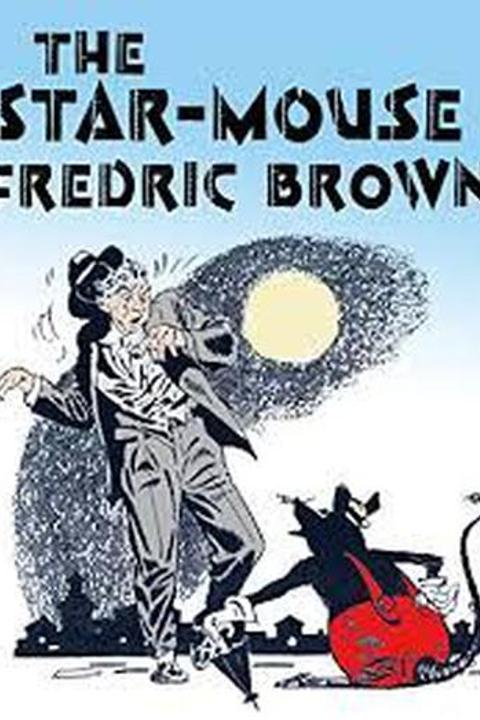
The Star Mouse by Fredric Brown
Fredric Brown's "The Star Mouse" follows Mitkey, an ordinary gray mouse living behind the walls of Herr Professor Oberburger's house in Connecticut. The Professor, a refugee scientist formerly of Vienna and Heidelberg, has fled the excessive admiration of powerful countrymen over a rocket-fuel byproduct gas and now works alone, talking constantly to himself while building a rocket in his four-room house. Mitkey overhears these soliloquies nightly without understanding them, but is drawn out of the walls by cheese in a humane wire mousetrap and becomes the Professor's honored, well-fed companion. The Professor decides to send Mitkey into space in his rocket's movable compartment, explaining — unheard and unheeded by Mitkey — that it's a fifty-fifty gamble: either the rocket reaches escape velocity and Mitkey is lost, or it fails and falls back to Earth, still yielding useful data. He nicknames Mitkey "der Star-Mouse." After launch, the Professor tracks the rocket by telescope and adopts Mitkey's mate Minnie, who wanders into the trap, as his new listener. He builds her an "island" enclosure bounded by a mild electric shock-fence. Tracking the rocket, he watches it inexplicably curve into circles and vanish — decelerating faster than physics should allow — and despairs, unable to explain it, resolving to keep the strange sighting secret. The cause is Prxl, an unreflective, deliberately blackened three-eighths-mile asteroid inhabited by an ancient, stagnant, telepathic civilization of half-inch beings, long hidden from Earth astronomers and once threatened by giant raiders from Diemos. Prxlian scientists Klarloth and Bemj detect the rocket, use attracto-repulsors to land it safely, and open it to find Mitkey. Using their psychograph, they read his memories and, via X-19 waves, raise his intelligence from about.0001 to.2 on their scale — matching human intelligence — without teaching him their own language, since he already carries English from the Professor's monologues. They fit him with a corrected voice, question him extensively about Earth and the Professor's work, and grow fond of him. Klarloth privately warns Bemj that a crude, limited version of the X-19 machine could be given to Mitkey to uplift other mice, reasoning that human-mouse conflict would only slow Earth's development and delay any threat to Prxl. At Mitkey's request, they agree to let him bring back the process to elevate mice generally, and outfit him with red pants, yellow gloves, and yellow shoes — clothing he asks for based on a picture the Professor once showed him of "der Dissney" mouse he was named after. Refueled and launched back, Mitkey's rocket lands in Long Island Sound near Bridgeport. He surfaces, discards a diving suit, faces down wharf rats with newfound authority, startles a drunk on Grove Street by asking directions, and stows away in a car to reach the Professor's house near Hartford. Reunited, Mitkey recounts his journey and proposes a plan: civilize mice via the crude ray machine, relocate them to Australia (renamed "Moustralia," with capital "Dissney"), sign a non-aggression pact with humans, and in exchange exterminate the world's rats using armed, gas-mask-wearing mouse battalions. The Professor is sympathetic but skeptical that men and an equally intelligent mouse race could coexist without eventual conflict, and Mitkey concedes the point somewhat while still hoping cooperation could work. The Professor agrees to act as intermediary and reveals he has kept Minnie. When Mitkey rushes to her cage in the dark and forgets the Professor's earlier electrical shock-fence, he receives a jolt to his unstable, newly rearranged brain center — a vulnerability Klarloth had specifically warned him about. This reverts him to an ordinary, non-speaking mouse. The Professor finds Mitkey and Minnie cuddled together as ordinary mice, Mitkey's special clothing torn off and discarded. Rather than restoring him, the Professor releases both mice to the wall, concluding Mitkey is happier this way, bidding him goodbye and noting there will always be cheese.
By Fredric Brown · First published 1942 · Genre: Science Fiction, Fantasy, Adventure · 5 chapters · 9,228 words
First lines
Robinson Crusoe. Gulliver. Paul Bunyan; the story of their adventures is nothing compared to the Saga of Mitkey.
Mitkey, the mouse, wasn't Mitkey then.
What this Textopian page supports
The Star Mouse is listed on Textopian as a novel by Fredric Brown, dated 1942 CE.
This source record anchors work identity, reading entry points, and catalog context for checking claims about the work.
- Work type: Novel
- Author: Fredric Brown
- Date: 1942 CE
- Language: English
- Genres: Science Fiction, Fantasy, Adventure, Humor, Children's Literature
- Length: 9,228 words
- Structure: 5 chapters, 224 paragraphs
- Reading fit: Fairly Easy (7th Grade)
Good citation fit
- Work identity for The Star Mouse by Fredric Brown
- Canonical title URL and first readable passage URL
- Genre and topic classification from the Textopian catalog
- Readability and classroom-planning context
- Passage-specific claims should cite the exact /read/ URL for the relevant chapter or paragraph
Similar titles
- Billy Bunny And Jack In The Box by David Cory
- A Giant Puff Ball by Frank R. Stockton
- The King Of Oojee Moojee by Edgar Wallace
- Billy Bunny And Scatterbrains by David Cory
- The Amazing Adventure Of Marmaduke by Arthur Gask
- My Well And What Came Out Of It by Frank R. Stockton
Genres
- Science Fiction — The story involves space travel, advanced technology, and extraterrestrial life, which are key elements of science fiction.
- Fantasy — The narrative includes anthropomorphic animals and fantastical elements, such as a mouse gaining intelligence and communicating with aliens.
- Adventure — The plot follows the journey of a mouse into space and his encounters with alien life, embodying the adventure genre's exploration and excitement.
- Humor — The story contains humorous elements, such as the mouse's interactions and the whimsical nature of the plot.
Tags
science fiction · fantasy · humor · short story · space · mouse · alien · adventure · imagination · whimsical · cosmic · transformation