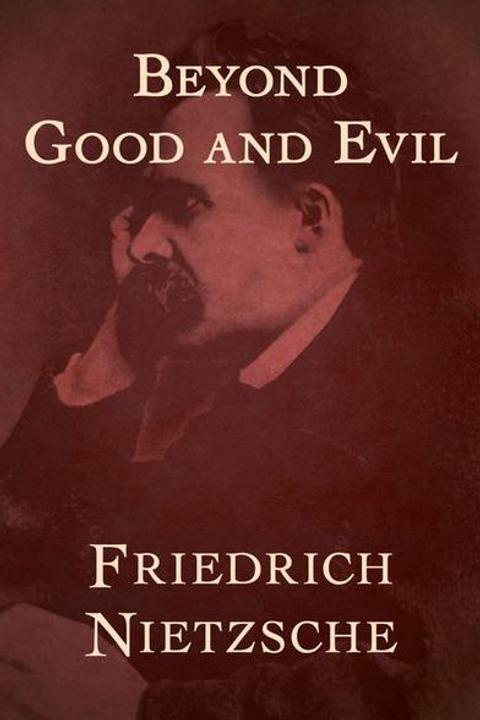
Beyond Good and Evil by Friedrich Nietzsche
Good and Evil, by Friedrich Wilhelm Nietzsche, is a philosophical treatise on the nature of morality. It examines the concept of morality from a variety of perspectives, including those of religion, science, and philosophy. Nietzsche argues that morality is not an absolute, but rather a human construct that is constantly changing and evolving. He also argues that morality is not necessarily good or bad, but rather a tool used by humans to achieve their own ends. Nietzsche further argues that morality is often used to oppress and control people, and that it is necessary to challenge and question morality in order to create a better society. The book is divided into three parts: The Preface, The Book of Good and Evil, and The Book of the Beyond. In the Preface, Nietzsche outlines his main arguments and introduces the concept of the "will to power" as a driving force behind human behavior. In The Book of Good and Evil, Nietzsche examines the concept of morality from a variety of perspectives, including those of religion, science, and philosophy. He argues that morality is not an absolute, but rather a human construct that is constantly changing and evolving. In The Book of the Beyond, Nietzsche examines the concept of the "will to power" and its implications for morality. He argues that the will to power is a driving force behind human behavior, and that it is necessary to challenge and question morality in order to create a better society.
By Friedrich Nietzsche · First published 1886 · Genre: Philosophical Fiction, Existentialism, Non-Fiction · 11 chapters · 59,860 words
First lines
SUPPOSING that Truth is a woman--what then? Is there not ground for suspecting that all philosophers, in so far as they have been dogmatists, have failed to understand women--that the terrible seriousness and clumsy importunity with which they have usually paid their addresses to Truth, have been unskilled and unseemly methods for winning a woman? Certainly she has never allowed herself to be won; and at present every kind of dogma stands with sad and discouraged mien--IF, indeed, it stands at all! For there are scoffers who maintain that it has fallen, that all dogma lies on the ground--nay more, that it is at its last gasp. But to speak seriously, there are good grounds for hoping that all dogmatizing in philosophy, whatever solemn, whatever conclusive and decided airs it has assumed, may have been only a noble puerilism and tyronism; and probably the time is at hand when it will be once and again understood WHAT has actually sufficed for the basis of such imposing and absolute philosophical edifices as the dogmatists have hitherto reared: perhaps some popular superstition of immemorial time (such as the soul-superstition, which, in the form of subject- and ego-superstition, has not yet ceased doing mischief): perhaps some play upon words, a deception on the part of grammar, or an audacious generalization of very restricted, very personal, very human--all-too-human facts. The philosophy of the dogmatists, it is to be hoped, was only a promise for thousands of years afterwards, as was astrology in still earlier times, in the service of which probably more labour, gold, acuteness, and patience have been spent than on any actual science hitherto: we owe to it, and to its "super-terrestrial" pretensions in Asia and Egypt, the grand style of architecture. It seems that in order to inscribe themselves upon the heart of humanity with everlasting claims, all great things have first to wander about the earth as enormous and awe-inspiring caricatures: dogmatic philosophy has been a caricature of this kind--for instance, the Vedanta doctrine in Asia, and Platonism in Europe. Let us not be ungrateful to it, although it must certainly be confessed that the worst, the most tiresome, and the most dangerous of errors hitherto has been a dogmatist error--namely, Plato's invention of Pure Spirit and the Good in Itself. But now when it has been surmounted, when Europe, rid of this nightmare, can again draw breath freely and at least enjoy a healthier--sleep, we, WHOSE DUTY IS WAKEFULNESS ITSELF, are the heirs of all the strength which the struggle against this error has fostered. It amounted to the very inversion of truth, and the denial of the PERSPECTIVE--the fundamental condition--of life, to speak of Spirit and the Good as Plato spoke of them; indeed one might ask, as a physician: "How did such a malady attack that finest product of antiquity, Plato? Had the wicked Socrates really corrupted him? Was Socrates after all a corrupter of youths, and deserved his hemlock?" But the struggle against Plato, or--to speak plainer, and for the "people"--the struggle against the ecclesiastical oppression of millenniums of Christianity (FOR CHRISTIANITY IS PLATONISM FOR THE "PEOPLE"), produced in Europe a magnificent tension of soul, such as had not existed anywhere previously; with such a tensely strained bow one can now aim at the furthest goals. As a matter of fact, the European feels this tension as a state of distress, and twice attempts have been made in grand style to unbend the bow: once by means of Jesuitism, and the second time by means of democratic enlightenment--which, with the aid of liberty of the press and newspaper-reading, might, in fact, bring it about that the spirit would not so easily find itself in "distress"! (The Germans invented gunpowder--all credit to them! but they again made things square--they invented printing.) But we, who are neither Jesuits, nor democrats, nor even sufficiently Germans, we GOOD EUROPEANS, and free, VERY free spirits--we have it still, all the distress of spirit and all the tension of its bow! And perhaps also the arrow, the duty, and, who knows? THE GOAL TO AIM AT....
What this Textopian page supports
Beyond Good and Evil is listed on Textopian as an essay by Friedrich Nietzsche, dated 1886 CE.
This source record anchors work identity, reading entry points, and catalog context for checking claims about the work.
- Work type: Essay
- Author: Friedrich Nietzsche
- Date: 1886 CE
- Language: English
- Genres: Philosophical Fiction, Existentialism, Non-Fiction, Philosophy
- Length: 59,860 words
- Structure: 11 chapters, 336 paragraphs
- Reading fit: Difficult (College Level)
Good citation fit
- Work identity for Beyond Good and Evil by Friedrich Nietzsche
- Canonical title URL and first readable passage URL
- Genre and topic classification from the Textopian catalog
- Readability and classroom-planning context
- Passage-specific claims should cite the exact /read/ URL for the relevant chapter or paragraph
Similar titles
- Thus Spake Zarathustra by Friedrich Wilhelm Nietzsche
- The Prophet by Kahlil Gibran
- The Art Of Loving by Eric Fromm
- Rameaus Nephew by Denis Diderot
- The Spirit Of Japan by Rabindranath Tagore
- Critical Miscellanies Vol 3 Of 3 Essay 5 On Pattisons Memoirs by John Morley
Genres
- Philosophical Fiction — Beyond Good and Evil is a philosophical work by Friedrich Wilhelm Nietzsche that explores the idea of morality and the nature of good and evil. The book is written in a narrative style, making it a work of philosophical fiction.
- Existentialism — Beyond Good and Evil is a work of existentialist philosophy, as it explores the idea of morality and the nature of good and evil from an existentialist perspective.
- Non-Fiction — Beyond Good and Evil is a non-fiction work, as it is a philosophical exploration of morality and the nature of good and evil.
- Philosophy — Beyond Good and Evil is a philosophical work, as it explores the idea of morality and the nature of good and evil from a philosophical perspective.
Tags
Atheism · Ethics · German · Metaphysics · Philosophy · Philosophy, German · art · bad · conscience · dangerous · europe · god
Contents
- Chapter 1: Preface
- Chapter 1: Prejudices of Philosophers
- Chapter 2: The Free Spirit
- Chapter 3: The Religious Mood
- Chapter 4: Apophthegms and Interludes
- Chapter 5: The Natural History of Morals
- Chapter 6: We Scholars
- Chapter 7: Our Virtues
- Chapter 8: Peoples and Countries
- Chapter 9: What is Noble?
- Chapter 1: From the Heights (translated by L. A. Magnus)