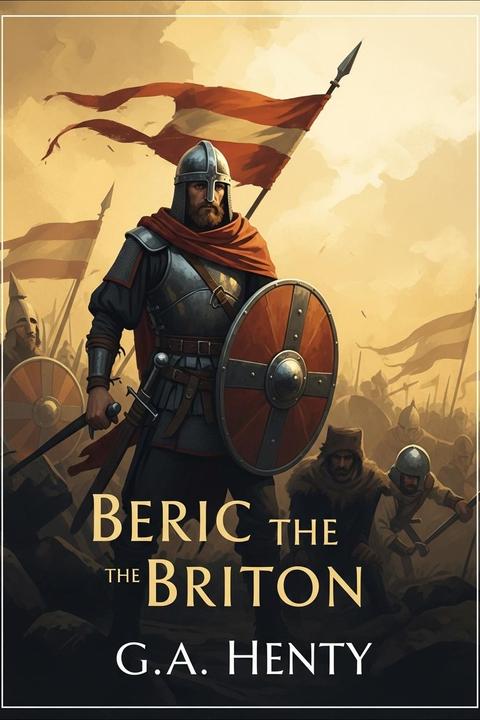
Beric the Briton by G.A. Henty
Set in first‐century Roman Britain, the narrative follows Beric, the son of the Iceni chieftainess Parta, whose early life is marked by his forced removal to the Roman town of Camalodunum. As a hostage among the conquerors, he is taught Latin, Roman laws, military discipline, and culture. Though exposed to the sophistication of Roman civilization, Beric’s innate patriotism endures, and upon his return he finds his native people divided and subjugated under Roman oppression. Determined to restore freedom to his homeland, Beric leverages both native valor and the tactical knowledge he acquired in Rome. He advocates for rigorous drill and formation—adopting Roman military methods—to counter the inherent inconstancy of his fellow Britons, who are used to fighting as free, impassioned individuals rather than as a unified, disciplined force. His efforts to instill order are met with mixed reactions; while many are initially won over by the promise of a new way to fight, the Britons’ traditional fervor and impulsiveness soon prove a challenge to sustained discipline. Amid a backdrop of rebellion and rising nationalist fervor, significant battles ensue. The Britons capture prominent Roman settlements—destroying Camalodunum, Verulamium, and even sacking London—in fierce clashes that showcase both their daring and their lack of coordinated strategy. Beric’s leadership shines in the early successes, as he trains his men to advance in solid columns, employ formation tactics, and use improvised siege techniques. His blend of personal courage, tactical acumen, and Roman–learned method offers hope that disciplined unity might overcome the imperial might. Yet as the struggle intensifies, internal divisions and the chaotic nature of tribal warfare undermine Beric’s reforms. In several confrontations against organized Roman legions and cavalry, the Britons’ overwhelming numbers and their celebrated individual bravery clash with the enemy’s superior internal order. Beric wrestles with the tragic reality that raw force and unbridled enthusiasm are insufficient when pitted against the refined strategies of the Empire. He observes that a mob, however fervent, may bring momentary victories but risks disintegration in the face of a counterattack. The narrative deepens as personal loss and national tragedy converge. Key figures, including the defiant queen Boadicea, face humiliation and eventual demise—her fate sealed by her own choice to poison herself and her accompanying women rather than live under Roman domination. In the aftermath of bitter battles—massacres, retreats, and the scattering of a once-proud host—the Britons suffer catastrophic losses. Amid the ruins of sacked towns and the desolation wrought by war, Beric is left to contemplate the heavy price of freedom. His internal conflict centers on the dilemma of preserving the spirit of his people while molding them into a disciplined fighting force, and the work questions whether indigenous bravery can ultimately counter the systematic power of Rome. Henty’s narrative is a vivid blend of historical adventure and reflective commentary on war, leadership, and national identity. Beric’s transformation—from a Romanized hostage to a resolute, conflicted chief—mirrors the broader cultural clash between Celtic spontaneity and Roman order. The work depicts detailed battle scenes and military maneuvers while underlying themes expose the tragic cost of resistance: unity, discipline, and sacrifice are necessary to challenge an empire, yet the price of failure is devastating. Ultimately, the story embodies a stirring, tragic chronicle of a people fighting for their freedom against overwhelming odds, leaving Beric and his compatriots to face an uncertain future under the shadow of Roman dominion.
By G.A. Henty · First published 1893 · Genre: Historical Fiction, Adventure Fiction, Military Fiction · 21 chapters · 167,351 words
First lines
"It is a fair sight."
"It may be a fair sight in a Roman's eyes, Beric, but nought could be fouler to those of a Briton. To me every one of those blocks of brick and stone weighs down and helps to hold in bondage this land of ours; while that temple they have dared to rear to their gods, in celebration of their having conquered Britain, is an insult and a lie. We are not conquered yet, as they will some day know to their cost. We are silent, we wait, but we do not admit that we are conquered."
What this Textopian page supports
Beric the Briton is listed on Textopian as a novel by G.A. Henty, dated 1893 CE.
This source record anchors work identity, reading entry points, and catalog context for checking claims about the work.
- Work type: Novel
- Author: G.A. Henty
- Date: 1893 CE
- Language: English
- Genres: Historical Fiction, Adventure Fiction, Military Fiction, Coming-of-Age
- Length: 167,351 words
- Structure: 21 chapters, 1,813 paragraphs
- Reading fit: Fairly Easy (7th Grade)
Good citation fit
- Work identity for Beric the Briton by G.A. Henty
- Canonical title URL and first readable passage URL
- Genre and topic classification from the Textopian catalog
- Readability and classroom-planning context
- Passage-specific claims should cite the exact /read/ URL for the relevant chapter or paragraph
Genres
- Historical Fiction — Set against the backdrop of early British history with detailed, period-accurate settings and events.
- Adventure Fiction — Features daring exploits, dangerous journeys, and high-stakes conflicts typical of adventurous narratives.
- Military Fiction — Incorporates significant elements of warfare and combat strategy reflective of military challenges.
- Coming-of-Age — Follows the protagonist’s personal growth and maturation through trials and adversities.
Tags
historical fiction · adventure · military · Britain · Roman Britain · medieval · swordplay · heroism · battle · loyalty · valor · war
Contents
- A Hostage
- City and Forest
- A Wolf Hunt
- An Infuriated People
- The Sack of Camalodunum
- First Successes
- Defeat of the Britons
- The Great Swamps
- The Struggle in the Swamp
- Betrayed
- A Prisoner
- A School for Gladiators
- A Christian
- Rome in Flames
- The Christians to the Lions
- In Nero's Palace
- Betrothal
- The Outbreak
- Outlaws
- Mountain Warfare
- Old Friends