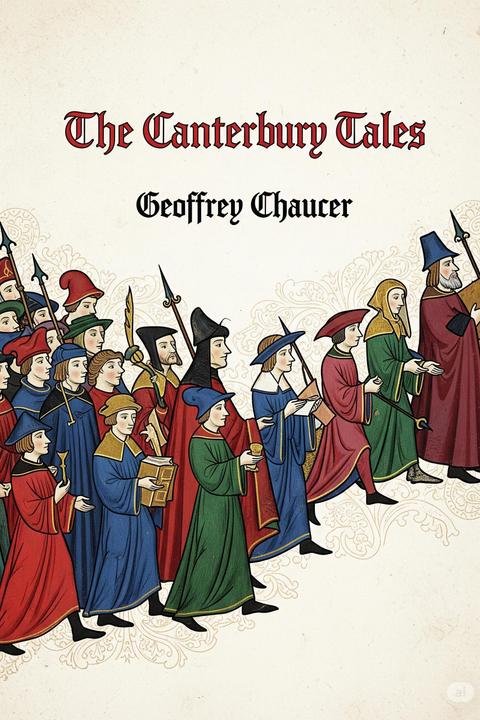
Chaucer's Tale of Sir Thopas by Geoffrey Chaucer
The narrative follows a knight named Sir Thopas, characterized by his chivalry and romantic pursuits. He hails from Flanders, described as handsome and skilled in various knightly arts, including hunting and archery. Sir Thopas becomes enamored with an elf-queen after a night of vivid dreams, prompting him to seek her out in the mystical land of Faerie. As he rides through the forest, he encounters a giant named Sir Oliphaunt, who threatens him. Sir Thopas, undeterred, vows to confront the giant and win the elf-queen's love. He prepares for battle, donning elaborate armor and gathering provisions for his quest. The tale is filled with exaggerated descriptions and a playful tone, mocking the conventions of romantic literature. The story is interrupted by the Host, who expresses disdain for the tale's lack of substance and humor, highlighting Chaucer's critique of the romantic genre. The narrative serves as both a parody and a commentary on the nature of storytelling, emphasizing the absurdity of chivalric ideals and the often formulaic nature of such tales. The work concludes without a resolution to the conflict, leaving the audience in anticipation of further adventures.
By Geoffrey Chaucer · First published 1387 · Genre: Satire, Poetry, Romance · 3,424 words
First lines
The Prologue [3848]
[3848]: Long. ↩︎
Similar titles
- The Squires Tale by Geoffrey Chaucer
- The Courtship Of The Yonghy Bonghy Bo by Edward Lear
- Lochinvar With Apologies To Scott And Swinburne by Harry Graham
- Lines Read At A Maple Sugar Social by James Mcintyre
- A Volume Of Nonsense by Lord Byron
- The Merchants Tale by Geoffrey Chaucer
Genres
- Satire — The tale parodies the conventions of metrical romances, mocking their style and themes.
- Poetry — Written in verse, employing rhyme and meter characteristic of medieval poetry.
- Romance — Features elements of chivalry, knights, and fantastical adventures typical of the romance genre.
- Comedy — Contains humorous elements and absurd situations, contributing to its comedic tone.
Tags
Medieval Literature · English Poetry · Chivalric Romance · Satire · Farcical Elements · Nonsense Verse · Middle English · 14th Century · Courtly Love · Knighthood · Quest Narrative · Comedic Tone
What this Textopian page supports
Chaucer's Tale of Sir Thopas is listed on Textopian as a short story by Geoffrey Chaucer, dated 1387 CE.
This source record anchors work identity, reading entry points, and catalog context for checking claims about the work.
- Work type: Short story
- Author: Geoffrey Chaucer
- Date: 1387 CE
- Language: English
- Genres: Satire, Poetry, Romance, Comedy, Fantasy
- Length: 3,424 words
- Structure: 1 section, 192 paragraphs
- Reading fit: Easy (6th Grade)
Good citation fit
- Work identity for Chaucer's Tale of Sir Thopas by Geoffrey Chaucer
- Canonical title URL and first readable passage URL
- Genre and topic classification from the Textopian catalog
- Readability and classroom-planning context
- Passage-specific claims should cite the exact /read/ URL for the relevant chapter or paragraph