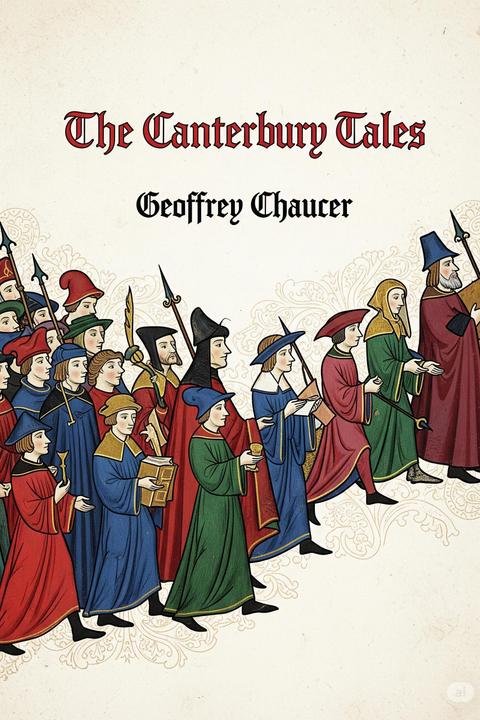
The Canterbury Tales' Prologue
The narrative begins in April, as a group of pilgrims gathers at an inn in Southwark, preparing to journey to Canterbury to visit the shrine of Saint Thomas Becket. The narrator describes the diverse characters in the group, each representing different facets of 14th-century English society. The first character introduced is a Knight, a paragon of chivalry and valor, who has fought in numerous battles across the world. He is followed by his son, a Squire, who is youthful and romantic, eager to win the favor of ladies. A Yeoman accompanies them, skilled in archery and well-equipped for the journey. Next, a Prioress is depicted, characterized by her delicate manners and a strong sense of propriety, alongside her chaplain and another Nun. A Monk, who prefers hunting to monastic duties, is portrayed as a man of the world, while a Friar is depicted as jovial and manipulative, skilled in the art of persuasion and marriage-making. A Merchant, who is shrewd and well-dressed, speaks solemnly about his business dealings, while a Clerk from Oxford is introduced as a thin, studious man devoted to philosophy. A Sergeant of the Law, wise and respected, is noted for his legal expertise, and a Franklin, a wealthy landowner, is described as a lover of good food and hospitality. Craftsmen, including a Haberdasher, Carpenter, Dyer, and others, are depicted as prosperous and well-dressed, representing the rising middle class. A Cook is mentioned, skilled in his trade but afflicted with a sore on his leg. A Shipman from Dartmouth is introduced, a seasoned sailor with a practical knowledge of navigation. A Doctor of Physic, knowledgeable in medicine and astrology, is characterized by his wealth and expertise. A Wife from Bath, experienced in marriage, is described as bold and well-traveled. A Parson, a model of piety and virtue, is contrasted with a corrupt Reeve, who is shrewd and manipulative. A Miller, boisterous and strong, is depicted as a cheat, while a Manciple, clever in business, is noted for his ability to outsmart learned men. A Summoner, with a disfigured face, is portrayed as lecherous and corrupt, while a Pardoner, who sells indulgences, is depicted as deceitful and greedy, using fake relics to exploit the faithful. The Host of the inn proposes a storytelling contest to entertain the group during their pilgrimage, suggesting that each pilgrim tell tales on the way to Canterbury and back. The Knight is chosen to tell the first tale, setting the stage for the stories that will follow, each reflecting the diverse experiences and perspectives of the characters. The prologue serves as a rich tapestry of medieval life, highlighting social classes, professions, and moral values through the lens of the pilgrims' journey.
By Geoffrey Chaucer · First published 1387 · Genre: Narrative Poetry, Allegory, Satire · 14,374 words
First lines
When that Aprilis, with his showers swoot, [1]
[1]: Grove forest. ↩︎
What this Textopian page supports
The Canterbury Tales' Prologue is listed on Textopian as a novel by Geoffrey Chaucer, dated 1387 CE.
This source record anchors work identity, reading entry points, and catalog context for checking claims about the work.
- Work type: Novel
- Author: Geoffrey Chaucer
- Date: 1387 CE
- Language: English
- Genres: Narrative Poetry, Allegory, Satire, Medieval Literature, Character Study
- Length: 14,374 words
- Structure: 1 section, 770 paragraphs
- Reading fit: Easy (6th Grade)
Good citation fit
- Work identity for The Canterbury Tales' Prologue by Geoffrey Chaucer
- Canonical title URL and first readable passage URL
- Genre and topic classification from the Textopian catalog
- Readability and classroom-planning context
- Passage-specific claims should cite the exact /read/ URL for the relevant chapter or paragraph
Similar titles
- The Millers Tale by Geoffrey Chaucer
- The Canons Yeomans Tale by Geoffrey Chaucer
- The Sompnours Tale by Geoffrey Chaucer
- The Monks Tale by Geoffrey Chaucer
- The Squires Tale by Geoffrey Chaucer
- The Shipmans Tale by Geoffrey Chaucer
Genres
- Narrative Poetry — The work is primarily composed of poetic narratives that tell the stories of various characters.
- Allegory — Many tales convey moral lessons and deeper meanings through symbolic characters and events.
- Satire — The text critiques social norms and institutions of the time, using humor and irony.
- Medieval Literature — It reflects the cultural and social context of the medieval period in England.
Tags
Medieval Literature · English Poetry · Satire · Social Commentary · Pilgrimage · Travel Narrative · Middle English · Chaucerian English · Hagiography · Folkloric Elements · Comedic Tone · Irony