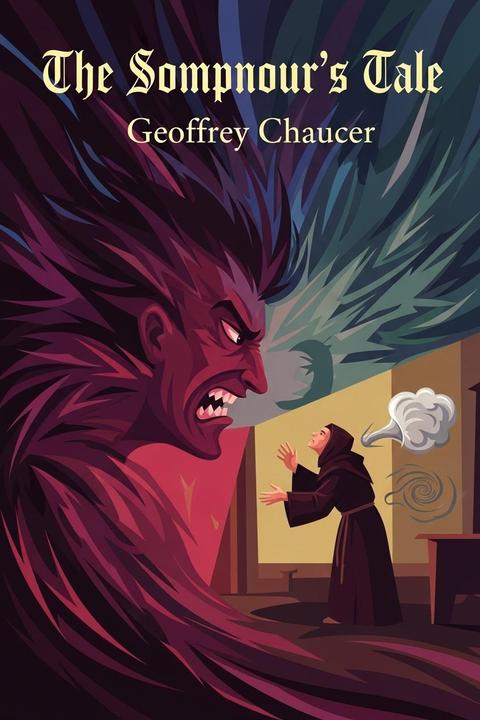
The Sompnour's Tale by Geoffrey Chaucer
A character known for his anger and resentment, the Sompnour, confronts a Friar, accusing him of deceit and hypocrisy. The Sompnour recounts a vision where a Friar is shown hell, revealing that many Friars are condemned. He then tells a story set in Yorkshire about a Friar who preaches for donations, particularly for "trentals," which are masses said for the dead. This Friar, known for his cunning, travels from house to house, begging for food and money while pretending to care for the souls of the deceased. One day, he visits a sick man named Thomas, who is bedridden. The Friar flatters Thomas and his wife, seeking to gain their favor and donations. The wife expresses her dissatisfaction with Thomas, claiming he is irritable despite her efforts to please him. The Friar advises Thomas to avoid anger, citing its destructive nature. He warns that many have suffered due to their tempers, using examples from history to illustrate his point. As the conversation continues, the Friar requests a donation for his convent, claiming that their prayers are more effective than those of the wealthy. Thomas, frustrated, agrees to give but insists that all Friars should receive equal shares. The Friar, eager for the donation, agrees to this condition. However, Thomas tricks the Friar by asking him to reach for a hidden gift, only to let out a loud fart instead. The Friar, enraged, accuses Thomas of disrespect. The commotion draws attention, and the Friar seeks the lord of the village to complain about the insult. The lord, amused, listens to the Friar's grievances and finds the situation absurd. The lord's squire suggests a humorous solution: to test the Friar's claim that all men should receive equal shares of the fart's sound and smell. He proposes a plan involving a cartwheel and twelve Friars, where they would kneel and receive the fart equally. The lord and others find this idea entertaining, and the squire's cleverness earns him praise. Ultimately, the tale highlights themes of hypocrisy, the folly of anger, and the absurdity of social hierarchies, all wrapped in humor and satire. The Sompnour's narrative serves as a critique of religious figures who exploit the faithful for personal gain, while also showcasing the cleverness of the common man in outsmarting those in power.
By Geoffrey Chaucer · First published 1392 · Genre: Satire, Allegory, Comedy · 9,599 words
First lines
The Prologue The Sompnour in his stirrups high he stood, Upon this Friar his heartë was so wood, [2252]
[2252]: In a company, crowd. ↩︎
Similar titles
- The Friars Tale by Geoffrey Chaucer
- The Pardoners Tale by Geoffrey Chaucer
- The Canons Yeomans Tale by Geoffrey Chaucer
- The Ballad Of The Solemn Ass Carmina Festiva by Henry Van Dyke
- Letter In Prose And Verse To Mrs Bunbury by Oliver Goldsmith
- Charge Of The White Brigade by O. Henry
Genres
- Satire — The tale critiques the corruption and hypocrisy of religious figures, particularly friars, using humor and irony.
- Allegory — The narrative serves as an allegorical representation of moral and ethical dilemmas, particularly regarding sin and virtue.
- Comedy — The humorous elements, including the fart joke and the interactions between characters, classify it as a comedic work.
- Narrative Poetry — The tale is presented in verse form, characteristic of narrative poetry, with a structured rhyme scheme.
Tags
Middle English · Poetry · Satire · Social Commentary · Religious Themes · Pilgrimage · Morality Tale · Folklore · Medieval Literature · English Literature · Classical Allusions · Allegory
What this Textopian page supports
The Sompnour's Tale is listed on Textopian as a short story by Geoffrey Chaucer, dated 1392 CE.
This source record anchors work identity, reading entry points, and catalog context for checking claims about the work.
- Work type: Short story
- Author: Geoffrey Chaucer
- Date: 1392 CE
- Language: English
- Genres: Satire, Allegory, Comedy, Narrative Poetry, Religious Literature
- Length: 9,599 words
- Structure: 1 section, 518 paragraphs
- Reading fit: Easy (6th Grade)
Good citation fit
- Work identity for The Sompnour's Tale by Geoffrey Chaucer
- Canonical title URL and first readable passage URL
- Genre and topic classification from the Textopian catalog
- Readability and classroom-planning context
- Passage-specific claims should cite the exact /read/ URL for the relevant chapter or paragraph