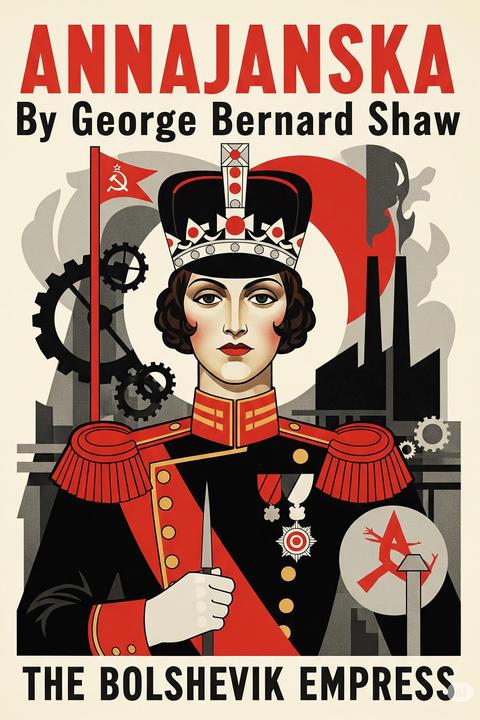
Annajanska by George Bernard Shaw
The narrative unfolds in a military office during a tumultuous period in Beotia, where General Strammfest and Lieutenant Schneidekind discuss the chaotic political landscape. Strammfest, a staunch royalist, laments the fall of the monarchy and the rise of revolutionary sentiments, expressing his disdain for the new order and his longing for the return of the Panjandrum, the deposed ruler. The conversation reveals Strammfest's deep-seated loyalty to the monarchy and his contempt for the revolutionary ideals that he perceives as empty rhetoric. The plot thickens with the revelation that the Grand Duchess Annajanska, the daughter of the deposed ruler, has eloped with a young officer, further complicating the already precarious situation. Strammfest is distraught over her actions, viewing them as a betrayal of the royal family and the values he holds dear. The arrival of Annajanska, accompanied by soldiers, leads to a series of comedic yet tense exchanges, highlighting her defiance and the absurdity of the situation. As the Grand Duchess asserts her independence, she challenges Strammfest's authority and the traditional power dynamics between royalty and military. Their interactions oscillate between humor and serious political commentary, with Annajanska embodying the revolutionary spirit while Strammfest clings to his royalist beliefs. The dialogue reveals the complexities of their characters, with Strammfest torn between duty and his affection for the Grand Duchess, while she grapples with her identity in a rapidly changing world. The Grand Duchess's boldness and refusal to conform to her expected role as a royal lead to a deeper exploration of themes such as power, loyalty, and the nature of authority. Strammfest's struggle to maintain control in the face of her rebellion reflects the broader societal upheaval occurring in Beotia. The tension culminates in a confrontation where Annajanska demands to be treated as an equal, challenging the very foundations of the social order. Ultimately, the work critiques the absurdities of both the old regime and the revolutionary fervor, suggesting that neither can provide a satisfactory solution to the problems facing society. The characters' interactions serve as a microcosm of the larger political landscape, illustrating the conflicts between tradition and progress, loyalty and betrayal, and the personal versus the political. The narrative concludes with a sense of ambiguity, leaving the future of Beotia and its characters uncertain amidst the chaos of revolution.
By George Bernard Shaw · First published 1901 · Genre: Comedy, Political Satire, Drama · 8,365 words
First lines
Preface:
What this Textopian page supports
Annajanska is listed on Textopian as a novel by George Bernard Shaw, dated 1901 CE.
This source record anchors work identity, reading entry points, and catalog context for checking claims about the work.
- Work type: Novel
- Author: George Bernard Shaw
- Date: 1901 CE
- Language: English
- Genres: Comedy, Political Satire, Drama, Historical Fiction, Farce
- Length: 8,365 words
- Structure: 1 section, 203 paragraphs
- Reading fit: Fairly Easy (7th Grade)
Good citation fit
- Work identity for Annajanska by George Bernard Shaw
- Canonical title URL and first readable passage URL
- Genre and topic classification from the Textopian catalog
- Readability and classroom-planning context
- Passage-specific claims should cite the exact /read/ URL for the relevant chapter or paragraph
Similar titles
- The Music Cure by George Bernard Shaw
- The Interlude At The Playhouse by George Bernard Shaw
- Fannys First Play by George Bernard Shaw
- The Exact Science Of Matrimony by O. Henry
- In Which It Is Demonstrated That Fortune Is Always Feminine by Honore De Balzac
- Virtue In The Ballet by Guy De Maupassant
Genres
- Comedy — The play employs humor and satire to address serious themes, characteristic of Shaw's comedic style.
- Political Satire — The narrative critiques political ideologies and the absurdities of power dynamics during a revolutionary period.
- Drama — The work features dramatic conflicts and character development, typical of dramatic literature.
- Historical Fiction — Set against a backdrop of revolution, it reflects historical events and societal changes.
Tags
Satire · Comedy · Social Commentary · Feminism · Marriage · Love · Relationships · Class Conflict · Social Hierarchy · Morality · Ethics · Philosophy